
Despite No Longer Required, Photocopies of e-KTP Still Demanded for Public Services
The government has repeatedly urged public service agencies not to make photocopies of e-KTP the main requirement for administrative services. Identity verification should suffice through the Population Registration Number (NIK), integration of population data, use of e-KTP chip readers (card readers), or through Digital Population Identity (IKD).
However, field practices show a different situation. In several community health centres to sub-district offices in Jakarta, photocopies of e-KTP are still frequently requested, even listed in the requirements posted on service information boards.
Yet, old habits persist strongly. Technological changes are not always followed by readiness of devices, verification systems, or public understanding, with some still preferring paper documents.
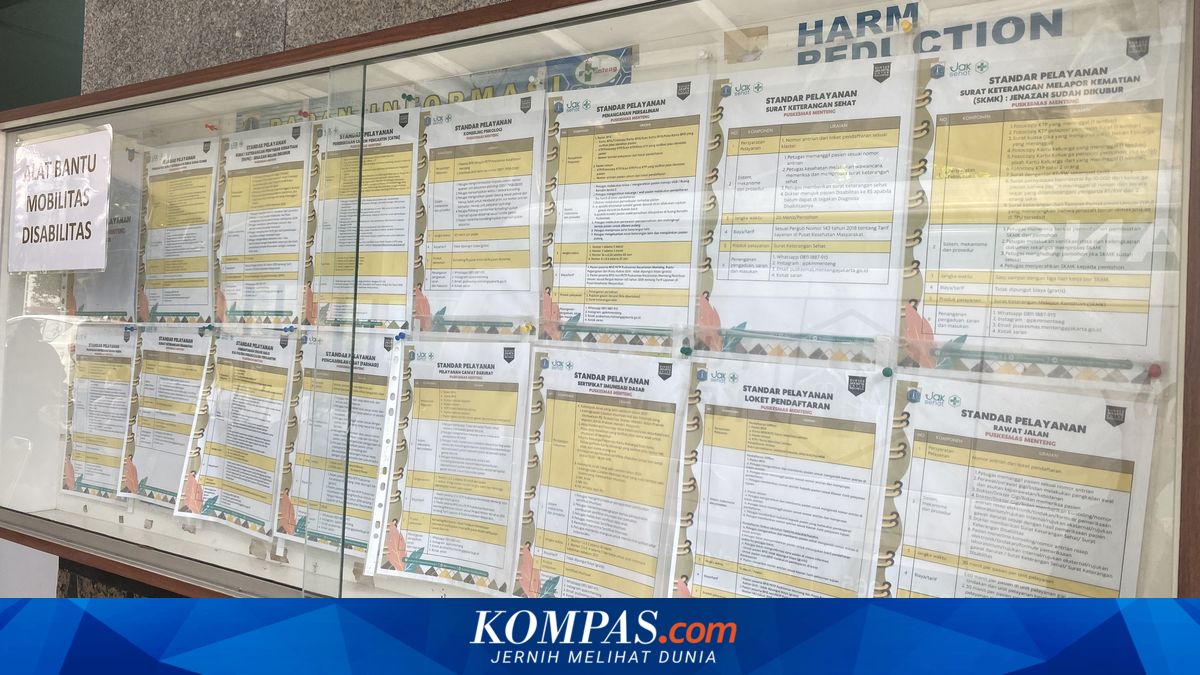
At the Menteng Sub-district Community Health Centre in Central Jakarta, service information is clearly displayed in the front service area.
Various announcement boards and notice boards contain service standards for various needs, from outpatient services, premarital check-ups (catin), to death certificate processing.
In several displayed service standards, photocopies of e-KTP are still listed as one of the requirements.
For the Death Reporting Certificate (SKMK) service, for example, requirements include photocopies of the deceased’s KTP, the applicant’s KTP, and witness KTPs.
Similarly, for premarital check-up services, the public is asked to attach photocopies of the prospective bride and groom’s KTPs.
A staff member at the Menteng Community Health Centre counter explained that KTP photocopies are still part of the administration, especially for health certificate services.
“For marriage health certificates, the requirements are letters from RT/RW and KTP. At least one partner must have a KTP from the work area. The photocopy is left for administration,” said the counter staff when met by Kompas.com.
The original KTP must still be brought but only to be shown. Meanwhile, the files stored by the health centre remain in photocopy form.
For work-related health certificates, patients also undergo examinations such as colour blindness tests and blood type checks.
If necessary, blood is taken. However, identity requirements remain the same, namely a KTP from the work area.
A different situation is seen at the Kenari Community Health Centre in Senen, Central Jakarta. At this location, no specific notice boards or information panels detailing service requirements like those at Menteng Community Health Centre were found.
Kenari Community Health Centre counter staff stated that sick leave certificates can only be issued if the patient has undergone a doctor’s examination. The doctor will then determine whether the certificate can be issued or not.
Meanwhile, for premarital services, registration is done through the Jam Sehat or JakSehat application.
Nevertheless, the health centre still opens manual channels for residents who have difficulty accessing the application, especially the elderly.
“If they don’t have a mobile phone or can’t use the application, they can still register manually. Just take a queue number,” said a staff member.
In manual registration, residents’ identities can be in the form of original KTP or photocopies. However, the photocopies are only used for verification and will be returned.
Staff also revealed that Kenari Community Health Centre does not yet have a card reader for reading e-KTP chips. As a result, the verification process still relies on manual data matching.
Some elderly visitors, said the staff, are accustomed to bringing complete documents like KTP photocopies, family cards (KK), and even birth certificates.
However, there are also elderly who come without documents because they are confused or unaccompanied by family.
“Sometimes elderly patients come without bringing anything. We usually still help, but it’s harder to find the data,” he said.
For local government BPJS processing, the health centre still requires KTP and KK photocopies.
At Senen Community Health Centre, Kompas.com found several information boards in the waiting room and registration area displaying service standards.
On the “Registration Service Standards” board, it is stated that new and returning patients are asked to bring KTP, KK, or child identity cards (KIA).
Meanwhile, for health certificate issuance services, the listed requirements are KTP/KK/KIA as well as service queue numbers and proof of payment.
In the waiting room, several residents were seen carrying folders with files. Some elderly people were seen carrying KTP and KK photocopies.
A middle-aged woman named Niar (58) admitted to bringing KTP photocopies in anticipation if requested by staff at any time.
“I usually bring KTP and KK photocopies just in case. Sometimes services ask for them, sometimes not, so it’s safer to prepare from home,” said Niar when met.
She admitted she is not yet accustomed to online registration, so she prefers bringing physical documents.
“If I register online, I don’t really understand yet. So I just bring the files so if asked, I can give them,” she said.
Mulyadi (61) expressed something similar. He said he always keeps KTP photocopies in his bag so he doesn’t have to go back and forth if needed.
“I always carry KTP photocopies in my bag. I’m afraid they’ll be asked for registration or for BPJS,” said Mulyadi.