
Despite Clear Weather, the 1 Syawal Hilal Was Not Visible at the DKI Ministry of Religious Affairs Regional Office
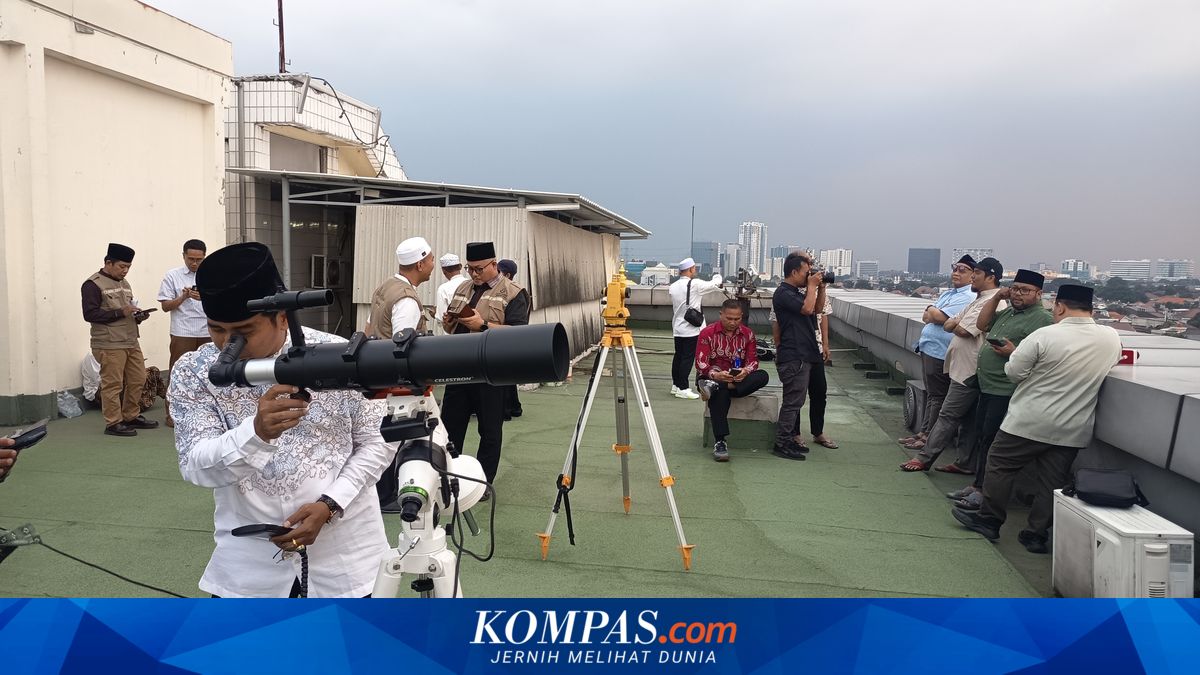
JAKARTA – The 1 Syawal 1447 Hijriah crescent moon was not visible during monitoring conducted at the DKI Jakarta Regional Office (Kanwil) of the Ministry of Religious Affairs (Kemenag) on Thursday (19/3/2026), even though the weather conditions were observed to be quite clear.
Head of the Islamic Religious Affairs Division at the DKI Jakarta Kemenag Regional Office, Fadil, explained that the current position of the hilal remains below the visibility criteria set by the Ministers of Religious Affairs from Brunei, Indonesia, Malaysia, and Singapore (MABIMS).
“According to the MABIMS agreement, the hilal must be at least at an elevation of three degrees with an elongation of 6.4 degrees. Therefore, on behalf of the DKI Jakarta Provincial Ministry of Religious Affairs, we state that the hilal was not visible this afternoon,” Fadil said at the Kemenag Jakarta Regional Office building on Thursday.
Fadil emphasised that the non-visibility of the hilal was not due to weather factors, but rather because the hilal’s position is still below the visibility threshold (imkanur rukyat).
“If technically speaking, I think the natural conditions and weather were good and clear, but since the hilal is still below the imkanur rukyah, it was indeed difficult to see. We brought all the equipment, theodolites, then telescopes, but the hilal could not yet be seen,” he stated.
Previously, the hilal monitoring at the location was carried out using two telescopes and one theodolite installed on the seventh floor of the DKI Jakarta Kemenag Regional Office building.
Based on Kompas.com’s observations, the monitoring process began with a preparation stage by the observation team. One theodolite was seen already installed to help determine the hilal’s elevation.
Additionally, another telescope was set up by a team from the Indonesian Islamic Dawah Institution (LDII) at the same location.
Head of the Hisab Rukyat Working Team at the DKI Jakarta Kemenag Regional Office, Reza, explained that hilal visibility is influenced by several factors, not just the moon’s position, but also environmental conditions.
He added that the weather conditions this afternoon were actually quite supportive, with pollution levels assessed as lower than usual.
“The weather is supportive, yes. This is probably because people have started heading to their hometowns, so there’s not much pollution now. Usually, it’s really thick here, usually a bit dark over there,” he continued.
The results of this monitoring will serve as one of the considerations in the isbat session held by the Ministry of Religious Affairs to determine the beginning of Eid al-Fitr 1447 Hijriah.