
Despite Being Bombed, Teaching Activities at Iranian University Continue
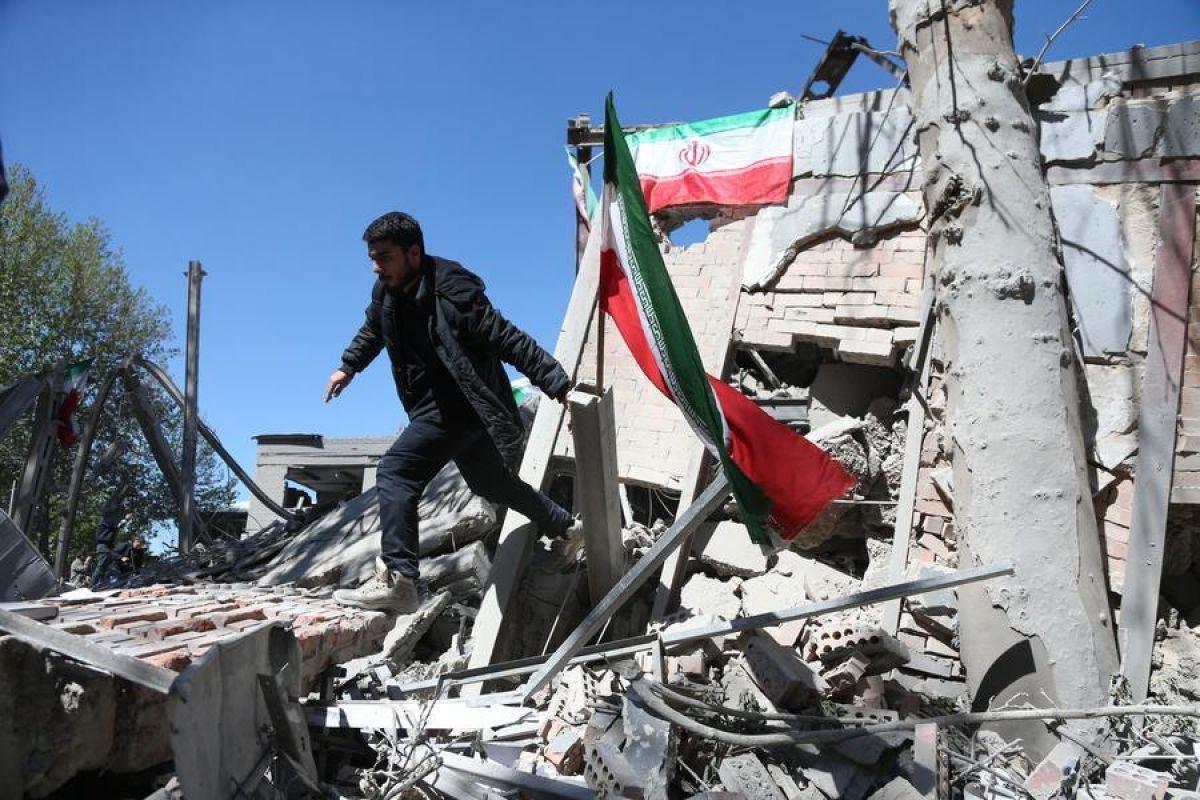
Tehran (ANTARA) - Debris is scattered across the floor. Potted plants are covered in dust. Jagged cracks run along the walls, revealing the bricks behind them.
In that room, amid the rumble of explosions, Alireza Zarei, Head of the Information Technology Centre at Sharif University of Technology in Tehran, continues his teaching activities.
That is what a Xinhua reporter witnessed a day after US-Israel airstrikes hit the university, one of Iran’s leading scientific institutions, causing severe damage to the Information Technology Centre building and a gas substation near the campus mosque.
Several parts of the campus have been completely destroyed. Scattered rubble, bent steel reinforcements, and exposed building frames make the atmosphere there resemble a war zone more than a university campus.
Yet, amid such destruction, the place still feels profoundly academic. Textbooks and documents are scattered among the damaged equipment. And above all, the voices of lecturers can be heard, calm and steadfast as they continue their lectures. “We at the university are moving together towards this great victory. We will rebuild this country,” he said.
Zarei is one of them. As the US and Israel attacks continue, many students can no longer come to campus. Not wanting them to fall behind, Zarei has started providing special online algorithm classes for postgraduate students, directly from the classroom where they once sat together, now reduced to a pile of rubble.
For Masoud Tajrishi, the university president, every part of the campus once felt familiar. However, as he led reporters to view the post-bombing damage, even he had to pause occasionally to recognise what once stood there.
“I ask you and hope you do not see this destruction as a setback or weakness,” Tajrishi told reporters, but rather as a manifestation of the “enemy’s hatred” towards Iran’s scientific and technological progress.
“We at the university are moving together towards this great victory. We will rebuild this country. The main reason the enemy targets this sensitive infrastructure is because they do not want us to gain access to this technology,” he said, adding that many Iranians abroad have contacted the university and offered financial assistance for its recovery.
Sharif University of Technology is not the first educational institution to be targeted in the latest US and Israel attacks.
Iran’s Minister of Science, Research, and Technology, Hossein Simaei-Sarraf, said on Saturday (4/4) that more than 30 universities in Iran have been directly targeted by US and Israel attacks since the war began at the end of February.
Five university professors and more than 60 students were killed in the attacks, added Simaei-Sarraf, who described the strikes on Iranian infrastructure as “crimes against humanity”.
During the tour around the campus, several loud explosions caused the crowd to panic, while intercepted projectiles streaked across the sky.
Standing in front of the national flag fluttering beside a destroyed podium, Tajrishi proudly recounted the university’s advancements in computer science and artificial intelligence.
“The main reason the enemy targets this sensitive infrastructure is because they do not want us to gain access to this technology,” he said, adding that many Iranians abroad have contacted the university and offered financial assistance for its recovery.
In response to these foreign attacks, Tajrishi said, Iranian academics will respond in their own way, in the realm of science and knowledge, just as others respond “on the streets” and “on the battlefield”.
However, for now, the most evident response is simpler: in a bomb-damaged classroom, amid the dust and ruined walls, a lecturer opens his laptop and starts again.