
Deputy Villages Minister Declares Student Regiment the Frontline of National Defence on Campuses
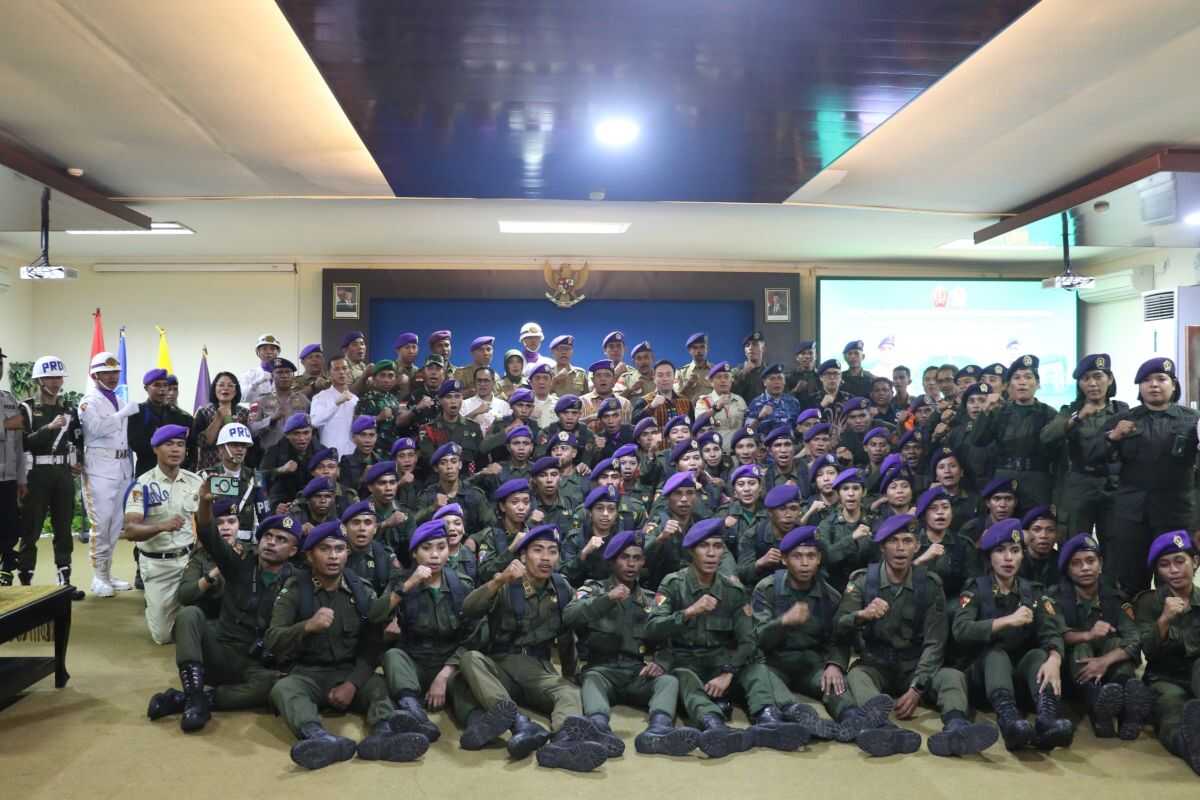
Deputy Minister of Villages and Development of Disadvantaged Regions (Wamendes PDT) and National Commander of the Student Regiment (Dankonas Menwa) Ahmad Riza Patria has declared the Student Regiment (Menwa) to be the frontline of national defence on university campuses.
“This is not merely a position, but a mandate and a form of service,” he said in a statement received from the NTT Provincial Government’s public relations office in Kupang on Friday.
The remarks were delivered during his attendance at the inauguration of the NTT Mahadana Student Regiment Commander at Nusa Cendana University (Undana) in Kupang on Thursday afternoon, 19 February.
The inauguration was attended by NTT Governor Melki Laka Lena, who was conferred honorary membership of the NTT Mahadana Student Regiment on the occasion.
According to Riza Patria, strengthening the Student Regiment is an important element of the national defence strategy, village development, and character building among the younger generation in border regions.
He stressed that the inauguration of the Menwa commander was not a ceremonial affair but rather a moment of national responsibility.
During the event, Riza also recounted the history of Indonesia’s Student Regiment, which was established between 1959 and 1963 as a vehicle for national defence among university students.
He further stated that Menwa personnel must always remain loyal to the greater national interest and have a tangible impact on social life and development within communities.
“Menwa was conceived by General AH Nasution to strengthen the Reserve Component of the defence of the Unitary State of the Republic of Indonesia in 1959, owing to Indonesia’s vast territorial coverage but limited defence personnel,” he said.
Beyond this, he continued, Menwa must now be present among the people, accompanying and supporting central government programmes down to the most remote villages and making a real difference to surrounding communities.
He also urged Menwa members to properly and diligently carry out the Tri Dharma of Higher Education — the three pillars of teaching, research, and community service — so that the human resources they produce are broad-minded, creative, independent, contributory to national progress, and imbued with a patriotic spirit.
He cited Law No. 23 of 2019 on the Management of National Resources for State Defence, which affirms that national defence is the responsibility of all citizens.
“Menwa is a tangible manifestation of the intellectual generation’s involvement in the total defence system. Students must be mentally resilient, disciplined, and steadfast in their national commitment,” he said.
Riza reviewed the history of Menwa’s formation during the era of President Soekarno, based on General AH Nasution’s concept of total people’s defence. He acknowledged that following the reform era, Menwa’s presence had declined at a number of universities.
“I want Menwa to be great again — strong in character, integrity, and morals,” he said.
Meanwhile, Undana Rector Professor Jefri S. Bale, contacted separately on Friday morning, said he held great expectations for the Mahadana Menwa leadership to remain adaptive to every change and dynamic, and to continue serving as agents of change in national development.
“There are several hopes I wish to convey. First, that Menwa can continue to be adaptive in maintaining a balance of roles, where the primary duty remains the pursuit of knowledge — completing studies on time and producing quality academic work that has a real impact on society,” he said.
“Second, become cadres who drive change; use esprit de corps to build collaboration and commitment for a better future,” the rector added.
“Third, continue to strengthen synergy in building the nation. I hope Menwa remains present in the most remote villages and continues to contribute to rural development. And finally, preserve noble values and uphold the good name of the Menwa corps wherever you are,” Bale concluded.