
Deputy Provincial Police Chief: Five Principles for Mining Governance in West Papua
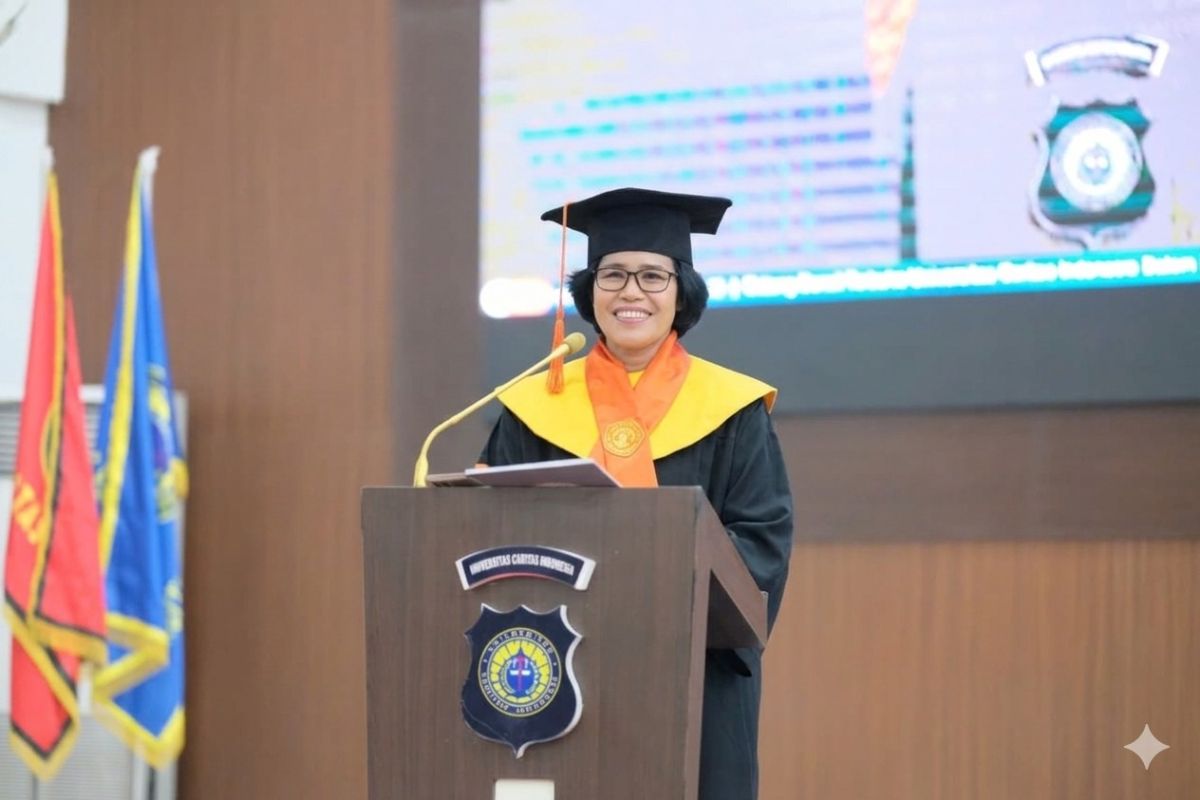
Manokwari (ANTARA) - The Deputy Chief of the West Papua Regional Police, Brigadier General Dr. Sulastiana, stated that five risk-based principles for mining governance need to be implemented by the local government in the region. This approach serves as a policy framework to help the local government manage natural resources (SDA) more cautiously, transparently, responsibly, and with a focus on sustainability.
“It is time to reorganise natural resource development with a new paradigm, not prioritising permits faster than dialogue, or production over protection,” said Sulastiana during his scientific oration at the inaugural graduation ceremony of Caritas University in Manokwari on Saturday.
He mentioned that the first principle is for the local government to strengthen policies for recognising and protecting indigenous legal communities and their customary territories as the basis for development governance.
Second, the FPIC (free, prior and informed consent) principle should rightfully be made a substantive procedure in every mining operational activity that intersects with indigenous legal territories.
Third, implement a joint oversight mechanism involving the government, indigenous communities, higher education institutions, religious organisations, and other independent elements to ensure that natural resource management does not proceed without social accountability.
Fourth, benefit sharing must be tangible, including job opportunities, education, empowerment of local businesses, protection of indigenous women, and social investment according to the needs of the local community.
Fifth, mining operations must adhere to the principle of environmental sustainability because ecological damage causes social damage that will be paid dearly by future generations.
“Many mining problems in West Papua require a paradigm shift in management. Therefore, I offer these five principles in my scientific oration,” he said.
He noted that the characteristics of challenges in gold mining governance differ from those in upstream oil and gas (migas), but the resolution instruments must use an approach that prioritises risk identification and mapping.
The identification and mapping referred to include determining areas with high ecological vulnerability so they are not designated as mining zones, strengthening oversight of unlicensed mining, and ensuring indigenous community involvement.
“Indigenous communities must be involved from the planning process and decision-making for every mining activity,” he said.
According to him, the scientific oration on the topic of risk-based mining governance policy analysis aims to increase awareness and participation of new graduates who can bridge knowledge, ethics, and social service.
Young people have a very important role in mitigating environmental damage risks and preserving nature resulting from mining activities or natural resource exploration that does not align with sustainability principles.
“Young people have broad access; they can directly conduct oversight or be part of policy formulation,” he said.