
Deputy President's Special Staff Pushes for Strengthening SMEs and Women's Economy
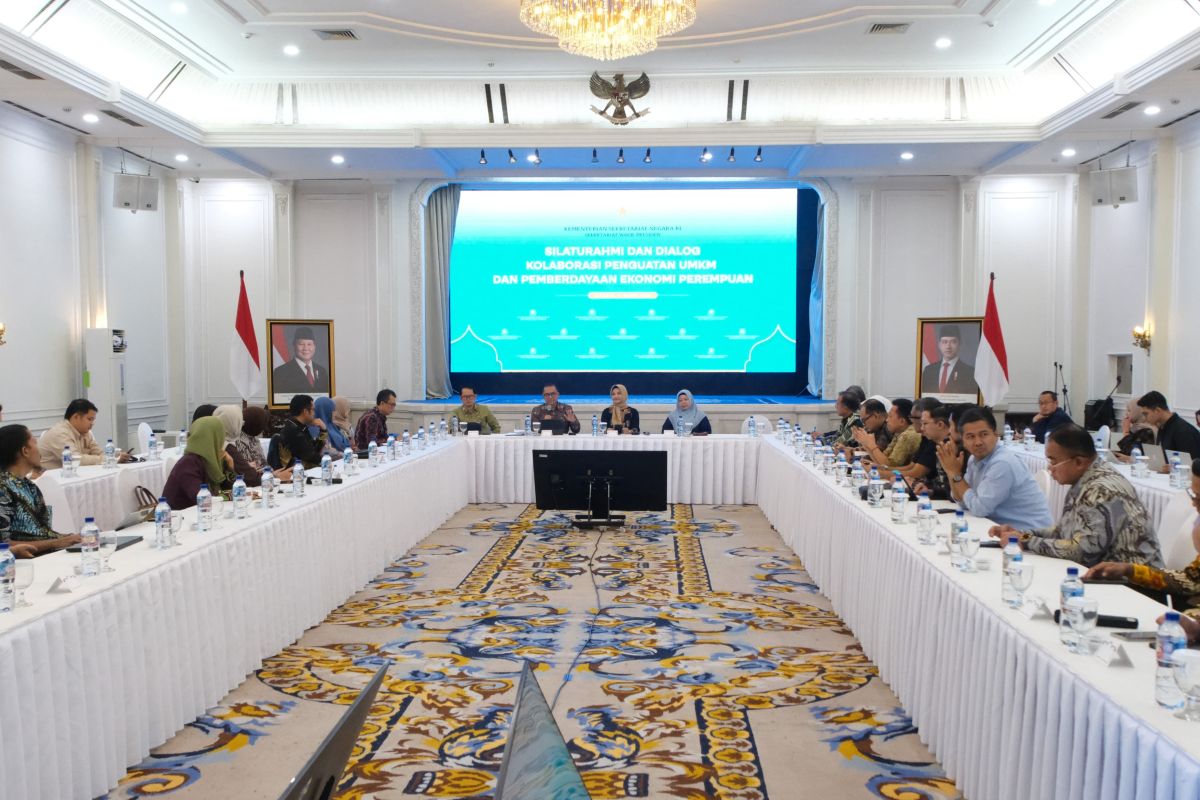
Jakarta (ANTARA) - The Vice President’s Secretariat emphasised the importance of cross-sector collaboration in strengthening SMEs and empowering women’s economy through the Silaturahmi and Collaboration Dialogue forum held at the Vice President’s Secretariat Auditorium in Jakarta.
Vice President’s Special Staff Tina Talisa stated that this forum is part of the President and Vice President’s directives to strengthen the people’s economic foundation through synergy among various parties.
“As part of the President and Vice President’s directives to strengthen the people’s economic foundation, we are organising a silaturahmi and cross-ministry, agency, business world, and community organisation collaboration dialogue,” said Tina Talisa, quoted from her official Instagram account @tina_talisa, on Thursday.
The forum, held in the spirit of International Women’s Day, was attended by representatives from the National Development Planning Agency (Bappenas), BPS (Statistics Indonesia), Ministry of Investment and Downstreaming/BKPM, BPJPH (Halal Product Assurance Agency), Ministry of SMEs.
Then OJK (Financial Services Authority), KNEKS (National Committee for Sharia Economy and Finance), BPOM (National Agency of Drug and Food Control), INDEF, UI, CORE Indonesia, as well as various strategic partners such as Fatayat NU, Aisyiyah, HIPMI (Indonesian Young Entrepreneurs Association), IWAPI (Indonesian Women Entrepreneurs Association), KNTI (Indonesian Traditional Fishermen Unity) Women ICMI (Indonesian Muslim Intellectuals Association), to business entities such as PNM, Bank BRI, GoTo, Grab, and Sampoerna.
The former TV journalist explained that this forum serves as a space to unite efforts in promoting SME strengthening and women’s economic empowerment to proceed in a more coordinated and impactful manner.
“The aim is to promote SME strengthening and women’s economic empowerment,” she said.
In addition, Tina also highlighted the lack of clear indicators in defining SME class progression.
According to her, this poses a challenge in driving measurable business transformation.
“We don’t yet have criteria for what is meant by class progression. So we often say, let’s push for class progression. How do we define class progression? From micro to small? Because of adding employees? Because of adding assets? Because of increasing turnover? Because of increasing financial literacy or what?” said Tina.
In the discussion, various stakeholders expressed views on the challenges and opportunities for strengthening SMEs and women’s economy. Deputy for Community Empowerment, Population, and Employment at Bappenas, Maliki, highlighted the still low proportion of female entrepreneurs in Indonesia.
“If we look at the proportion of female entrepreneurs, it might be around 37 percent,” he said.
Meanwhile, Deputy for Investment Climate Development at the Ministry of Investment/BKPM, Riyatno, emphasised the importance of business legality for SME actors, especially micro businesses, through ownership of Business Identification Number (NIB).
“We invite stakeholders to work together on how to ensure SME actors, especially micro ones, obtain NIB,” said Riyatno.
From a data perspective, Deputy for Social Statistics at BPS, Nashrul Wajdi, assessed that there is still much homework to ensure women’s economic contributions are truly optimal.
“We still have a lot of homework; our women work perhaps out of necessity, because they need to, because they must. But then, does their contribution sufficiently provide the contribution we expect?” he said.
General Chair of the DPP IWAPI, Nita Yudi, affirmed that women play an important role in the business world and are no less capable than men in facing challenges.
“So, women must also strive, not just men. We see that women are the strongest, the most resilient,” she said.
Meanwhile, Chair of the Education Sector for ICMI Women, Euis Amalia, highlighted the importance of halal certification as part of product competitiveness, including for SMEs.
“There is no exception; all products entering and circulating in Indonesia, even American products, must eventually have halal certification. This must become a commitment,” said Euis.
On the other hand, Chair of the Womenpreneur Autonomous Body of BPP HIPMI, Mellisa Hamid, emphasised the importance of ecosystem support for female entrepreneurs to develop optimally.
“Many female entrepreneurs and we need a support system, also support from the government, and a healthy platform for female friends to create,” she said.