
Deputy Police Chief: Terrorism Patterns Have Changed, Protecting the Younger Generation Is Key
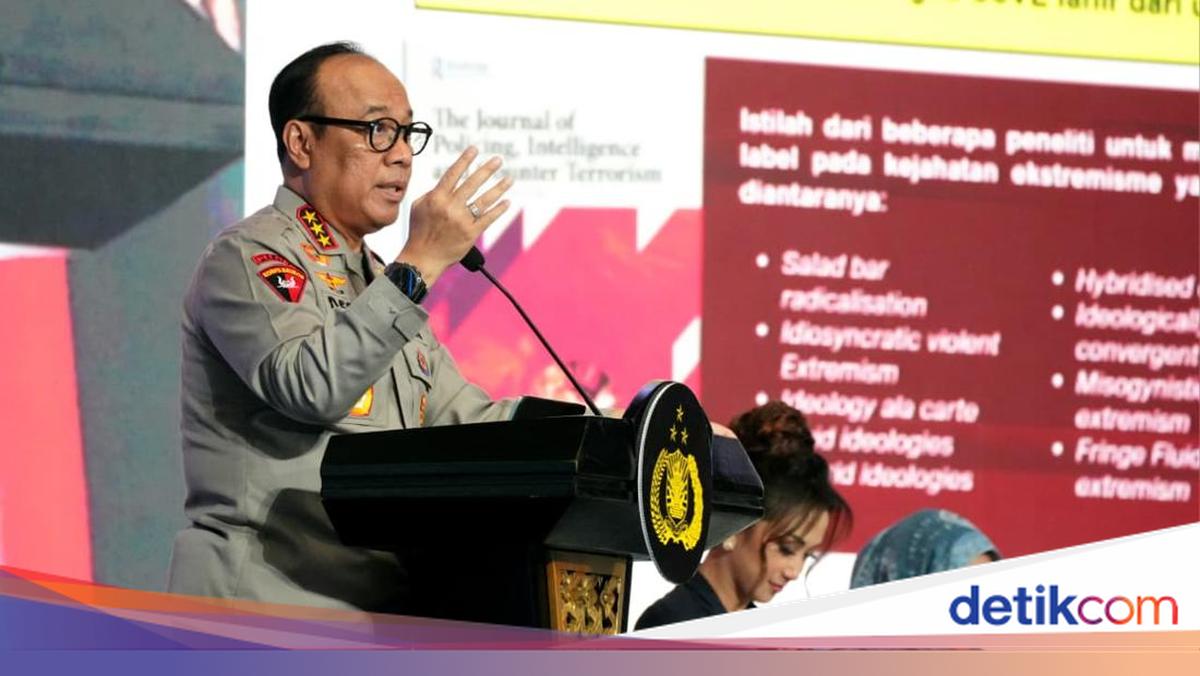
Deputy Chief of Police General Dedi (Komjen Dedi) told a strategic forum on counter-terrorism and extremism on Thursday (21 May 2026). The forum was also attended by the Director General of the National Counter-Terrorism Agency (BNPT), retired Commissioner General Edwin Hartono (Komjen (Purn) Eddy Hartono), and Head of Detachment 88 Counter-Terrrorism (Densus 88 AT) of the Indonesian Police, Irjen Sentot Prasetyo.
The forum served as a momentum to reinforce Indonesia’s counter-terrorism policy direction, increasingly emphasising early prevention, child protection, strengthened digital literacy, and a cross-sector collaborative approach, as extremism patterns move faster than previous handling approaches.
In his remarks, Commissioner General Dedi underscored that all counter-terrorism strategies must be grounded in the Polri Grand Strategy 2025-2045 and aligned with Polri’s Strategic Plan (Renstra) 2025-2029. This aims to ensure the effectiveness and sustainability of policies in facing future dynamics.
“We are facing a major change. Terrorism patterns no longer always appear in the form of large, easily mappable organisations; they develop through digital spaces, loose sympathisers, and networks formed by algorithms. Therefore, our strategy must also change,” he said.
According to Komjen Dedi, modern extremism is increasingly fragmented through digital exposure and social environments. He explained that the perpetrators’ ideologies no longer appear as a single, intact doctrine, but as fragments of ideas mixed according to the individual’s psychological and social needs.
Therefore, he added, the old approach to understanding extremism should be complemented with new perspectives such as Composite Violent Extremism (CoVE) to read patterns that are ambiguous and convergent. Moreover, Komjen Dedi reminded that extremism today is ‘glocal’, with global information flows able to rapidly influence local social dynamics via digital media.
“Extremism patterns can no longer be understood separately as global and local dimensions. Information flows move quickly and can influence the social environment in a short time,” he asserted.
One major concern raised by Komjen Dedi is the increasing vulnerability of the younger generation to exposure to extremism and the normalisation of violence in the digital space.
Densus 88 AT Polri data as of 19 May 2026 show 115 children involved in the True Crime Community (TCC) and 132 children exposed to radicalisation in various parts of Indonesia.
According to Komjen Dedi, these figures must be understood as an iceberg phenomenon, so prevention must be undertaken early before developing into a larger problem.
“Counter-extremism policies touching children must be built on the logic of early protection, not punitive action,” he said.
Komjen Dedi stressed that children should be understood both as victims and as agents, so the approach used must be rehabilitative, protective, and rights-based rather than purely punitive.
To this end, Densus 88 AT Polri is directed to use a layered socio-ecological model, integrating family, school, community, government, and the digital space as a joint protective system.
The concept is implemented through the development of the ecosystem “Safe Home towards a Safe School,” where the Police serve as the coordinating link across parties to detect and prevent potential risks from the outset.
In the occasion, Komjen Dedi also stressed that today’s extremism patterns cannot be tackled by a single institution alone. What is needed is a collaborative approach, namely active and sustained collaboration between security agencies, ministries and agencies, local government, schools, families, religious figures, communities, akademia, digital platforms, and civil society.
“Extremism cannot be severed by a single institution. It must be faced through complete synergy among the Polri, ministries, local government, schools, families, and society. Future security is built through collaboration,” he asserted.
This collaborative approach is viewed as a fundamental foundation to confront extremism patterns that are now multidimensional, cross-platform, and transnational, while also strengthening social resilience as a main preventive defence.
In the same session, Komjen Dedi praised preventive measures already undertaken by Densus 88’s Counterterrorism Directorate (Ditcegah Densus 88), including strengthening the PPA-PPO Directorate in 11 Polda and 22 Polres, educational programmes at 90 SMAN in Jakarta (DKI) reaching 31,234 students and 1,300 teachers and parents, the Ratakan Bali Pro Max programme in 70 schools with 9,950 participants, and the issuing of 70 circulars restricting gadget use in schools across 33 provinces.
“The state cannot merely arrive when the fire is already large; social prevention must occur earlier, with law enforcement as a measured last resort,” he said.
The direct presence of the BNPT head further reinforced the message that counter-terrorism requires national policy orchestration, linking prevention, deradicalisation, public literacy, law enforcement, and community strengthening within a single integrated security ecosystem.
Meanwhile, Head of Densus 88 AT Polri stressed that Densus 88 continues to strengthen a more adaptive counter-terrorism strategy, prioritising early detection, risk assessment, and strengthening the resilience of the younger generation, in step with changing extremism patterns in the digital era.
The forum also underscored institutional transformation towards a predictive, preventive, humane, and science-based approach, aligned with the direction of Polri’s Transformation.