
Deputy National Police Chief: Traffic Flow on Trans-Java Toll Road Remains Smooth until Kalikangkung
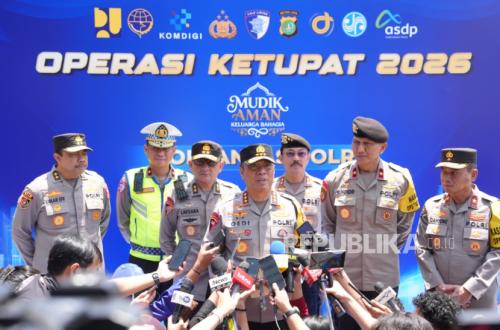
Traffic flow on the main return-to-hometown route of the Trans-Java toll road remained smooth during the initial phase of Operation Ketupat 2026. Vehicle volumes started to increase, but vehicle movement on several major toll sections remained stable.
Deputy National Police Chief General Dedi Prasetyo conducted direct monitoring through aerial patrol from Jakarta to the National Traffic Command Centre at Cikampek on Saturday, 14 March 2026. The monitoring was conducted to assess the flow of vehicles departing Jakarta towards various return-to-hometown destinations.
Dedi stated that traffic conditions on several major toll sections remained manageable until the Central Java region.
“Earlier we observed monitoring of several toll sections from Cikampek, Cirebon, up to the Central Java border at Kalikangkung. Even through the Ngawi exit in East Java, conditions remained very smooth,” said Dedi.
Monitoring also covered routes to Merak Port, which serves as the main access point for crossings to Sumatra. Vehicle flow towards the port remained relatively smooth in the early stages of the return-to-hometown period.
To maintain smooth travel for returning passengers, officers had diverted heavy vehicles in the Cilegon area. Three-axle vehicles were directed off the toll road onto arterial roads to maintain optimal toll road capacity for returning passengers.
“At Merak, specifically at the Cilegon exit, diversions have already been implemented, particularly for three-axle vehicles leaving the toll road for arterial routes,” said Dedi.
The National Traffic Police also prepared various anticipatory measures should vehicle volumes increase during certain hours. One scenario prepared was the implementation of traffic engineering involving contraflow.
“This contraflow is being prepared and anticipated three hours before the discretionary measure is implemented,” said Dedi.
Additionally, the National Traffic Police also prepared implementation of one-way systems should vehicle volumes increase significantly on the main return-to-hometown route.
“When traffic flow through Cikampek exceeds 6,000 vehicles per hour, one-way engineering and other traffic arrangements will be implemented,” said Dedi.
Monitoring of return-to-hometown traffic this year was strengthened through utilisation of traffic monitoring technology, including the use of drones to monitor points not reached by CCTV cameras along the return-to-hometown route. The drones are connected to a mobile command centre that can move in line with vehicle flow dynamics in the field.
“Drones are also important. Earlier there were two types of drones used by traffic control,” said Dedi.
Dedi assessed that preparations for managing return-to-hometown traffic this year were more mature thanks to support from surveillance technology and integrated monitoring systems. Traffic patrol personnel were also equipped with body cameras to monitor field situations.
“In my assessment, we are far better prepared. In addition to mobile command centre technology, equipped with drones and electronic traffic enforcement using drone-based enforcement, we have significantly improved capabilities,” said Dedi.
The National Police also prepared information services for the public during the return-to-hometown journey. Returning passengers can contact the National Police emergency service 110 if they experience difficulties during their journey.
Previously, National Police Chief General Listyo Sigit Prabowo announced that Operation Ketupat 2026 would run for 13 days, from 13 to 25 March 2026. A total of 161,243 combined personnel were deployed to secure the return-to-hometown traffic flow and celebrations for Eid al-Fitr 1447 Hijriah.
Security efforts were also supported by 2,746 posts consisting of security posts, service posts, and integrated posts at various strategic locations.