
Deputy National Police Chief Pushes for Data-Driven Police Policy
Jakarta – Digital technology developments and shifts in global geopolitical dynamics are prompting many state institutions to adapt their working methods, including those in the security sector. In Indonesia, research and data-based approaches are increasingly being strengthened in police policy-making to become more adaptive to contemporary challenges.
This point was emphasised by Deputy National Police Chief Dedi Prasetyo, who stressed the importance of developing police science based on academic research. According to him, future security policies must be formulated based on robust scientific analysis to ensure they are better targeted and can be scientifically justified.
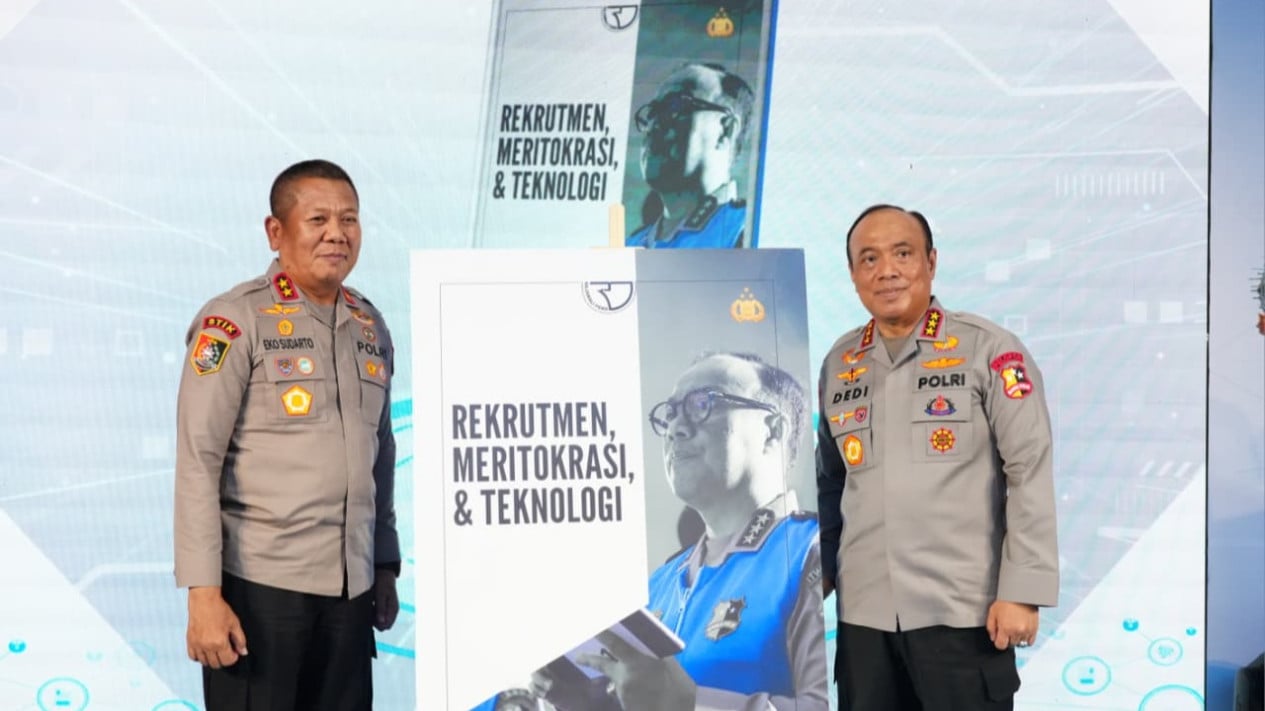
These views were shared during the inauguration of a police studies centre held at the National Police Science University (PTIK) under the National Police Education and Training Institution on Tuesday, 10 March 2026. During the event, Dedi Prasetyo also introduced two academic works related to the development of police science and data-based policy.
“These two books demonstrate that results from academic research can form the basis for accurate, data-driven police policy decisions, thereby ensuring that every step taken by the National Police can be scientifically justified,” he stated.
One of the works introduced addresses human resource management within the police. The writing illustrates how recruitment systems and career development for law enforcement personnel can be built through meritocratic principles and the use of modern technology.
This concept emphasises that the quality of human resources is a primary factor in creating a professional and integrated police institution. With transparent, ability-based recruitment systems, the police organisation is expected to deliver personnel with high competence capable of addressing increasingly complex security challenges.
Moreover, the utilisation of digital technology has become one of the main focuses in human resource management. The concept introduced includes developing a digital ecosystem through a “Single Police HR Data” system, which aims to consolidate various information related to police personnel in one integrated system.
This approach is considered capable of increasing transparency whilst facilitating information access for police personnel. With an integrated data system, human resource management processes—from recruitment and placement through to career development—can be conducted more accurately and efficiently.