
Deputy National Police Chief: Ketupat Operation 2026 Supported by Advanced Technology
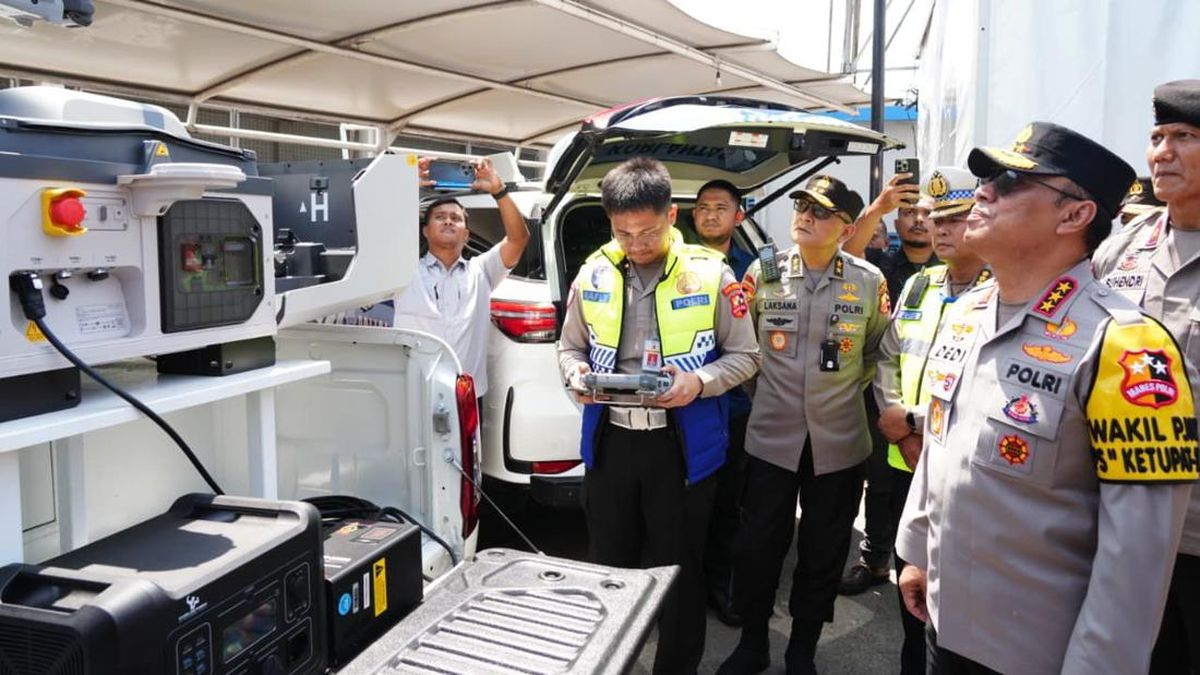
Deputy National Police Chief (Wakapolri) Brigadier General Dedi Prasetyo monitored outbound traffic from Jakarta on the second day of the Ketupat Operation 2026 on Saturday (14 March).
The Deputy National Police Chief assessed that the technological readiness deployed for managing the annual migration period was considerably superior to previous years. He conveyed this during a direct inspection of the Ketupat Operation Command Centre at KM 29 of the Jakarta-Cikampek Toll Road.
Various technological devices currently in use enable officers to monitor traffic conditions in real time whilst facilitating decision-making processes in traffic management engineering. Additionally, during this year’s Ketupat Operation, all traffic patrol personnel deployed in the field have been equipped with bodycams mounted on the officers’ bodies. This equipment is utilised to monitor situations and ensure that every action taken by personnel in the field can be properly supervised, enabling field operations to proceed transparently and with accountability.
“These bodycams are important for observing situations whilst controlling the actions undertaken by field personnel,” Dedi stated in an official statement.
Beyond bodycam deployment by patrol officers, traffic management during the migration period is also supported by various integrated technological devices linked to the Command Centre.
“In my assessment, we are far better prepared this year. Besides the mobile Command Centre technology equipped with drones, for electronic traffic enforcement we also utilise ETLE drones,” Dedi said.
He explained that drone deployment represents one of the critical components in the traffic monitoring system during the migration period. Two types of drones are employed in this year’s Ketupat Operation. The first is a drone integrated with the mobile Command Centre, utilised to monitor traffic conditions at locations inaccessible to surveillance cameras or CCTV. With such technological support, officers can obtain a more comprehensive picture of the field situation, enabling traffic data analysis to be conducted more rapidly and accurately.
“The mobile Command Centre is equipped with drones that will observe locations not covered by CCTV. From there we can conduct data analysis to make necessary decisions,” the Deputy National Police Chief explained.
Beyond drone-based monitoring, this year’s traffic surveillance system is also supported by artificial intelligence (AI)-based analysis. This technology enables real-time traffic data analysis and situation interpretation throughout migration routes. Such monitoring is directly integrated with command centres distributed across various regions, spanning Java, Sumatra, Bali, and various primary migration routes throughout Indonesia. With this system, developments in traffic conditions in the field can be monitored rapidly and centrally.
Additionally, the monitoring system is equipped with traffic counting technology that calculates the number of vehicles passing through major road segments. This data serves as one of the key indicators for officers in determining traffic engineering measures such as contraflow and one-way systems should vehicle volumes surge.
All such data are displayed in an integrated manner on the monitor screens of the Command Centre located at the Integrated Ketupat Operation Post at Rest Area KM 29. The various information displayed on these screens form the basis for officers’ situation analysis and the determination of traffic management policies during the migration period.
Regarding current traffic conditions, the Deputy National Police Chief stated that the situation was running smoothly based on aerial monitoring.
“Overall, from my aerial observation, outbound traffic from Jakarta is flowing very smoothly and whilst there has been an increase, it remains in the very smooth category,” Dedi said.
“Overall public order and security conditions are also very conducive. Traffic flow, despite increases, remains entirely manageable,” he added.