
Deputy Minister of Law Outlines Transformation of Social Rehabilitation in the Era of the National Criminal Code
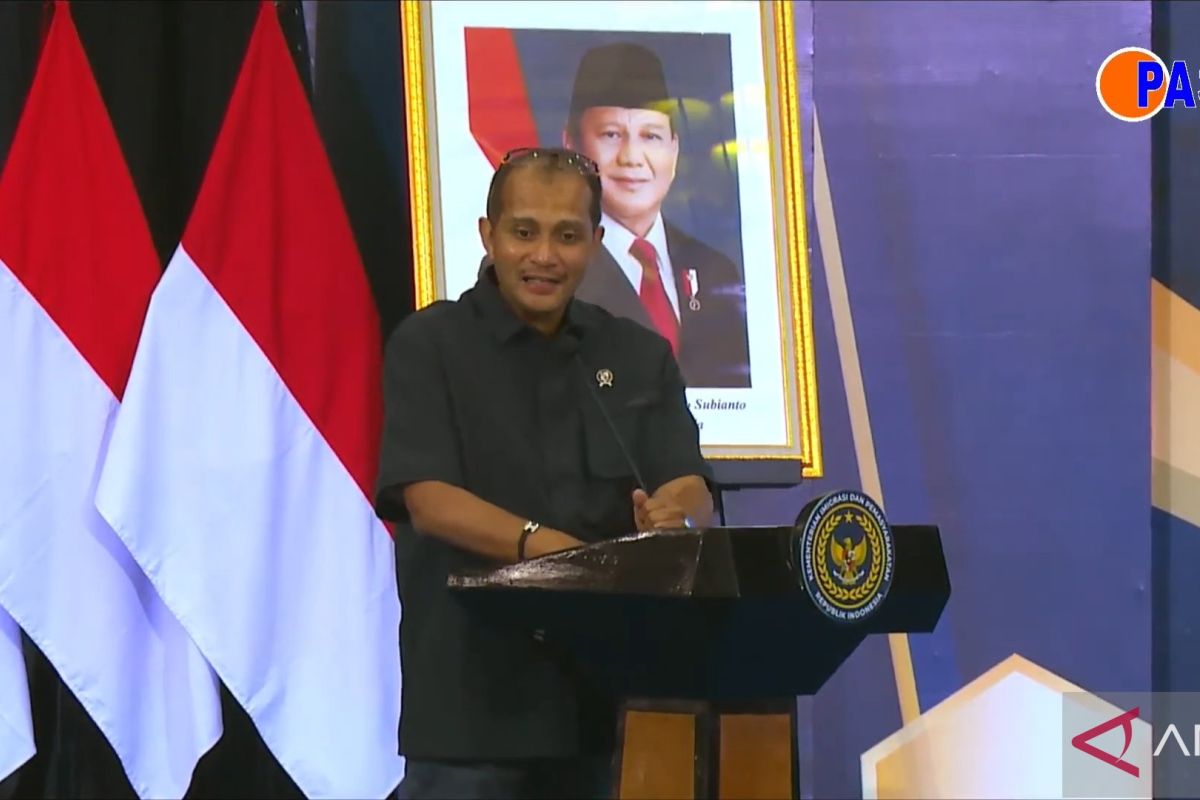
Jakarta (ANTARA) - Deputy Minister of Law Edward Omar Sharif Hiariej outlined the transformation of social rehabilitation in the era of the National Criminal Code (KUHP), which is oriented towards social reintegration, where imprisonment becomes the last resort.
In the era of the new KUHP and KUHAP, the role of social rehabilitation becomes central, and its position is on par with the police, prosecutors, judges, and advocates in the integrated convict justice system.
“Imprisonment is the last alternative, but this does not mean at all that the workload of social rehabilitation officers disappears. However, the supervisory body’s function becomes central,” said Eddy, the familiar name for the Deputy Minister of Law, during a national seminar on social rehabilitation attended online in Jakarta on Wednesday.
This central role of social rehabilitation is regulated in Law Number 22 of 2022 on Social Rehabilitation, which explains that the role of social rehabilitation in the integrated convict justice system begins from adjudication, during adjudication, and after (post) adjudication. This role is also outlined in the new KUHAP or Law Number 20 of 2025.
Article 2 explains that based on the integrated criminal justice system which emphasises the investigative function on the National Police (Polri), prosecution on prosecutors, judging on judges, advocates tasked with balancing criminal cases proportionally and professionally, and social rehabilitation supervisors tasked with guiding convicts and inmates.
“So there is no more such thing as prisons as the final dumping ground; it’s gone. Everyone is given equal standing; everyone must be involved from pre-adjudication, adjudication to post-adjudication. That’s why in various derivative regulations related to social rehabilitation supervisors, they are always involved, for example, social rehabilitation supervisors in the restorative justice process,” he explained.
This central role of social rehabilitation aligns with the social reintegration mission in the implementation of the new KUHP and KUHAP. Where possible, imprisonment is avoided, so alternative sentencing is provided in the KUHP.
The modifications to alternative penalties in the National Criminal Code include supervision penalties, community service penalties, and fine penalties.
Eddy explained the reason why the lawmakers made the vision of the new KUHP social reintegration as an affirmation to law enforcement officials and society that sentencing of convicts or inmates is not solely the task of social rehabilitation institutions but a collective task.
According to him, law enforcement officials, including advocates, are ready to implement the National Criminal Code. What is concerning is at the societal level, which is not yet ready.
This concern is due to the mindset that has formed in society. For example, when a victim’s family is asked for comments on the case they are facing, they will definitely demand that the perpetrator be punished as severely as possible according to what they have done.
This mindset indicates that society is still using the old paradigm of making criminal law a means of revenge.
Then, the occurrence of repeated criminal acts by inmates or recidivism is also due to the stigma in society. A person who has been punished for stealing or deceiving will become the talk of the town in society until that person dies.
“Why is society wrong? As soon as someone gets out of prison, for example, a neighbour becomes the talk of the town, saying don’t associate with that person, he’s an ex-thief, so a kind of stigma is given until he enters the grave, still branded as a thief and deceiver,” said Eddy.
Eddy also conveyed that during his tenure as Deputy Minister of Law and Human Rights, in every visit to detention centres, prisons, and social rehabilitation bodies across Indonesia, he always encouraged the inmates that not everyone in prison is always wrong, just as not everyone outside prison is good.
“What we convey is that we carry out guidance for inmates with full heart. With this new KUHP and KUHAP, the role of social rehabilitation will become central, and this is enshrined in the government regulations that we are preparing,” said Eddy.