
Deputy Minister of Law Explains the Special Character of Capital Punishment in Indonesia
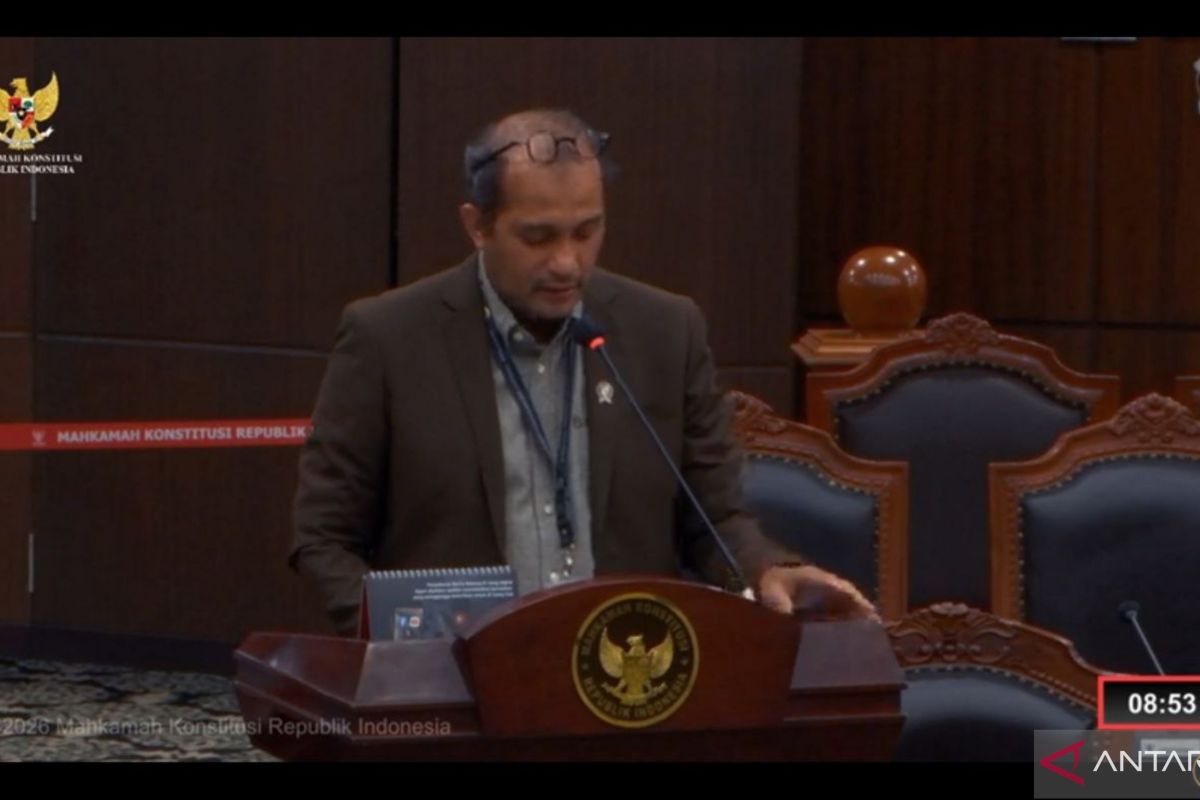
Batam – Indonesia’s Deputy Minister of Law Prof Edward Omar Sharif Hiariej has explained that capital punishment in Indonesia is no longer classified as a principal penalty, but rather as a special penalty distinguished by a 10-year probationary period.
Regarding capital punishment in Indonesia’s new Criminal Code, Edward Omar Sharif Hiariej, commonly known as Eddy, stated that the death penalty has been modified under Law Number 1 of 2026 on Penalty Adjustment, and represents a materially controversial matter.
“Those who follow abolitionist doctrine—who wish to abolish capital punishment—have strong arguments, equally as strong as those who hold retentionist views and continue to support capital punishment,” Eddy said during a continued substantive hearing on the material examination of Law Number 1 of 2023 on the Criminal Code on Monday.
He explained that the new Criminal Code’s provisions were subsequently adjusted through the Penalty Adjustment Law, establishing capital punishment as a special penalty. This special character lies in the 10-year probationary period.
“As stated in the Constitutional Court’s decision in 2006, every death sentence will be imposed with a probationary period,” he noted.
“This represents the Indonesian Way, a win-win solution between those who wish to retain capital punishment and those who wish to abolish it,” he explained.
He outlined the government’s rationale for imposing death sentences with a probationary period, citing alignment with the national Criminal Code’s vision of social reintegration.
“If a death-sentenced convict had no probationary period, it would not be social reintegration but reintegration into heaven or hell—they would simply be executed. However, because social reintegration is the goal, a probationary period is granted,” he said.
Regarding the 10-year probationary period formulation, Constitutional Court judge Daniel Yusmic F. questioned the indicators or methodology the government employed. He noted that a convict could potentially demonstrate rehabilitation within five years, so why wait ten years.
Responding to this, Eddy clarified that the 10-year indicator derives from the Constitutional Court’s decision, not from the government.
Regarding the 10-year probationary period during which the President requests the Supreme Court’s approval on whether the penalty becomes death or life imprisonment, Constitutional Court Chief Justice Suhartoyo noted there existed potential for presidential abuse of authority.
He requested clarification from the government as the legislative body regarding whether the political space or judicial space is more significant in this context.
“So it should be reversed—the judicial aspect should be primary, followed by the executive. Because the supervision function as it pertains to detained individuals falls under the prison system administered by the Ministry of Law and Human Rights. There are areas of presidential authority that could be susceptible to interference,” Suhartoyo stated.
Responding to this, Eddy explained that the President requests Supreme Court approval because evaluation of whether a convict demonstrates good behaviour involves the Ministry of Law and Human Rights, specifically the prison system, the Prosecutor’s Office as the court’s executor, investigators handling the relevant cases, and the Supervisory Commission for Human Rights Violations.
“Why involve all law enforcement officials? This is to prevent abuse of authority that might occur within the prison system,” he explained.
Eddy added that government regulations concerning penalty commutation outline how law enforcement officials collaborate to assess death-sentenced convicts, enabling commutation after 10 years and conversion to life imprisonment.
“True, it is possible that after five years a convict has already demonstrated good behaviour and rehabilitation. Again, the 10-year figure is what we follow based on the Constitutional Court’s decision,” Eddy concluded.