
Deputy Justice Minister clarifies that criticism is not prohibited under Articles 218, 240 and 241
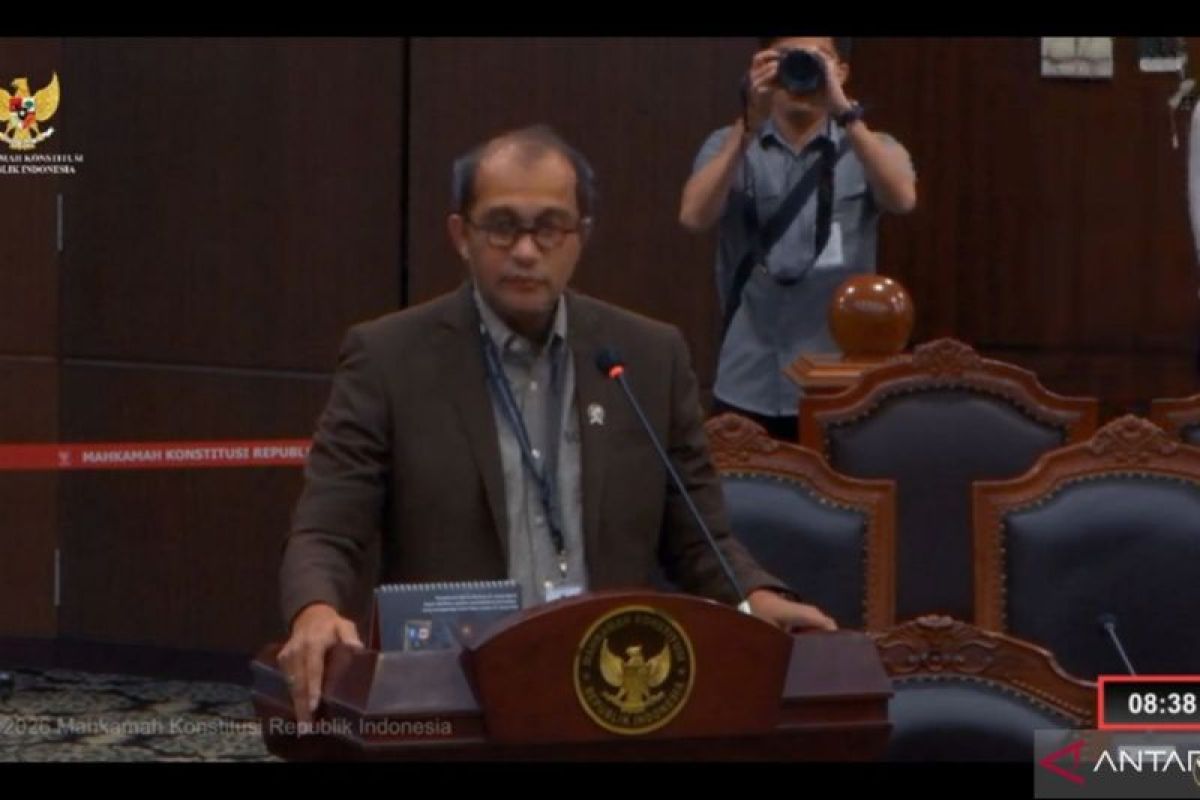
Jakarta — The Deputy Justice Minister Edward Omar Sharif Hiariej clarified that Articles 218 as well as Articles 240 and 241 in the new Criminal Code (KUHP) do not prohibit criticism relating to the public interest.
He explained that criticism in the public interest is detailed in Articles 240 and 241, which have identical explanations to Articles 218 and 219, and that these articles contain grounds for the removal of criminal liability if such criticism is made in the public interest.
“Criticism in the public interest is explained in Articles 218 and 240 in that criticism and protests against a policy are not prohibited at all under these articles, and this falls within the scope of the public interest,” said Eddy, the familiar name for Edward, at the Constitutional Court hearing number 275/PUU-XXIII/2026 in the Plenary Session Hall of the Constitutional Court (MK), Jakarta, on Monday.
Moreover, he said, the explanatory notes to the article state that one form of protest or criticism is public demonstration.
“This means Article 218 and its explanatory notes, as well as Articles 240 and 241 with their explanatory notes, permit demonstrations and permit criticism of the government and state institutions,” he said.
In the hearing chaired by Constitutional Court Chief Suhartoyo, Eddy explained the background to Article 218 concerning attacks on the honour or dignity of the President and Vice President.
This article was created through lengthy debate within the government team when discussing it with the House of Representatives. The substance of this article rests on five reasons, namely that the function of criminal law philosophically is to protect.
“Article 218 concerns state interests. What is protected relates to sovereignty and matters of honour and dignity. The President and Vice President as the personification of the Indonesian state, so their honour and dignity must be protected,” he explained.
The second reason is that in criminal codes throughout the world there are articles or chapters concerning attacks on the honour and dignity of foreign heads of state, so it would be strange if Indonesian law protects the honour and dignity of foreign heads of state, whilst the honour and dignity of the country’s own head of state is not protected.
The third reason is the doctrine of social control. It is understood that the President and Vice President have a minimum of 50 per cent plus one of those with the right to vote.
“Therefore, this article was created as a channel, as a form of social control so that society does not act anarchistically,” he said.
Additionally, he said, to prevent this article from being used arbitrarily. Therefore, this article is an absolute complaint offence, which only the President and Vice President may report.
Then to prevent this article from becoming an abuse of authority by officials, both in the article itself and in its explanatory notes it is strictly limited in that the insult in question has two forms: defamation and slander.
Meanwhile, in Articles 240 and 241 it is also limited in that insults against the government and state institutions are limited only to the President, Vice President, People’s Consultative Assembly, House of Representatives, Regional Representative Council, Supreme Court and Constitutional Court.
“Specifically regarding complaint offences for state institutions, this may only be carried out by the leaders of state institutions and is limited to only six state institutions,” said Eddy.