
Deputy Justice Minister: Citizenship Bill Solution to Issues of Children from Mixed Marriages
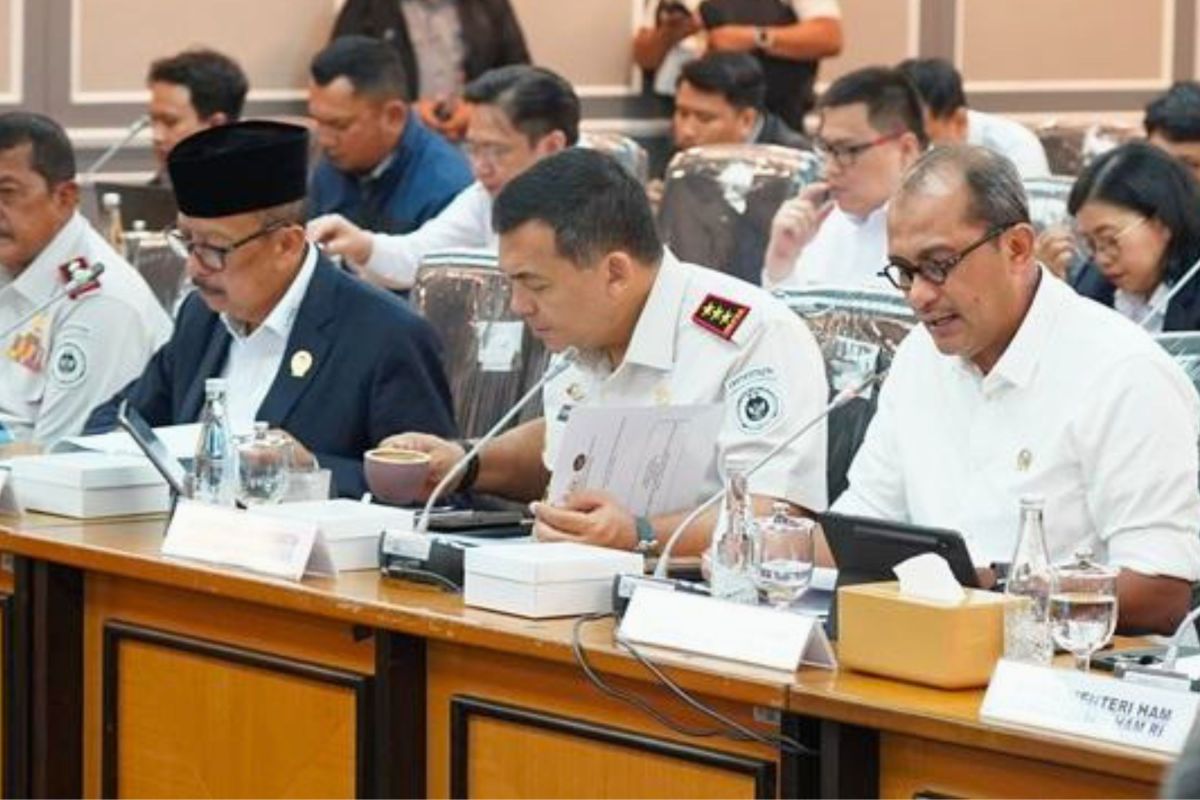
Jakarta (ANTARA) - Deputy Minister of Law Edward Omar Syarif Hiariej believes the Draft Law (RUU) on Indonesian Citizenship provides solutions to various problems surrounding dual-citizen children up to the Indonesian diaspora abroad.
In a working meeting with Commission XIII of the House of Representatives (DPR RI) in Jakarta on Monday (30/3), he said Indonesia adheres to a single citizenship system, but limited dual citizenship can be granted to children from mixed marriages between Indonesian citizens (WNI) and foreign citizens (WNA), as well as children born in countries with the ius soli principle or citizenship based on the country of birth.
“Currently, dual-citizen children must choose their citizenship at the age of 18-21 years,” said the man familiarly known as Eddy, as quoted from a statement confirmed in Jakarta on Tuesday.
Through the new Citizenship Bill, the Indonesian government extends the time period for dual-citizen children to choose citizenship up to the age of 26 years.
In addition, dual-citizen children who are late in choosing are given facilities to regain Indonesian citizenship.
The Deputy Minister of Law explained that the government has prepared regulations as a permanent solution for dual-citizen children who are late in choosing Indonesian citizenship, namely changing the age limit for choosing from 18-21 years to 18-26 years.
“For dual-citizen children who are late in choosing, facilities are provided to regain RI citizenship without going through naturalisation,” he said.
Eddy said the government is also introducing a breakthrough of certain dual citizenship for foreigners who have provided extraordinary services to the nation and state, or to parties whose presence is deemed to have strategic value for national interests.
The strategic fields mentioned include science and technology, economy and investment, culture, sports, and other fields that contribute significantly to national development and enhancing Indonesia’s competitiveness at the global level.
In the Citizenship Bill, it is emphasised that the granting of certain dual citizenship can only be done through mechanisms and requirements that are clearly regulated, including assessments of the services provided or the relevance of national interests underlying the granting of that status.
He stated that the granting of certain dual citizenship is carried out selectively and based on national interests. Therefore, the verification process for citizenship applications is conducted very carefully, selectively, with full responsibility, without burdening state finances or budget, and based on the principle of legal certainty for national interests.
“The granting of certain dual citizenship is not intended to open up the application of dual citizenship in general, but is specific, selective, and based on the state’s strategic interests,” said Eddy.
He revealed that the Indonesian Government has received much input regarding the diaspora, which is then incorporated into the diaspora concept in the Citizenship Bill, defined as former WNI and their descendants up to the third degree.
It is stated that the diaspora is given special attention as part of the nation’s community that has historical, cultural, and emotional ties with Indonesia.
According to Eddy, specific regulations regarding the diaspora are contained in Article 60 of the Citizenship Bill, which affirms the state’s commitment to fostering relations, providing empowerment, and opening stronger access between the diaspora and the homeland of Indonesia.
The Indonesian Citizenship Bill is included in the list of the 2026 Priority National Legislation Programme (Prolegnas).
The bill has undergone preparation at the inter-ministerial committee level since August 2025 until January 2026. To date, the Citizenship Bill is still in the harmonisation discussion stage.