
Deputy Interior Minister Ribka Haluk Emphasises Strengthening of MRP in Drafting Second Amendment to Government Regulation 54 of 2004
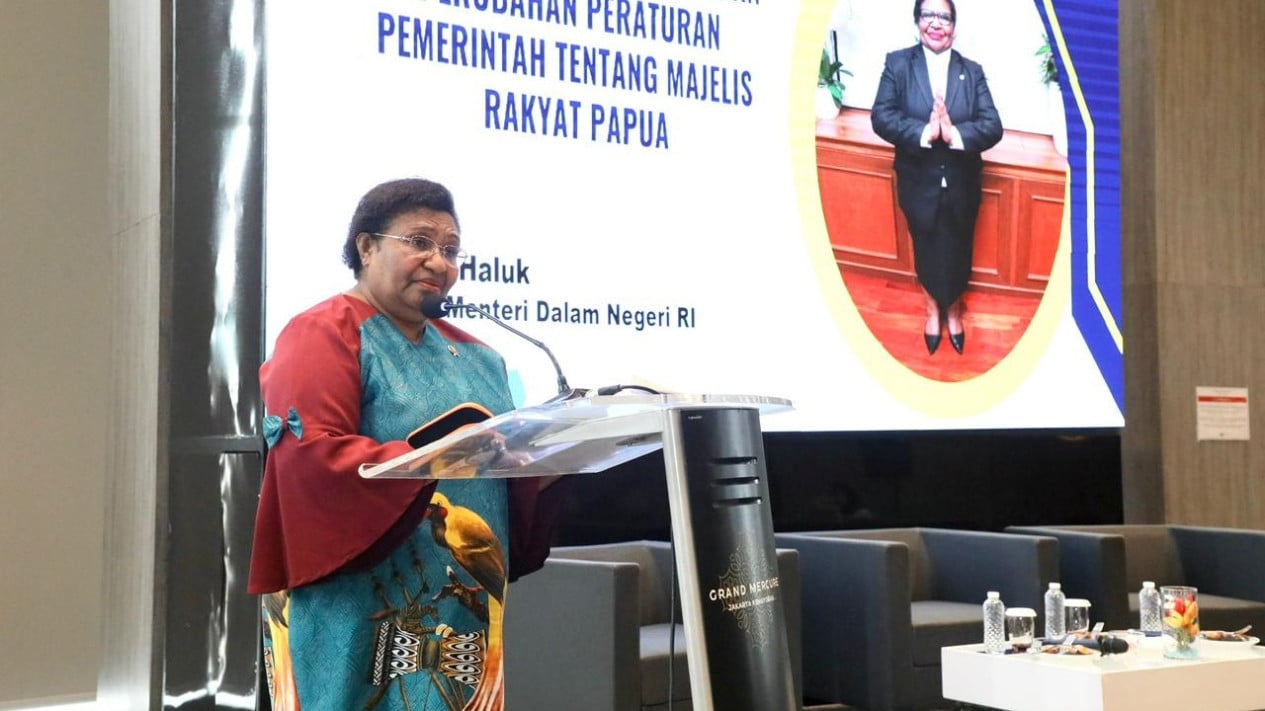
Deputy Interior Minister (Wamendagri) Ribka Haluk has emphasised the importance of drafting a Government Regulation (RPP) on the Second Amendment to Government Regulation No. 54 of 2004 concerning the Majelis Rakyat Papua (MRP) as a step to strengthen the role, functions, and institutional framework of the MRP in implementing Special Autonomy (Otsus) for Papua.
This was conveyed by Ribka during her speech at the Kick Off Meeting for the Revision of PP 54/2004 at the Mercure Hotel in Jakarta on Thursday, 7 May 2026.
According to Ribka, these regulatory changes are necessary to align the MRP’s institutional arrangements with developments in the governance of Papua’s special autonomy following the second amendment to Law No. 21 of 2001 on Special Autonomy for the Province of Papua, as amended by Law No. 2 of 2021.
“The Majelis Rakyat Papua represents the existence and affirmation provided by the state to the indigenous Papuans based on its definition under the Special Autonomy Law No. 2 of 2021,” she stated.
She explained that over nearly two decades of implementing PP No. 54 of 2004 in conjunction with PP No. 64 of 2008, various dynamics have emerged indicating that the existing provisions are no longer adequate to address developments in the political, legal, and social rights of Papuan society. Therefore, the government deems it necessary to update the regulations so that the MRP can carry out its functions and authorities more effectively and efficiently.
In addition to strengthening the MRP’s institutions, the revision of the regulation is also directed towards addressing various legal and social needs of Papuan society. This includes oversight of special autonomy funds, protection of indigenous communities, empowerment of Papuan women, and strengthening the MRP’s role in formulating regional policies.
“Regulatory improvements serve as the gateway to strengthening the role and existence of the MRP in carrying out its mandate to protect indigenous Papuans,” she said.
Furthermore, Ribka emphasised that the government targets the completion of the RPP drafting by December 2026 in line with the 2026 Government Regulation Drafting Programme mandate. To this end, she urged all inter-ministerial and agency committees to maintain commitment, focus, and coordination to ensure the regulatory drafting process runs on time and produces legal products capable of meeting the needs of Papuan society.
On that occasion, Ribka also reminded of the importance of synergy between the MRP, local government, the Papuan DPR, DPRK, academics, customary leaders, religious figures, and women’s groups in overseeing the implementation of Special Autonomy for Papua. According to her, the involvement of all these elements is crucial so that the RPP drafting truly strengthens the state’s commitment to the rights of indigenous Papuans while supporting improvements in community welfare.