
Deputy Interior Minister Reminds Universities to Optimise Demographic Bonus
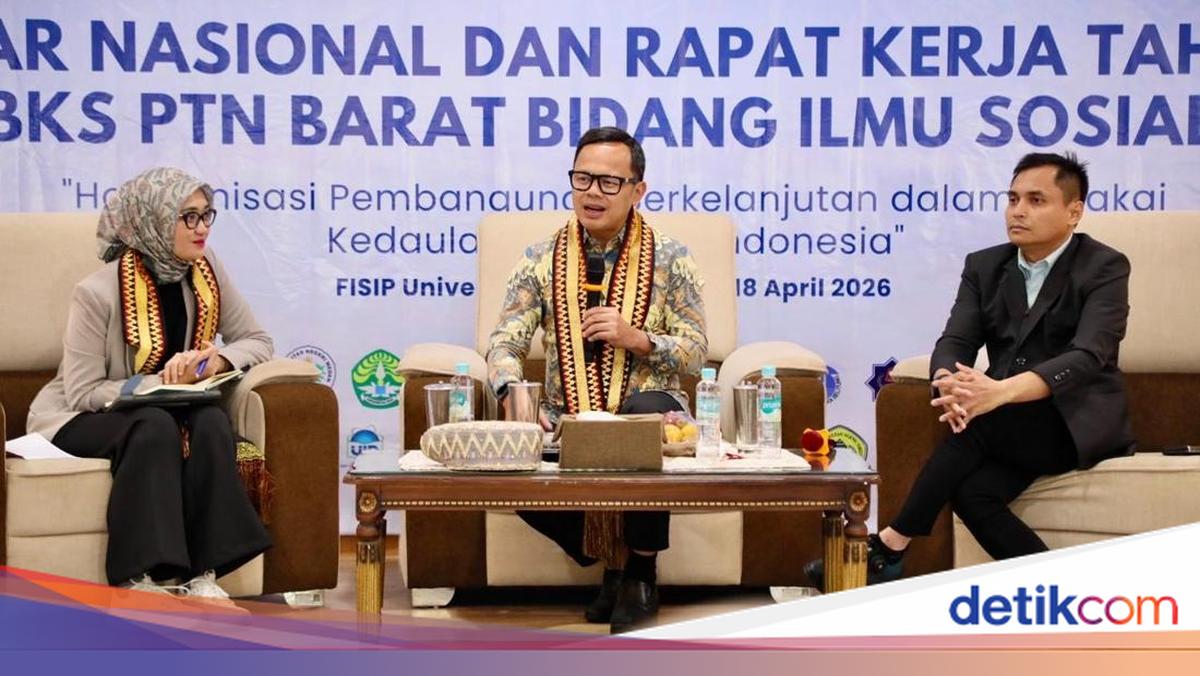
Deputy Interior Minister (Wamendagri) Bima Arya Sugiarto has reminded universities of their strategic role in optimising the demographic bonus. This is crucial for promoting sustainable development within the framework of national sovereignty.
He conveyed this during the National Seminar and Annual Working Meeting of the Cooperation Agency (BKS) for State Universities (PTN) in Western Indonesia in the Social Sciences at the University of Lampung on Friday (17/4).
In his presentation, Bima stressed that the demographic bonus represents a major but limited opportunity that will shape Indonesia’s future. Therefore, this momentum must be utilised optimally through cross-sector collaboration, including between the government and universities.
“The biggest challenge for Indonesia today is how to maximise the demographic bonus towards the Golden Indonesia. This is a momentum that not many people realise,” Bima stated in his remarks on Friday (17/4/2026).
He explained, based on projections from international institutions such as the World Bank, that Indonesia has the potential to become one of the world’s five largest economies in the next 20 years.
However, this opportunity can only be achieved if Indonesia manages to escape the middle-income trap that has long hindered growth acceleration.
Bima encouraged academics to strengthen data bases and research in assessing Indonesia’s current position regarding the demographic bonus. He views universities as important centres of knowledge and think tanks capable of bridging the gap between theory and policy implementation.
“Now this is my challenge to my campus friends, let’s compile that data. The Ministry of Home Affairs will contribute to discussions, we will exchange ideas and share data,” he asserted.
Furthermore, Bima outlined four keys to success for countries that have successfully advanced: sustainable national vision, self-reliance, effective leadership, and collaboration and innovation.
He assessed that Indonesia’s current challenges lie in the suboptimal synchronisation of policies, weak research bases in decision-making, and regional fiscal capacity disparities.
On the other hand, he also emphasised that sustainable development must be carried out substantively and data-based, not merely symbolic or gimmicky.
In this regard, universities are expected to play an active role in producing superior human resources, including through strengthening green leadership among the younger generation.
Through this forum, Bima hopes that synergy between the government and universities will grow stronger in optimally utilising the demographic bonus, thereby driving the emergence of adaptive, research-based policies with real impacts on sustainable national development.