
Deputy Interior Minister Discusses Evolving Styles of Regional Leadership Since 2005 Direct Elections
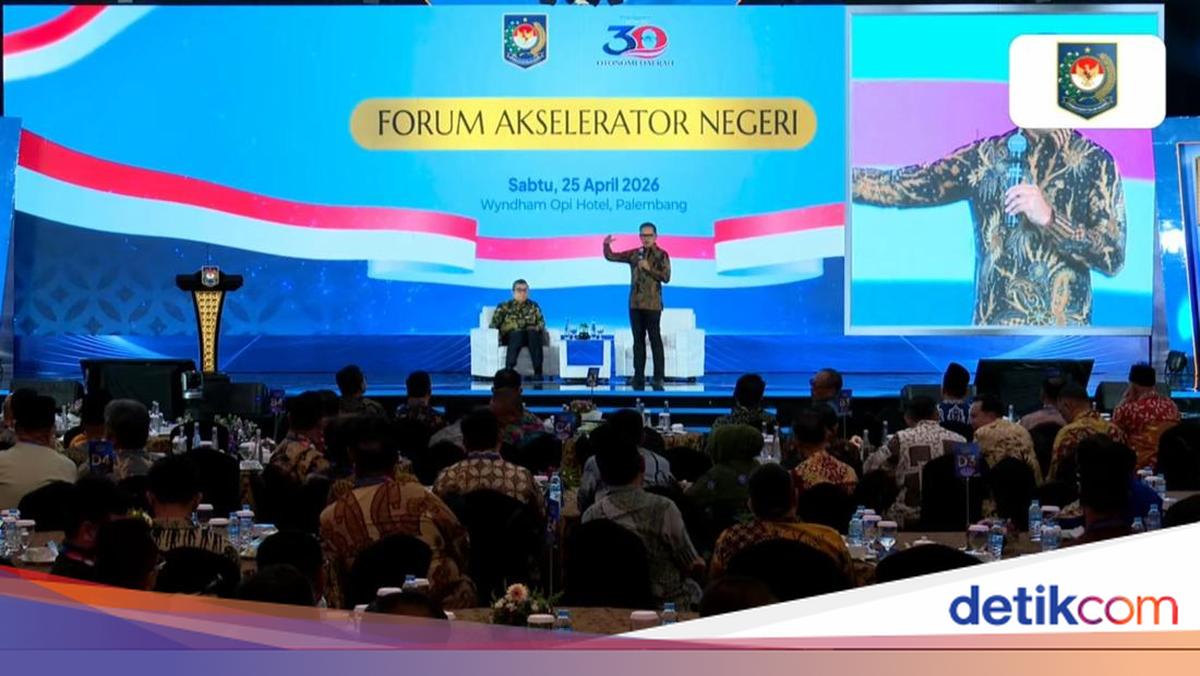
Deputy Interior Minister (Wamendagri) Bima Arya Sugiarto depicted the changes in the style of regional leadership since the direct regional elections in 2005. He outlined three waves of regional leadership styles that have adapted to the challenges of their times.
Bima delivered these remarks in his speech at the 2026 Outstanding Regional Government Appreciation event, a collaboration between detikcom and the Ministry of Home Affairs, held in Palembang, South Sumatra, on Saturday (25/4/2026).
According to Bima, the first wave was marked by the emergence of regional heads who were close to the public and focused on meeting basic societal needs. One icon of this phase was Joko Widodo during his tenure as Mayor of Solo, known for his pro-people approach such as strengthening MSMEs and creating jobs.
“Governors and all regional heads present today, colleagues from the Ministry of Home Affairs, ladies and gentlemen whom I respect. Since the direct regional elections in 2005, we have observed many styles of regional leadership,” said Bima.
“The first wave, the regional heads who became media darlings at that time were the Mayor of Solo, the Regent of Jembrana, the Regent of Sragen; the icon then was Mr Jokowi. He was known for innovations at that time focused on basic needs: in Bali it was health, for Mr Jokowi it was jobs, MSMEs, and other things that touched basic societal needs,” he continued.
The next wave gave birth to regional heads with more progressive breakthroughs. Names such as Tri Rismaharini, Ridwan Kamil, and Abdullah Azwar Anas were cited as representations of the second phase. During this period, innovations developed towards concepts like ‘smart city’, collaboration, and policy breakthroughs.
“There was the next wave after Mr Jokowi’s batch or generation, namely Ms Risma, Mr Ridwan Kamil, Azwar Anas from Banyuwangi, and so on. This second batch was also known for distinctive features. If the first phase was basic needs, the second phase was breakthrough innovations. We all became familiar with Smart City, we became familiar with the terms innovation and collaboration,” he stated.
Now, according to Bima, regional heads are in a new wave with challenges no less complex. He acknowledged the perception that being a regional head today feels more difficult, especially because the room for manoeuvre for regions is seen as narrowing due to national priority programmes.
“And today, ladies and gentlemen, you may be entering the third or fourth wave with challenges that could be the same or different. Some say that this is the most uncomfortable time to be a regional head. I’m sure some will applaud this,” he said.
However, Bima assessed that these challenges depend on each leader’s perspective and response. He cited the COVID-19 pandemic era, which also limited the room for regional governments but was still navigated successfully.
Bima emphasised that the key to regional leadership today is acceleration, connecting the central government’s vision with implementation at the local level. He admitted to often receiving complaints from regional heads but also seeing many who remain optimistic.
“Well, today, ladies and gentlemen, let’s say these national strategic priority programmes are making the room at the regional level shrink. That depends on perception and depends on each one’s actions. At the Ministry of Home Affairs, ladies and gentlemen, we often hear complaints from regional head colleagues. Not a few complain and grumble, but there are also those who are enthusiastic,” he said.
“So, why is today’s title ‘Accelerator’? Because essentially, the main language today is acceleration. How all the President’s visions at the national level connect and are accelerated with the regions,” he continued.
In closing his remarks, Bima reminded that 30 years of regional autonomy have produced many outstanding regional heads. However, homework remains significant, particularly regarding fiscal independence.
“Because today is 30 years of Regional Autonomy, ladies and gentlemen, colleagues, yes, 30 years. And if we talk about what we have gained in 30 years, the emergence of media darlings, icons in the regions as examples, outstanding regional heads. But the fiscal capacity which is still largely not independent, that is our homework. 30 years full of good notes, but 30 years that we also need to accelerate together,” he said.
This event is part of the central government’s efforts to encourage improved regional performance through fiscal incentives. The policy refers to Law Number 1 of 2022 on Financial Relations between the Central Government and Regional Governments, which allows for performance-based awards.
In addition, the implementation of this programme is strengthened by regulations on regional financial management as stipulated in Government Regulation Number 12 of 2019.
In this forum, several provincial, regency, and city governments in Sumatra will receive appreciation in four main categories: Inflation Control, Reduction in Unemployment Rate, Poverty Alleviation and Stunting Reduction, and Entrepreneur Government/Creative Financing.
The event in Palembang City, South Sumatra, serves as the opener for a series of national activities to be held across six islands in Indonesia.
In addition to the award ceremony, this event will also feature the National Accelerator Forum, a collaborative platform that brings together the central government, regional governments, business actors, investors, MSMEs, academics, and the general public in one dialogue and action forum.
The 2026 Outstanding Regional Government Appreciation and National Accelerator Forum will feature detikcom’s Editor-in-Chief Alfito Deannova Gintings as moderator.
The event is also attended by the Ministry of Health (Kemenkes), Ministry of Finance (Kemenkeu), National Development Planning Agency (Bappenas), and Central Bureau of Statistics (BPS). All regional heads from Sumatra, from governors, regents, to mayors, are also present.