
Deputy Industry Minister Strongly Criticises Speculators, Assures Indonesia's Plastic Raw Materials Supply is Secure
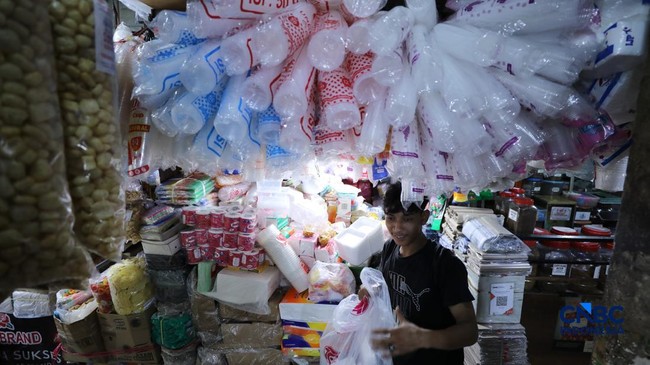
Jakarta, CNBC Indonesia - Deputy Minister of Industry (Wamenperin) Faisol Riza assesses that public concerns regarding plastic supplies are baseless when considering the actual conditions on the ground. He states that the supply of raw materials remains secure to support the continuously increasing national industrial needs.
“Plastic raw materials are abundantly available in the domestic industry. Therefore, there is no need to worry. Companies requiring plastic can source it from domestic producers,” Riza said in his statement on Friday (24/4/2026).
This statement also serves as a response to concerns raised by business actors due to global supply chain disruptions. The government, he said, is now focusing on ensuring that the distribution of raw materials proceeds smoothly, particularly for downstream sectors such as Small and Medium Industries (IKM) and MSMEs, which are vulnerable to impacts.
“The government’s duty is to ensure that business actors can easily access raw materials and are served by domestic producers without obstacles, including maintaining competitive prices. We must not allow any parties to exploit the situation to raise prices unjustly,” he emphasised.
The government is also beginning to promote strengthening domestic supplies to reduce dependence on imports. This step is deemed important for maintaining industrial stability amid global volatility.
“The government urges companies to prioritise domestic production because domestic production capacity is still very substantial. If there is a greater need in the future, perhaps the import route can be chosen,” Riza stated.
Meanwhile, Chairman of the Indonesia Biaxially Oriented Films Association (ABOFI), Santoso Samudra Tan, views the scarcity issue as more driven by market sentiment than actual supply conditions.
“It should be underlined that those directly affected are plastic pellets, naphtha, and primary raw materials for the plastic industry. However, in terms of availability, raw materials remain relatively secure and production continues smoothly,” Santoso said.
He warns that perceptions of scarcity should not lead to policies that excessively open the floodgates to imports of finished products, as this risks pressuring the domestic downstream industry.
“If imports are only in the form of raw materials like plastic pellets, it can still be accepted. But if imports include finished products, this has the potential to harm the domestic downstream industry, which actually still has adequate production capacity,” he emphasised.
Manufacturers acknowledge that supply disruptions did occur, particularly at the start of the geopolitical conflict in the Middle East. However, the industry is said to have adapted quickly through supplier diversification.
“We had a supplier from Saudi that stopped. But it wasn’t long, as we quickly switched. We also have supplies from ASEAN, China, Russia. We can quickly redirect to those vendors. That’s why during the Iran war, we were normal,” said Director of PT Argha Karya Prima Industry Tbk (AKPI), Jimmy Tjahjanto.
Although supplies are relatively maintained, another pressure comes from the price side, driven by the rise in global oil prices. This condition causes raw material costs to surge significantly and is difficult for industry players to control.
“In terms of price, it cannot be controlled. Now it’s around 1,600 dollars, almost double. We still supply for domestic customers,” Jimmy said.