
Deputy Home Affairs Minister Wiyagus Emphasises Strengthening Democracy to Support Development Toward Indonesia's Golden 2045
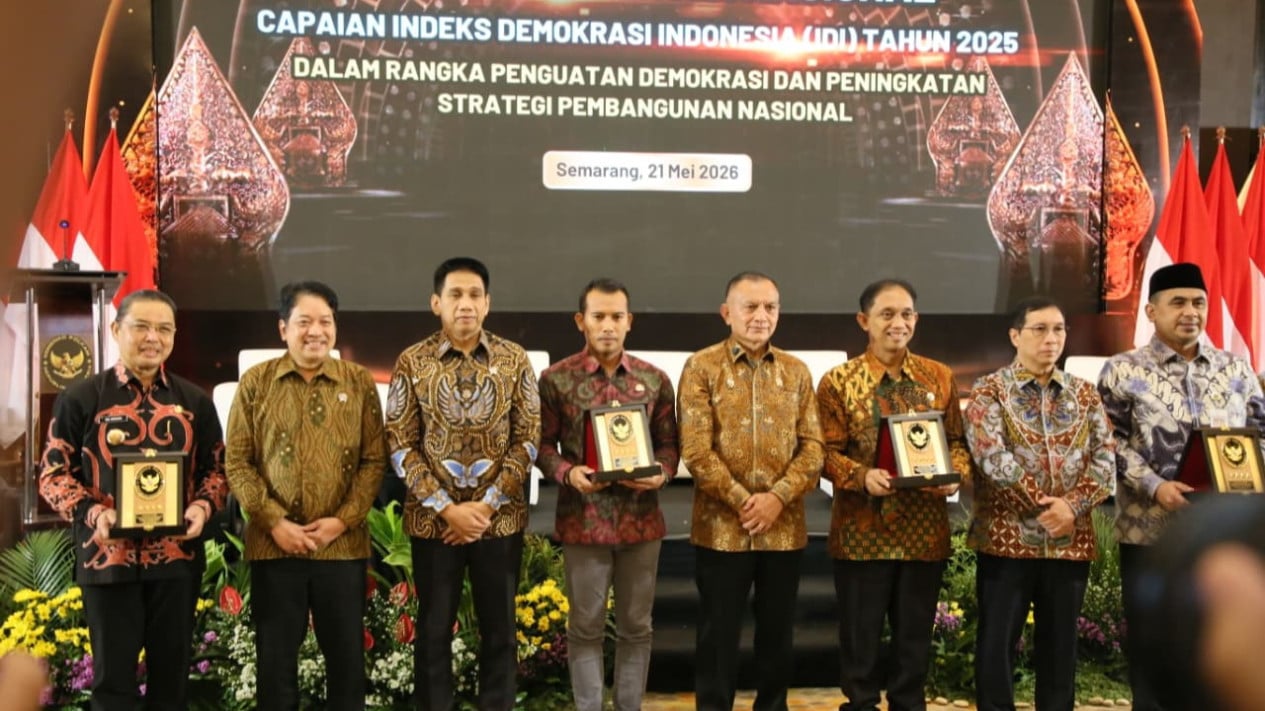
Semarang, VIVA – The Deputy Minister of Home Affairs (Wamendagri) Akhmad Wiyagus stressed that strengthening democracy plays a strategic role in supporting national development and realising public welfare toward Indonesia Emas 2045 (Golden Indonesia 2045). He said this at the Kick Off National Evaluation of the Indonesian Democracy Index (IDI) in the Ballroom of Horison Ultima Sentraland Hotel, Semarang, Central Java, Thursday (21 May 2026).
In his remarks, Wiyagus explained that Indonesia has a huge capital in natural resources, demographic bonus, and social and cultural diversity which are the country’s main strengths. However, the large potential requires a strong democratic foundation so that development can proceed in a fair, participatory, and sustainable manner.
“Because democracy can be the glue of the nation, and also an instrument to ensure that this development proceeds fairly, and is participatory and sustainable,” said Wiyagus.
He said that a healthy democracy will strengthen government stability while increasing public trust in government policies. Conversely, weakening democracy risks social polarisation and hindering national development achievement.
“Democracy that we build must also move toward substantive democracy, that is democracy that delivers real benefits for the people and strengthens the effectiveness of national development,” he asserted.
In that context, Wiyagus assessed that IDI has a strategic role as a instrument of political development and the quality of local democracy based on data that can be used as the basis for policy formulation.
He explained that IDI is not only an evaluation instrument but has become an important part of RPJPN 2025–2045 (Long-Term National Development Plan 2025–2045), RPJMN (National Medium-Term Development Plan), and indicators of local government performance. Thus, strengthening democracy through IDI is no longer just normative agenda, but has become an integral part of national development and regional development agendas.
“These data must be a shared concern, and the IDI evaluation should not stop at statistics alone, but must be followed up with policy recommendations, institutional strengthening, and comprehensive steps to improve democracy in the regions,” he said.
On that occasion, Wiyagus also expressed appreciation to regional governments that achieved high scores in the IDI 2025 assessment, namely the Special Province of Yogyakarta with 89.79; Bali 88.73; Central Java 86.72; West Kalimantan 86.17; and East Java 84.05. According to him, these achievements reflect the regions’ commitment to strengthening the quality of democracy, maintaining government stability, and promoting inclusive and sustainable development. (LAN)