
Deputy Agriculture Minister: Government to Provide Free Seeds for 1 Million Hectares of Maize Cultivation
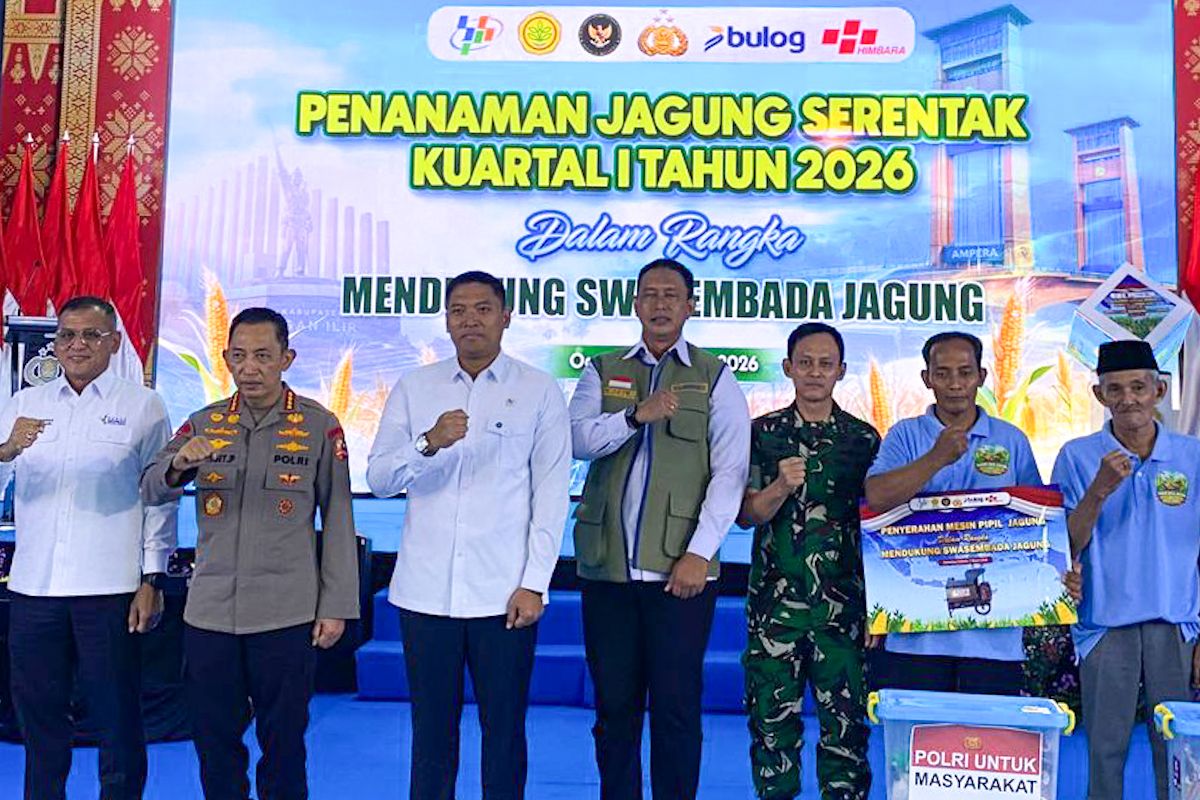
Jakarta – Deputy Agriculture Minister (Wamentan) Sudaryono stated that the government is preparing free maize seed assistance for land area up to 1 million hectares as an effort to accelerate the increase in national maize production and support self-sufficiency targets for this commodity.
Sudaryono said the success of agricultural sector development is supported by four main factors: seed availability, irrigation, fertiliser, and price certainty for farmers’ harvests.
“In agriculture there are four key matters: seeds, water or irrigation, fertiliser, and after harvest the price must be purchased at a good price,” said Deputy Agriculture Minister Sudaryono during the simultaneous maize planting activity for the First Quarter of 2026 held in Ogan Ilir, South Sumatra, as stated in Jakarta on Monday.
He explained that the Agriculture Ministry has prepared various strategic measures to ensure these four components are fulfilled. One of them is through the provision of free maize seeds to farmers.
“The Agriculture Ministry is preparing free maize seeds for 1 million hectares of land from a total of approximately 2.5 million hectares of national maize land,” the Deputy Agriculture Minister explained.
Additionally, the government is also strengthening support for agricultural infrastructure through a programme to revitalise irrigation networks nationally.
“The President has allocated Rp12 trillion for revitalisation of primary, secondary, and tertiary irrigation networks in 2025, and this programme will continue in subsequent years,” he added.
On the other hand, he continued, the government is also simplifying the distribution of subsidised fertiliser as well as providing additional incentives for farmers. The quota for subsidised fertiliser is being met and the distribution mechanism is simplified. In fact, an additional price reduction of approximately 20 per cent is being given.
Sudaryono also affirmed that the government guarantees the purchase price of farmers’ harvests to remain profitable.
“The government has set harvest purchase prices of Rp6,500 per kilogramme for rice and Rp5,500 per kilogramme for maize,” he said.
In an interactive dialogue during the activity, the Central Kalimantan Police Chief, Iwan Kurniawan, reported developments in maize cultivation in his region through an intercropping system on palm oil plantation land.
According to him, the area of palm oil plantations in Central Kalimantan reaching approximately 2.1 million hectares opens opportunities for utilising intercrop land for maize development.
Additionally, his office also conveyed the need for support in agricultural equipment and machinery (alsintan), such as dryers and equipment supporting maize cultivation, to increase farmer productivity.
Responding to this report, Deputy Agriculture Minister Sudaryono assured that the government would follow up on these needs.
“I request expert personnel to immediately follow up on alsintan requirements, including maize cultivation guidance in palm oil plantations. This is one of the efforts to increase maize production, especially in younger palm oil plantations,” said Sudaryono.
“This simultaneous maize planting activity is a follow-up to the President’s directive in strengthening food self-sufficiency. We must utilise all the potential we have so that Indonesia becomes increasingly self-reliant in meeting its food needs,” said Sigit.
He also conveyed that nationally the maize planting programme continues to expand to increase domestic production.
“We have already planted more than 600,000 hectares with potential production of approximately 3.9 to 4 million tonnes. Going forward, the target is to reach planting of up to 1 million hectares or more,” he explained.
Through collaboration between the government, apparatus, local government, and farmers, the simultaneous maize planting programme is expected to strengthen national production whilst improving farmer welfare.