
Denny JA's Painting Exhibition Titled 'Sumatra Cries and Ecological Critique' Welcomes Ramadan
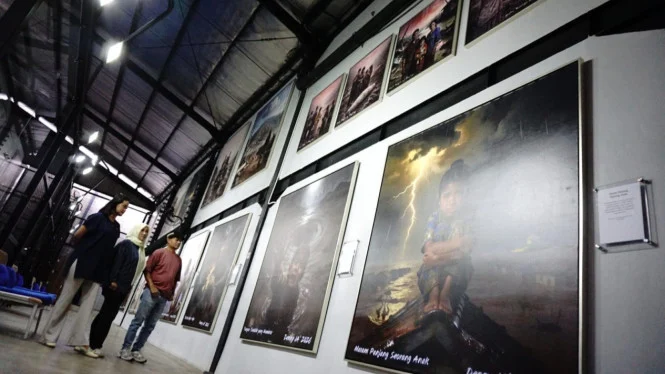
In the holy month of Ramadan, an art exhibition titled ‘Sumatra Cries and Ecological Critique’ is being held at the Denny JA Art Gallery, located in the Padel District of Ciputat. This exhibition presents a visual reflection on the environmental crisis, aiming to stir the conscience.
In the gallery, which also serves as a padel court, more than a hundred paintings by Denny JA are displayed on the walls. Among them are 27 paintings from the ‘Sumatra Cries and Ecological Critique’ series.
One of the most poignant works is a painting titled ‘The Last Hand Asking’. It depicts a young boy trapped in a whirlpool, his hand reaching towards the sky, not just asking for help, but demanding an answer. His face is not just one of fear, but the face of a generation born from our own mistakes.
Behind him, the shadow of a city looms faintly. Around him, pieces of wood and tree trunks float. The water that engulfs him is not the clear water of life, but murky water that holds the traces of deforestation and long-standing neglect.
This painting does not only record the tragedy of a child; it records the collective failure of a civilization.
The disaster in Sumatra is not just a matter of fate; it is a consequence of repeated choices.
Denny JA calls this approach the ‘Nusantara Imagination’ painting genre. It is not just a visual style, but an aesthetic and moral attitude in interpreting the times.
The ‘Nusantara Imagination’ genre he has developed is an innovation in digital art that combines realistic human figures, local cultural symbols, and surreal landscapes, with the help of artificial intelligence as a creative tool.
‘However, technology is not the main focus here; it is just a bridge. The main focus remains the soul, interpretation, and social concerns that we want to convey,’ said Denny JA in a written statement on Thursday, February 26, 2026.
In this genre, Denny said, batik is not just an ornament; it is the core of the visual narrative. The motifs worn by the characters are symbols of cultural roots, harmony, and local spirituality that remain intact amidst the harsh currents of modernity.
‘Batik is a statement that identity must not be swept away by the flood of time. It affirms the continuity of memory, even when the landscape around it is crumbling,’ he said.