
Demand for Migrant Workers Shifts from Low-Skill to High-Skill
The government is confronted with a policy dilemma, and there is no truly comfortable solution.
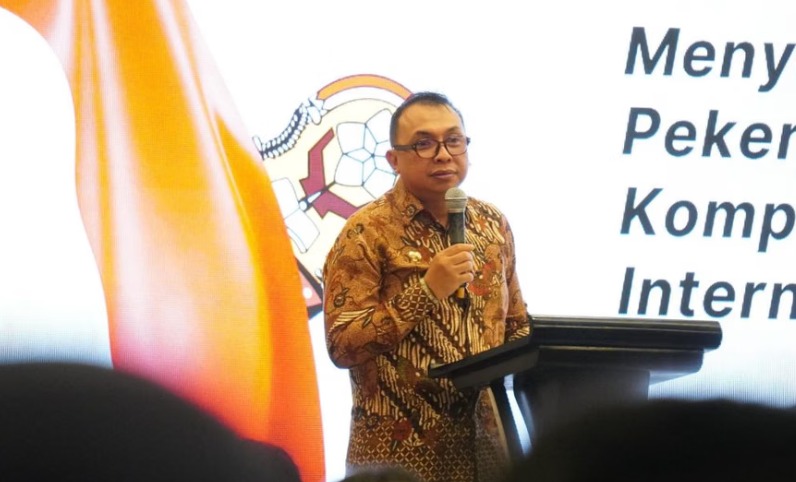
Director of Institutional Development for Indonesian Migrant Workers Vocational Training at the Ministry of Protection for Indonesian Migrant Workers (KP2MI), Abri Danar Prabawa, stated that there has currently been a shift in demand for migrant workers, from low-skill to high-skill.
“Therefore, it is now time for us to discuss that working abroad can become part of a process that can be prepared through educational institutions,” he explained during a discussion and socialisation forum titled Opportunities and Challenges for Skilled Indonesian Workers to Work Abroad through Strengthening in Higher Education at the Kemdiktisaintek Office, Jakarta, on Wednesday (8/4).
Furthermore, according to him, currently only 3.1 percent of higher education graduates fill the global job market. “For that, there is much that we need to collaborate on. We must ensure that those working abroad are of a higher level and that their protection also improves,” said Abri.
At the same venue, Director of Learning and Student Affairs at the Ministry of Higher Education, Science and Technology (Kemdiktisaintek), Beny Bandanadjaja, added that the world is currently undergoing changes that impact job losses, but also the emergence of many new jobs.
“This drives us to be able to adapt quickly. The most important thing for workers abroad is their level of readiness, and this lies in higher education. We encourage how learning can be relevant and impactful. Therefore, the scope of the vocational study programme curriculum must be able to produce graduates with high skills,” said Beny.
On the other hand, Task Force Team for Higher Education Graduate Employment, Anggun Siswanto, emphasised that Career Development Centres (CDC) in higher education can be developed for cooperation programmes between KP2MI and Kemdiktisaintek.
“Basically, in each higher education institution, the management of this CDC functions for student career development, career expos, as well as career consultation and counselling for students,” he explained.
“We present an international CDC or CDC-MC. This is an upgrade from the CDC that has been implemented in higher education institutions. In the future, there will be strengthening of global competencies, such as international CV creation, foreign language training, and competency certification. Furthermore, what is also important is networking of national and international alumni as cross-country mentoring,” continued Anggun.
On the other hand, Special Staff to the Minister for Industry Networking and Foreign Cooperation, Oki Earlivan Sampurno, said that data on skilled Indonesian workers continues to increase, but it is not proportional to the absorption of labour.
“So the needs can never be fulfilled. There is a 36 percent deficit. According to BPS, the unemployment rate in Indonesia is 7.4 million. The Philippines and India send high numbers of workers abroad in extraordinary quantities. But we only send 200-300 thousand people per year. We must build an ecosystem for the long term. Learning from the Philippines, from 550 thousand in 2020 to 3.1 million in 2023. There is an ecosystem built with an incentive system. The target is 100 thousand skilled workers who will work abroad,” said Oki.
Meanwhile, Chairman of the Indonesian Manpower Services Company Association, Said Saleh Alwaini, emphasised that the demand for Indonesian migrant workers from abroad has always been high for higher education graduates.
“The ecosystem for recruiting non-higher education graduates has been established for a long time. So it’s easier. Unfortunately, relations with higher education have not yet been established. With this condition, if there is demand for high competencies, it’s unimaginable where to find them. So the high-level demand mentioned earlier ends up being neglected,” he stated.
With this event, it is hoped that sustainable cooperation will be established so that skilled Indonesian migrant workers from higher education can meet demands from abroad.