
Defence Force Development 2025-2044: Quality or Quantity?
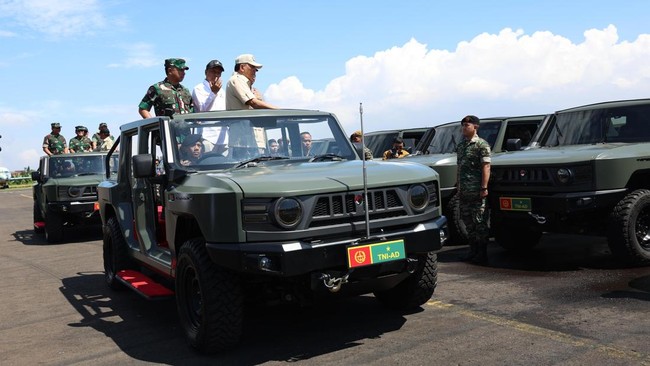
The long-term defence force development activities for 2025-2044 begin in a period full of challenges due to the global geopolitical situation and its implications, which are unfriendly to Indonesia from an economic perspective. The plan by President Prabowo Subianto’s government to increase defence spending, where the defence sector is one of the priority programmes, is confronted with increasingly limited fiscal space due to domestic and international factors.
The downgrade of Indonesia’s outlook from stable to negative by Moody’s Ratings and Fitch Ratings, along with the economic impact of the Iran-US and Israel war, makes fiscal management related to defence spending even more challenging. Meanwhile, defence spending for force modernisation still relies on Foreign Loans (PLN) because the capacity of pure Rupiah funding for such activities is very limited.
Funding issues have always been a classic problem in Indonesia’s defence force development programmes since the founding of the republic. Post-1998, significant modernisation occurred during the Minimum Essential Force (MEF) period of 2010-2014 with PLN capital of US$6.55 billion, marking a significant leap in defence force modernisation with several procurement activities for defence equipment that were previously unimaginable.
Such a significant leap continued in the MEF 2020-2024 period when PLN allocation sharply increased to US$34.7 billion. However, it is regrettable that several weapon system acquisition activities during that period were deemed off-target or insignificant in improving the quality of defence capabilities.
As part of the long-term defence force development for 2025-2044, the first phase of the Optimum Essential Force (OEF) has so far received a PLN quota of US$28 billion. It is not yet known how much PLN allocation for the second and third phases of OEF, which will be determined by subsequent governments based on the conditions faced at that time.
If we examine closely the quantity targets for defence equipment to be achieved by 2044, it is not excessive to say that those targets are quite ambitious. However, reflecting on the long-term defence force development programme from 2010-2024, there has always been a gap between the ambitions to be achieved and the programme’s realisation capacity, where the latter is influenced by various domestic and international factors.
As an illustration, the Indonesian Army (TNI AD) is planned to have 5,734 armoured combat vehicles and tanks, as well as a target of 1,245 anti-aircraft missile/artillery units.
The Indonesian Navy (TNI AL) is projected to have 294 warships, in addition to 490 units of Marine Corps combat materials and 227 aircraft. The Indonesian Air Force (TNI AU) assets include 460 aircraft and 59 air defence radars. Regarding the quantity targets to be achieved by 2044, several questions arise beyond economic/fiscal aspects.
First, does the quantity of war equipment correspond linearly to the quality possessed? Referring to what happened in the MEF 2010-2024 era, weapon system procurements often emphasised quantity over quality.
This is not only related to the purchase of some defence equipment questioned in terms of technical aspects (capabilities), but also the import of weapon systems that are actually good vehicles or items but not accompanied by an Integrated Logistic System (ILS) package and sufficient ammunition and missiles. Thus, there is sarcasm that the purchased war equipment is only useful for ceremonial activities and conversely doubted for operational use in combat interests.
Second, the age of the vehicles listed in the 2044 achievement targets. Will the quantity achievement targets force decision-makers to continue using vehicles purchased from the 1960s to 1990s?
There is suspicion that to chase the 2044 quantity achievements, vehicles brought in from the 1960s to 1990s era will be retained as assets until 2044. For example, in the target of 5,734 armoured combat vehicles and tanks for the TNI AD, does the AMX-13 count towards that number?
Third, details of vehicle types or weapon systems. Although there are mentions of vehicle or weapon system names to be achieved by 2044, for some vehicles, more detailed specifications are needed to obtain a clear picture regarding quality or quantity issues.
For example, with the target of 240 warships by 2044, what is the actual number of main combat vessels (frigates) and submarines? Similarly, with the projection of 460 aircraft for the TNI AU, details are needed on the types of air vehicles to be owned, such as fighter aircraft, transport aircraft, tanker aircraft, AEW&C aircraft, transport helicopters, and so on.
The matter of quantity currently prioritised over the quality of defence equipment shows that there has been no significant change in Indonesia’s defence capabilities over the last 25 years. It is an undeniable fact that in the last 25 years, there have been several significant weapon system acquisition programmes for Indonesia, but regrettably, those purchases were not followed by efforts to maintain the quality of the imported war equipment.
The scope of maintaining quality is a combination of completing ILS, maintaining ammunition and missile stock availability, and conducting regular capability upgrades every 10 years. As an illustration, the quality of Indonesia’s F-16 fleet, both those acquired during the New Order era and