
Debate on Involving the TNI in Counter-Terrorism: Why It Would Be Inappropriate
Discussion on involving the TNI in handling terrorism has again sparked debate, drawing controversy and facing rejection from academics and civil society. Conversely, the policy should not overlook the basic principles of the rule of law, democracy, and human rights.
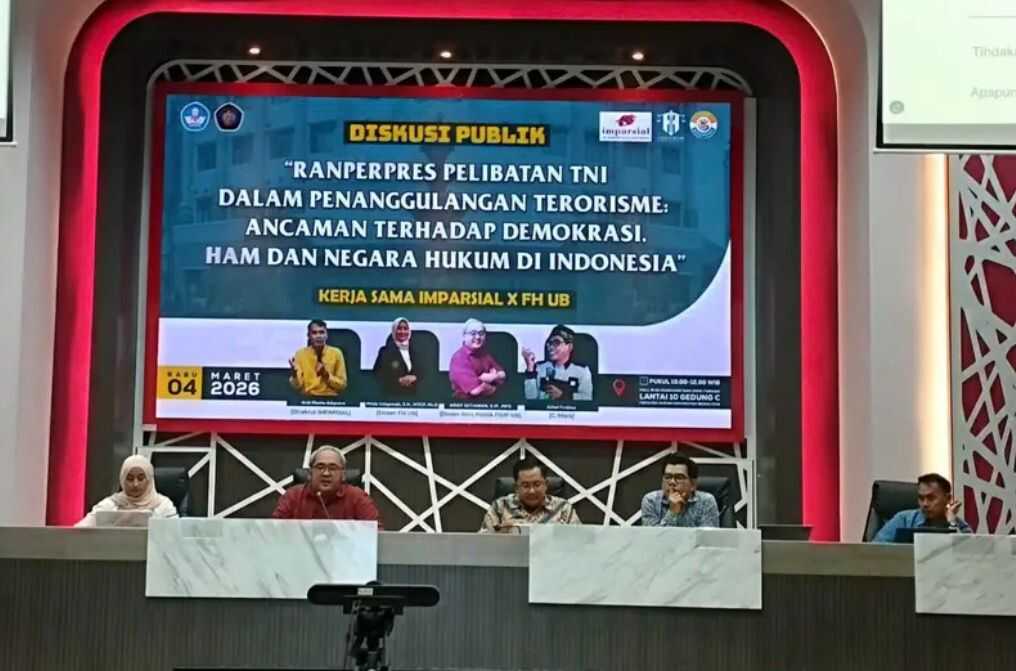
The public discussion titled RanPerpres Pelibatan TNI Dalam Penanggulangan Terorisme: Ancaman terhadap Demokrasi, HAM, dan Negara Hukum in Indonesia, organised by the Faculty of Law of Universitas Brawijaya together with Imparsial, on Wednesday 4 March, highlighted that some view regulation as potentially broadening the army’s role in domestic affairs, creating overlaps of authority and raising human rights concerns.
The forum concluded that involving the TNI in counter-terrorism is a complex issue involving legal, national security, and democratic dimensions.
It was stated that while legally the involvement is possible, its implementation must be regulated carefully to avoid inter-agency jurisdiction conflicts and human rights violations.
Hence, participants and speakers agreed that clear regulation and strong oversight mechanisms are essential to ensure the policy operates effectively and in accordance with the rule of law.
The discussion featured academics and civil society figures, namely Imparsial Director Ardi Manto Adiputra, Deputy Dean for Academic Affairs of FH UB Milda Istiqomah, and political science lecturer Arief Setiawan.
In her presentation, Milda emphasised that legally the involvement of the TNI in counter-terrorism is already regulated under Law No. 5 of 2018 on the Eradication of Terrorist Acts. However, she added, the problem arises when the draft PerPres seeks to regulate the military’s role more precisely across various stages of counter-terrorism.
‘Under the Anti-Terrorism Law there is already a provision regulating the involvement of the TNI in military operations other than war. However, this draft PerPres regulates in more detail down to the prevention and enforcement stages,’ she said.
According to Milda, this could lead to overlap with institutions that have long had the primary mandate in counter-terrorism, such as BNPT and Densus 88.
‘We fear that if the TNI is involved broadly, a cross-over of authority with these institutions will occur,’ she said.
She stressed that military involvement should be a last resort in extraordinary situations when law enforcement officers are no longer able to handle the threat.
‘If the threat to the country is very large and the police cannot tackle it alone, then the TNI can be involved. But its regulation should be at the legislative level, not merely in a PerPres,’ she added.
Meanwhile, Ardi Manto Adiputra judged that the process of drafting RanPerPres on TNI involvement in counter-terrorism has not shown adequate transparency. The lack of openness in the deliberation process risks hiding clauses that affect civil liberties.
‘We see the RanPerPres drafting process as not transparent and not sufficiently accountable. Closed processes often conceal clauses capable of harming civilians,’ he said.
Ardi also highlighted several provisions that are too broad and potentially grant extensive powers to the military.
One area of concern is the definition of threats to the nation’s ideology, which is deemed to be very broad and could give room for subjective interpretation of who is deemed to threaten the state ideology.
Ardi warned that a military approach to counter-terrorism also risks accountability problems in law enforcement. ‘If a military approach is used, assurances of civil rights will be increasingly undermined,’ he said.
The public discussion reaffirmed that counter-terrorism is indeed a vital requirement for maintaining state stability. However, security policies must not undermine democracy and human rights.
From an academic perspective, the debate over RanPerpres on TNI involvement in counter-terrorism shows that national security issues always sit at the intersection between threat management effectiveness and commitment to the rule of law.
Muktiono, Deputy Dean for Student Affairs, Alumni, and Student Entrepreneurship at FH UB, explained that the forum aims to ensure that any security policy remains within constitutional boundaries.
‘The event seeks to ensure that when there is a plan for a regulation related to TNI involvement in counter-terrorism, the policy upholds the rule of law, democracy, human rights, and civilian supremacy,’ he said.
He added that the academic findings from this forum are intended to inform the government and legislators to approach this issue cautiously.’