
Data-Driven Environmental Management Key to Industrial Estate Competitiveness
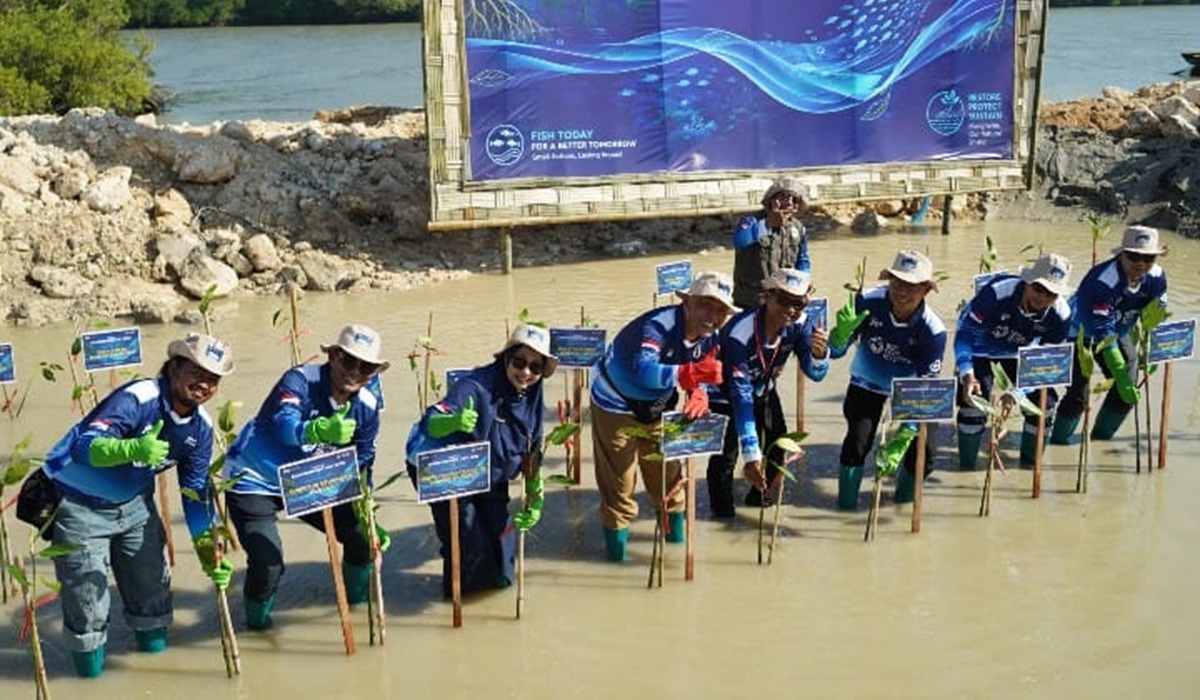
Amid rising industrial investment and demands for sustainable development practices, environmental management has become a crucial factor in determining the competitiveness of industrial estates. Modern industrial zones can no longer rely solely on complete infrastructure and utilities; they are also required to establish data-based environmental governance, supported by long-term monitoring and close collaboration between the government, academia, the business world, and the community.
This view emerged during a series of commemorations for World Environment Day 2026, organised by PT Berkah Kawasan Manyar Sejahtera (BKMS), the manager of the Java Integrated Industrial and Ports Estate (JIIPE) and the Gresik Special Economic Zone (SEZ). The forum served as a platform for synergy between the Gresik Regency Government, academics, estate tenants, and coastal communities.
The Deputy Regent of Gresik, Asluchul Alif, emphasised that this commemoration must serve as a momentum for real action rather than mere ceremony. “Collaboration is needed with industry, coastal communities, and all stakeholders. We appreciate the synergy that has been built, including social security protection for fishermen and the rehabilitation of coastal areas through mangrove planting,” he stated.
Professor Eddy Setiadi Soedjono, a Professor of Environment at the Faculty of Science and Technology, Universitas Airlangga, highlighted the importance of objectivity in assessing environmental conditions. According to him, the quality of waters and coastal ecosystems is influenced by many interacting factors, meaning they cannot be assessed based on a single parameter or a single observation alone.
“Long-term monitoring, periodic data, and multidisciplinary studies are required before drawing conclusions regarding the environmental condition of an area,” explained Prof. Eddy. This data-driven approach serves as the foundation to ensure that every environmental management policy is measurable and sustainable.
In line with this, the Head of the Gresik Regency Environmental Office, Sri Subaidah, appreciated BKMS’s steps in taking real action on the ground, such as planting thousands of mangrove trees in the Kalimireng area as an effort to mitigate abrasion and adapt to climate change.
As a form of commitment to the ecosystem and the welfare of the surrounding community, JIIPE conducted a series of rehabilitation actions during this year’s commemoration. This included the distribution of ecosystem assistance in the Kalimireng area.
The Head of the Gresik Regency Marine and Fisheries Office, Arief Witjaksono, expressed hope that the dispersal of seeds would allow fishermen to avoid venturing too far into the sea due to increased catch availability around the area. Support also came from the Chairman of the Gresik Regency KTNA, Hamzah Takim, and community leader Isharul, who viewed this step as highly positive for the sustainability of fishing grounds.
In addition to ecosystem rehabilitation, JIIPE continues to strengthen environmental infrastructure in accordance with Environmental, Social, and Governance (ESG) principles. Currently, JIIPE operates a Reduce, Reuse, and Recycle (TPS3R) waste processing facility.
The Director of PT BKMS, Bambang Soetiono, revealed that the company is preparing to develop this facility into an Integrated Waste Processing Site (TPST). This step aims to increase waste management capacity independently, integrally, and sustainably as operational activities within the estate increase.
“In the future, the competitiveness of industrial estates will not only be determined by infrastructure and investment, but also by the credibility of their environmental governance. We continue to build multi-stakeholder collaboration as part of a strategy for competitive and responsible regional development,” concluded Bambang.