
Danantara to Invest Rp16 Trillion in Low-Income Housing Programme on Lippo Land
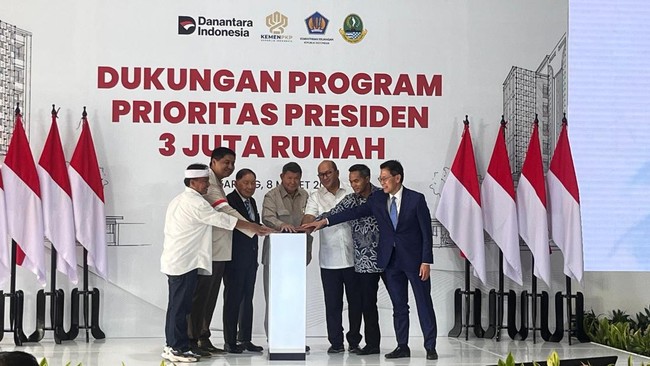
Jakarta – The Investment Management Board of Daya Anagata Nusantara (BPI Danantara) will allocate an initial fund of approximately Rp14 to Rp16 trillion for President Prabowo’s flagship three-million-home programme, which will be constructed on land donated by Lippo Group.
Rosan Roeslani, Chief Executive Officer of Danantara, stated that vertical housing for low-income households (MBR) will comprise 140,000 units. The first phase is planned to include 18 towers of 32 storeys each on a 12.8-hectare site.
“Based on calculations, with 32 storeys the figure is approximately between Rp14 and Rp16 trillion,” Roeslani said in Cikarang on Tuesday (10 March 2026).
Roeslani noted that Danantara will provide support through state-owned enterprises across construction and banking sectors. He expressed optimism about strong interest in the low-income housing programme.
“From a financing perspective, we will provide support because this is a very sound project, and given market demand and supply dynamics, there is significant interest,” he said.
Roeslani added that Danantara will fully support the programme by engaging private sector partners to meet Indonesia’s housing needs.
“We will provide full support, and we have state-owned enterprises that can collaborate on this project, working alongside other private companies. That is Danantara’s role in this initiative,” he stated.
Previously, Minister of Cooperative and Small Business Maruarar Sirait stated that Lippo Group has donated approximately 30 hectares of land in the Meikarta area, Cikarang, West Java. This represents a public-private partnership effort to address the housing shortage for Indonesian communities.
“Thirty hectares is extraordinary. Based on Danantara team calculations, this generates approximately 140,000 units. If each housing plot requires 1,200 hectares,” Sirait said in the Cikarang area on Sunday (8 March).
Sirait noted that the total project value is approximately Rp4.5 to Rp6 trillion. “Land is donated for 30 hectares. In this area, land is valued at Rp15-20 million per square metre; at Rp15 million that equals Rp4.5 trillion. At Rp20 million it equals Rp6 trillion,” he explained.
Financing for the low-income housing programme will be provided through APBN subsidies and banking institutions ranging from state-owned banks to private banks, with mortgage tenors extended to 30 years. “We have extended mortgage repayment terms for Indonesian citizens to 30 years to ensure manageable instalments,” Sirait said.
Rosan Roeslani noted that this housing development marks a new chapter because a single project will produce 140,000 units. This will create significant economic impact as the housing and property sector has a substantial multiplier effect on national economic growth.
“When you consider it, the figures are substantial. The multiplier effect will be extraordinary in terms of job creation, community empowerment, economic improvement, and driving the wheels of the economy,” he explained.
“Economic growth will not only be felt in this region of West Java, but across all of Indonesia. The impact will be felt not just by us, but by 140,000 families and all of Indonesia’s citizens,” he added.
Hashim Djojohadikusumo, Chair of the Housing Task Force, noted that the housing programme’s impact will be substantial as it involves more than 180 sectors of the economy related to property, construction, and housing businesses.
“It turns out the housing industry has a multiplier effect that can create extraordinary economic impact. The impact ranges from 1.5 to 5 times, with some suggesting 2 times,” he said.
“140,000 apartment units will require furniture. Each apartment needs beds – one couple and two children means 3-4 beds. But apartments also need tables, wardrobes, and other furnishings. Each apartment needs one television. When you calculate it, the economic impact is extraordinary,” he concluded.