
Danantara and Waste: A New Solution or Mere Rhetoric?
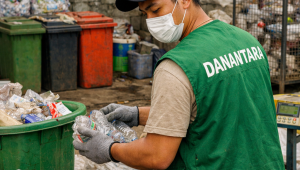
INDOPOLITIKA – The discourse on Danantara entering the waste management sector opens a new chapter in how the state views environmental issues. Hitherto, waste has been regarded as a burden, a social cost borne by local governments, rather than an economic potential that can be managed strategically.
Danantara’s entry, as an entity focused on asset management and investment, marks a change in perspective: waste is beginning to be seen as an asset, not merely as waste.
This step, if implemented seriously, actually has a strong logical foundation. Indonesia produces tens of millions of tonnes of waste each year, with a large portion still recyclable or convertible into energy. In the framework of the modern economy, this is a “dormant resource” that has not been optimally utilised thus far. This is where Danantara has the potential to enter: building an industrial ecosystem from upstream to downstream, starting from collection, sorting, recycling, to processing into energy.
However, the question is not about potential, but about execution. Waste management is not merely an infrastructure project or ordinary business investment. It touches on societal behaviour, inter-agency coordination, and governance that has long been known to be complex and often unsynchronised. If Danantara only enters as an investor without being able to integrate the system from upstream, what will happen is merely a repetition of the old patterns on a larger scale.
On the other hand, Danantara’s presence could be a momentum to push for structural changes that have been stalled thus far. With its capital strength and networks, Danantara has the potential to build a more modern waste processing industry, from large-scale recycling facilities to waste-based power plants. If linked to the circular economy concept, this step could transform Indonesia’s waste management from a disposal system into a value-added system.
But there remains a critical note. Waste management must not be driven solely by profit logic. If the orientation is only on profit, there is a risk that environmental and social aspects will be marginalised. Waste is not merely a commodity; it relates to public health, environmental quality, and social justice. Therefore, state involvement through Danantara must still maintain a balance between economic efficiency and ecological responsibility.
Furthermore, the success of this step still depends on one thing that cannot be bought with investment: changes in societal behaviour. Without the habit of sorting waste at the source, without collective awareness to reduce excessive consumption, even the most advanced system will be overwhelmed. Danantara can build factories, but it cannot single-handedly change the habits of millions of people.
In the end, Danantara’s entry into the waste management sector is both an opportunity and a test. An opportunity to prove that waste can be part of the future economy, and a test of whether Indonesia can break free from the old patterns that have only shifted problems without truly solving them. If successful, this could be a turning point. If it fails, it will merely be another large project that sinks amid the ever-growing mountains of waste.