
Cutting Through Rice Fields on Mount Merapi's Slope: Prambanan-Purwomartani Toll Road Makes Mudik Journeys Faster
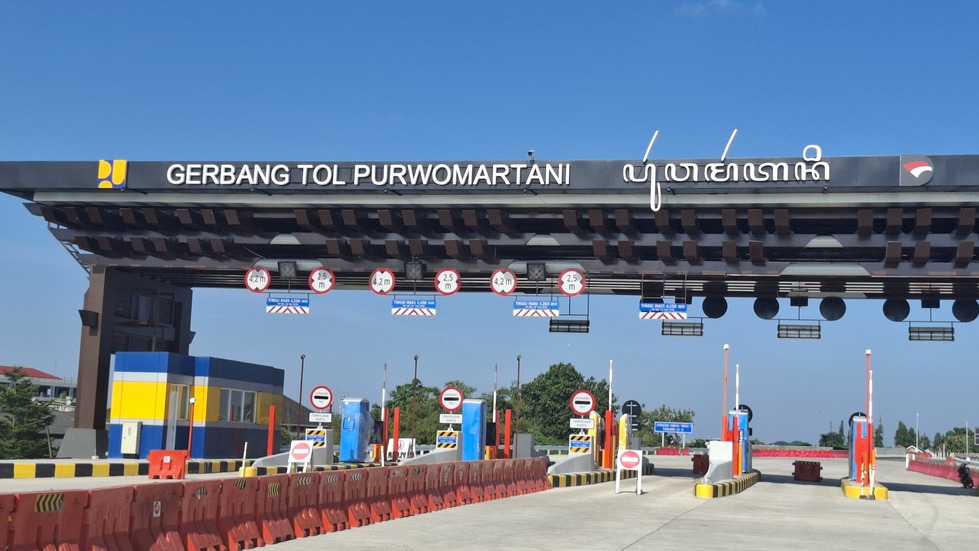
Cutting through rice fields on the slopes of Mount Merapi in the eastern region of Special Region of Yogyakarta (DI Yogyakarta), the Prambanan-Purwomartani toll road has emerged as a new route accelerating travel for Eid mudik travellers. The 11.5-kilometre (km) stretch, part of the Yogyakarta-Solo Toll Road project, will be opened for functional operations during a 14-day period from Monday 16 March to Sunday 29 March. During this period, the toll road will operate daily from 06:00 to 18:00 Western Indonesia Time (WIB).
Indonesia’s media outlets travelled the toll road section on Friday 11 March morning with officials from the Directorate General of Highways under the Ministry of Public Works. The toll road conditions still appeared to be in completion stages. Several traffic signs, safety barriers, and road markings were still using temporary facilities whilst awaiting installation of permanent fixtures. Technically, the toll road can be traversed by vehicles. The road surface feels quite smooth and can be traversed properly.
Ahmad Izzi, Principal Expert in General Affairs of Public Relations and Administration of the Toll Road Operating Company (BUJT) Jasa Marga Jogja-Solo, stated that the presence of this functional route is expected to significantly reduce travel time for mudik travellers.
“Perhaps half the journey time—let’s say from Prambanan to Purwomartani usually takes 30 minutes, via this route it could be 15 minutes,” he said at the Prambanan-Purwomartani Toll Road area, DI Yogyakarta, on Friday 13 March.
He explained that journeys from Prambanan to Purwomartani via the national road have often been hindered by congestion at several points. This time saving becomes a particular advantage for mudik travellers wanting to enter the Yogyakarta region or continue their journey to other neighbouring areas. Beyond accelerating travel, this functional toll route is also expected to help distribute vehicle flow so that they do not all accumulate on national roads and urban streets.
Izzi stated that the Purwomartani Toll Gate will be operated functionally by PT Jasa Marga Yogyakarta–Solo during the 2026 Eid holiday period.
“Functionally operational means this toll road is already usable and fit for travel,” he added.
Izzi explained that the Yogyakarta-Solo Toll Road overall has a length of 96.57 km and forms part of the Trans Java Toll Network connecting Solo with Yogyakarta. Currently, road users coming from Solo to Prambanan can already traverse the toll road normally.
“The toll road is already operating normally, meaning it is already tariffed,” Izzi said.
Meanwhile, the Prambanan to Purwomartani segment will be opened for functional operations without tariffs during the Eid mudik period. “And this is also specifically for Class 1 vehicles, small vehicles, non-buses,” he said.
The operation of this functional toll segment is also situational in nature and can be adjusted according to field conditions. Izzi stated that operational decisions will also follow police considerations.
“So all of this also depends on field conditions later,” he said.
This functional toll is also only designated for vehicles leaving Yogyakarta towards the Solo, Jakarta, and Surabaya directions. The toll has not yet been opened for vehicles entering Jogja because conditions at the at-grade intersection on the national road are still incomplete. This is because the required land has not been entirely freed up.
“The police assess that if the opening for inbound Jogja traffic is forced through, conditions at that intersection would actually risk causing congestion and create difficulties for many parties,” he explained.
His team estimates that the Purwomartani Toll Gate capacity during this year’s Eid mudik period will increase to serve up to 17,000 vehicles per day.
“That is our projection, an increase compared to last year’s Eid which was around 14,000 vehicles,” Izzi said.
The operation of this functional route will also be equipped with personnel at several points to ensure smooth vehicle flow.
Despite being passable, Jasa Marga reminds road users to remain cautious as the toll segment is still in the refinement stage.
“Currently it is undergoing refinement work, particularly regarding facilities or supporting infrastructure. So mudik travellers should still be careful when passing through. Maximum speed is 40 km per hour,” he stressed.
On the same occasion, Head of Preservation Field II at the Great Hall for National Road Implementation (BBPJN) Central Java-DIY, Directorate General of Highways Aris Rudianto Nugroho stated that his team has prepared various measures to support smooth Eid mudik flow, particularly in the Special Region of Yogyakarta.
One effort undertaken is placing an emergency post on the Janti-Prambanan stretch. The post is equipped with personnel on duty and various emergency materials to maintain road integrity should quick intervention be needed at any time.
Additionally, to anticipate potential impacts from extreme weather, the Directorate General of Highways also deployed an Equipment and Supply Unit (UPP) at Tanjung Tirta. At that location, various heavy equipment such as excavators, wheel loaders, and dump trucks are available for use should disasters or disruptions occur on national roads.
“Overall there are four UPP locations deployed, namely in Pekalongan, Yogyakarta, Semarang, and Buntu,” he explained.
All units operate under a 24-hour standby system and are equipped with on-duty personnel who can be contacted at any time should emergencies occur. At the prepared posts, not only personnel from the Commitment-Making Official (PPK) team and work units are stationed, but also service providers, both contractors and consultants, are involved to jointly support preparedness during the Eid period. Coordination is also conducted with the Serayu Opak Great River Regional Office, particularly in the Jombor Intersection area which has a flood-prone point at the Kentungan underpass. Personnel and pump equipment are stationed at that location as a precautionary measure should flooding occur.