
Currencies of Gulf States Weaken Together Against US Dollar; Which Has Suffered Most?
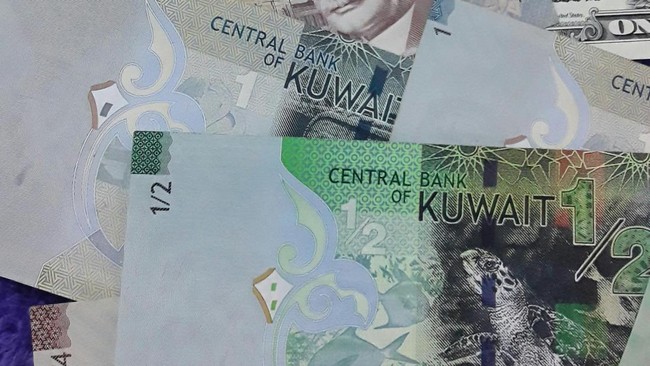
Jakarta, CNBC Indonesia - The majority of currencies from Gulf states have weakened against the US dollar following the Middle East conflict between the US-Israel coalition and Iran entering its second week. However, the depreciation recorded thus far remains relatively modest.
Gulf state countries include Bahrain, Kuwait, Oman, Qatar, Saudi Arabia, and the United Arab Emirates. The region is known for its close ties to global energy markets, whilst some of its currencies are traditionally strong against the US dollar.
As of this morning’s trading on Tuesday, 17 March 2026 at 15:00 WIB, only one currency in the region has strengthened compared to its position before the conflict erupted.
For reference, the conflict began on Saturday, 28 February 2026, allowing market reactions to be reflected in trading on Monday, 2 March 2026. Consequently, the comparison benchmark used is the final trading day before the war, Friday, 27 February 2026.
Based on Refinitiv data compiled by CNBC Indonesia, the Kuwaiti dinar recorded the deepest depreciation at 0.43%, declining from KWD 0.30545/USD to KWD 0.30675/USD. The Qatari riyal subsequently weakened 0.15% from QAR 3.6445/USD to QAR 3.65/USD.
The Bahraini dinar also declined 0.11% from BHD 0.3769/USD to BHD 0.3773/USD. Although weakening, the Kuwaiti dinar and Bahraini dinar are traditionally known as currencies with nominal values higher than the US dollar. This is reflected in their exchange rates remaining below 1 against the US dollar, meaning 1 dinar is worth more than USD 1.
Meanwhile, the Saudi riyal weakened 0.05% from SAR 3.7508/USD to SAR 3.7526/USD, and the Omani rial declined slightly by 0.02% from OMR 0.38486/USD to OMR 0.38495/USD.
Amid the general weakening trend, the UAE dirham emerged as the sole currency to strengthen, albeit marginally, by 0.03% from AED 3.6729/USD to AED 3.6719/USD.
This situation indicates that the conflict has not yet triggered major changes in Gulf state currencies. Movements indeed trend towards weakening, but the scale remains very limited and does not yet indicate extreme pressure.
This suggests that market participants have not engaged in large-scale selling of Gulf currencies thus far, despite the US dollar strengthening significantly. During the same period, the US Dollar Index (DXY), which measures the strength of the greenback against major global currencies, surged 3.85% to a level of 99.923 from its pre-conflict position of 96.217. The DXY even briefly breached the 100 level.