
Crisis Emerges After Energy Emergency, Purbaya Provides Evidence Indonesia Unaffected
Jakarta, CNBC Indonesia - Several countries are facing the risk of crisis after being confronted with energy emergency issues. The problem arose after supplies of oil, gas, and fertiliser were disrupted due to the conflict in the Middle East between Iran and the United States and Israel.
For Indonesia, the risk of crisis remains very distant. Finance Minister Purbaya Yudhi Sadewa has presented the evidence.
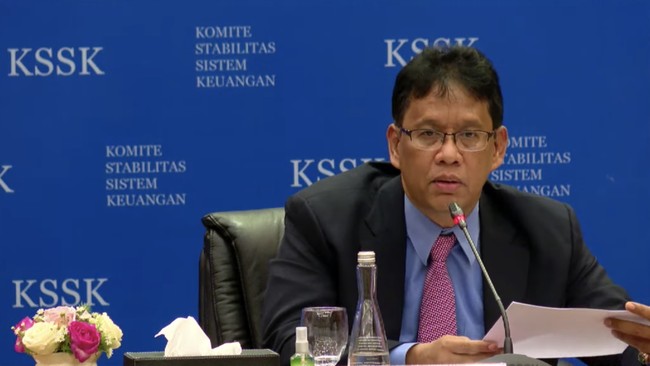
“Who says crisis? You just had Eid last month, right? There were traffic jams everywhere, right? People were shopping everywhere. That means purchasing power is there, and if we look at the indicators, we are indeed moving faster,” said Purbaya at his office in Jakarta on Friday (27/3/2026).
Purbaya emphasised that Indonesia is far from facing the current global crisis risks because the government’s state budget is still very strong in cushioning the spillover effects of economic pressures due to the skyrocketing prices of energy commodities.
When global crude oil prices surged to breach the US$100 per barrel level due to the impact of war on the Strait of Hormuz, the government, he said, is still able to keep prices under control domestically through subsidies deployed in the state budget.
“Even though globally it’s like that. So we are quite able to mitigate the high global oil prices. Because we absorb it in our state budget,” Purbaya stressed.
Therefore, Purbaya emphasised that with the facts on the ground showing that public economic activities are still running, Indonesia is far from the potential crisis being faced by other countries. Although global crude oil prices have exceeded the 2026 state budget macro assumption of US$70 per barrel.
“So we are far from crisis, we are even expanding continuously. If I say crystal ball, our leading economic index is not wrong, until 2029-2030 we will expand continuously. So we are far from crisis,” said Purbaya.
“Recession hasn’t even happened, slowdown hasn’t even happened. We are experiencing acceleration and I will keep it, we will keep it together going forward,” he stated.
For information, several of Indonesia’s neighbouring countries in Southeast Asia have issued energy emergency policies. This situation is an impact of the US-Israel and Iran War that has been ongoing for one month, causing world oil supplies to be held up in the Middle East.
The Strait of Hormuz, which is the shipping route for about 20% of the world’s oil, remains closed and only slightly open for a number of countries considered not enemies by Iran.
Oil prices have also boiled over, breaching the US$100 per barrel level. As a result, fuel prices have also skyrocketed, forcing several countries to think hard to face the oil shortage that is already being felt.
Malaysia’s Prime Minister Anwar Ibrahim, in a special announcement on Thursday (26/3/2026), even said the government was forced to make temporary adjustments to the subsidised fuel oil (BBM) quota to maintain the country’s fiscal resilience.
This step was taken after the fuel subsidy burden surged dramatically in a short time. Anwar explained that the subsidy value increased sharply from the original 700 million ringgit (Rp2.96 trillion) to 3.2 billion ringgit (Rp13.55 trillion) due to the surge in global crude oil prices.
“Insyaallah, I will outline the country’s strategic steps to increase preparedness in facing the global energy crisis arising from the conflict in West Asia, with a firm, structured approach focused on the interests of the people and national resilience,” said Anwar.
In the latest policy that will take effect on 1 April, the Malaysian government has decided to adjust the monthly quota for the Budi Madani RON95 (Budi95) subsidy programme. The quota, previously 300 litres per month, is now cut to 200 litres per month for private vehicle users.
The government explained that this step is a form of fiscal discipline needed so that the state budget does not collapse. Although there is a quota cut, Anwar assured that the retail selling price of RON95 petrol will be maintained at the subsidised level to protect the broad public’s purchasing power.
Philippines President Ferdinand R. Marcos Jr. has also officially announced the national energy emergency status due to the threat of fuel supply disruptions from the escalation of conflict in the Middle East region.
The declaration was set through Executive Order (EO) Number 110 signed on Tuesday (24/3/2026), considering the Philippines’ position as a country highly dependent on imports of petroleum products.
Citing the Philippines News Agency (PNA), the Philippine government identified that the heating up of the geopolitical situation in the Middle East, especially the potential closure of the strategic Strait of Hormuz route, could trigger disruptions in global oil production and transportation.
This condition is seen as having great potential to cause a domestic fuel supply crisis as well as trigger price volatility that threatens the country’s economic stability.
“As a net importer of petroleum products, the Philippines remains highly dependent on external fuel supply sources and is therefore vulnerable to disruptions in global oil production and transportation,” reads the Executive Order Number 110 document citing PNA, Tuesday (24/3/2026).