
Criminalisation of Creative Workers: PKB Legislator Urges Urgent Approval of GIG Workers Bill
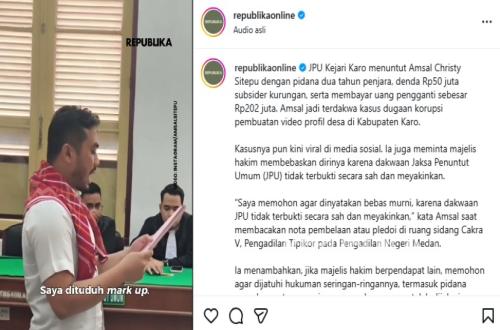
A legal case ensnaring a videographer from North Sumatra, Amsal Sitepu, has sparked deep concern among parliamentarians. The creative worker has been hauled before the court by the District Prosecutor’s Office on corruption charges in a village profile production project, where production items such as creative idea development and dubbing were deemed state losses (mark-up).
The initiator of the GIG Workers Bill, Syaiful Huda, considers this case a loud alarm regarding the fragility of legal protections for creative workers in Indonesia. This PKB legislator is urging parliament and the government to immediately discuss and approve the GIG Workers Bill in Indonesia.
“We view the dragging of Amsal Sitepu to court while carrying out his profession as an indicator of the weak position of creative workers in Indonesia’s employment system. Therefore, we urge all parties to jointly push for the discussion and approval of the GIG Workers Bill in Indonesia,” said Syaiful Huda in his statement on Tuesday (31/3/2026).
In the indictment letter from the Public Prosecutor (JPU), the creative worker is accused of inflating prices on items such as creative ideas, the dubbing process, and the purchase of a microphone. The JPU argues that creative ideas and dubbing should be valued at Rp 0 (free), whereas in the submitted proposal, each of these items was priced at Rp 1 million.
“The JPU’s perspective that considers creative ideas to be free reflects how weak the appreciation and bargaining position of creative workers are in our legal system,” said Syaiful Huda.
Huda revealed that Amsal Sitepu’s vulnerable position as a videographer is also experienced by other GIG workers such as film crews, stage crews, content creators, and even online transport drivers. Yet, in recent years, they have been the backbone of the national economy.
“Without a clear legal umbrella, the sweat and ideas of these creative workers can easily be criminalised or exploited because the standardisation of their work value is not recognised by the state,” he added.
The existence of the GIG Workers Act, continued Huda, will ensure that the currently unclear status of GIG workers will be equivalent to that of other formal workers under the Manpower Act. Nevertheless, the clarity of this worker status does not eliminate the element of work flexibility that is the essence of the GIG economy ecosystem.
“So, this GIG Bill will ensure a new status for GIG workers who have not been officially recognised by the state so far. However, the GIG ecosystem must be regulated specifically in its own act, not together in the Manpower Act, so as not to eliminate the flexibility element that is the essence in the GIG Act,” he explained.
In addition to state recognition guarantees, said Huda, his initiated GIG Workers Bill also guarantees clear work contracts, net income assurances, work hour regulations, social protections, and algorithm transparency. According to him, the state must not let creative young people continue in the dilemma of uncertain protection guarantees for their profession for too long.
“The GIG Workers Bill must be approved immediately so that there is a legal umbrella protecting the rights and dignity of creative workers throughout Indonesia,” said Huda.