
Creature Longer Than a Commuter Train Emerges in Chinese Construction Site
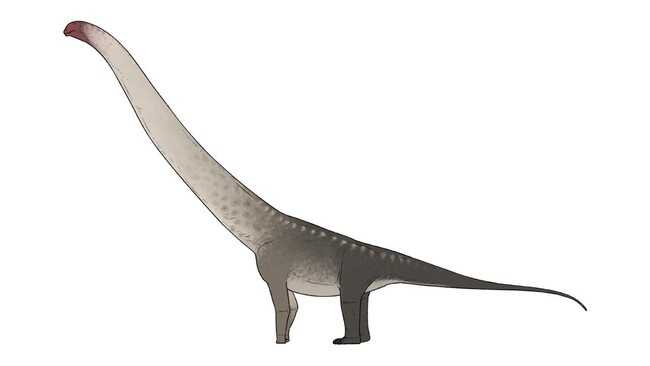
Scientists have reported the discovery of a giant sauropod dinosaur named Tongnanlong zhimingi, estimated to have been up to 92 feet or about 28 meters long. The species lived during the Late Jurassic period and was found in southwestern China.
The Tongnanlong fossil was found in the Tongnan District, Chongqing, which is part of the Sichuan Basin. The rock layer from which the fossil originated is estimated to be about 147 million years old.
The specimen that forms the basis of the naming (holotype) consists of three dorsal vertebrae, six tail vertebrae, a shoulder girdle, and part of the hind limb.
Quoting Earth, the bones were first found at a construction site before being studied in detail by experts.
Analysis shows that Tongnanlong belongs to the Mamenchisauridae family, a group of dinosaurs with very long necks. The structure of its bones has internal air cavities that help reduce body weight while strengthening the skeleton.
The estimated body size was carried out by comparing the bones found, especially the scapula and fibula, with close relatives that have more complete skeletons. The results show a body length of between 75 and 92 feet (28 meters). For comparison, the length of a commuter train carriage in Indonesia is about 20 meters.
“This new specimen enriches the diversity of Mamenchisauridae and provides additional information for understanding the evolution and diversity of eusauropod dinosaurs,” wrote Xuefang Wei from the Chengdu Center of China Geological Survey.
Previously, some scientists argued that East Asia during the Jurassic period was isolated from other continents. However, the discovery of close relatives of mamenchisaurids in Africa, such as Wamweracaudia keranjei, shows that this group has a global distribution.
“Mamenchisauridae were globally distributed in the Late Jurassic and not an endemic fauna as previously thought to be limited to East Asia,” wrote Wei.
This discovery reinforces the suspicion that giant long-necked dinosaurs were more widespread than previously thought.
The Tongnanlong fossil comes from the Suining Formation, which consists of mudstone and reddish-purple sandstone. The sedimentary structure indicates a lakeside environment with a relatively dry climate.
This environment likely provided abundant vegetation around water sources, while also allowing for rapid burial during floods.
The findings indicate that very large mamenchisaurids lived alongside smaller long-necked relatives.
This discovery also supports a broader biogeographic narrative by aligning East Asian forms with their distant relatives in the west, thus weakening the narrative of simple isolation.
Future research will test whether the size of Tongnanlong reflects local conditions, broader climate change, or evolutionary trends at the lineage level. Additional findings of bones from the skull and neck will clarify the picture.