
Creative Economy Ministry Strengthens Institutional Role as Investment Surges
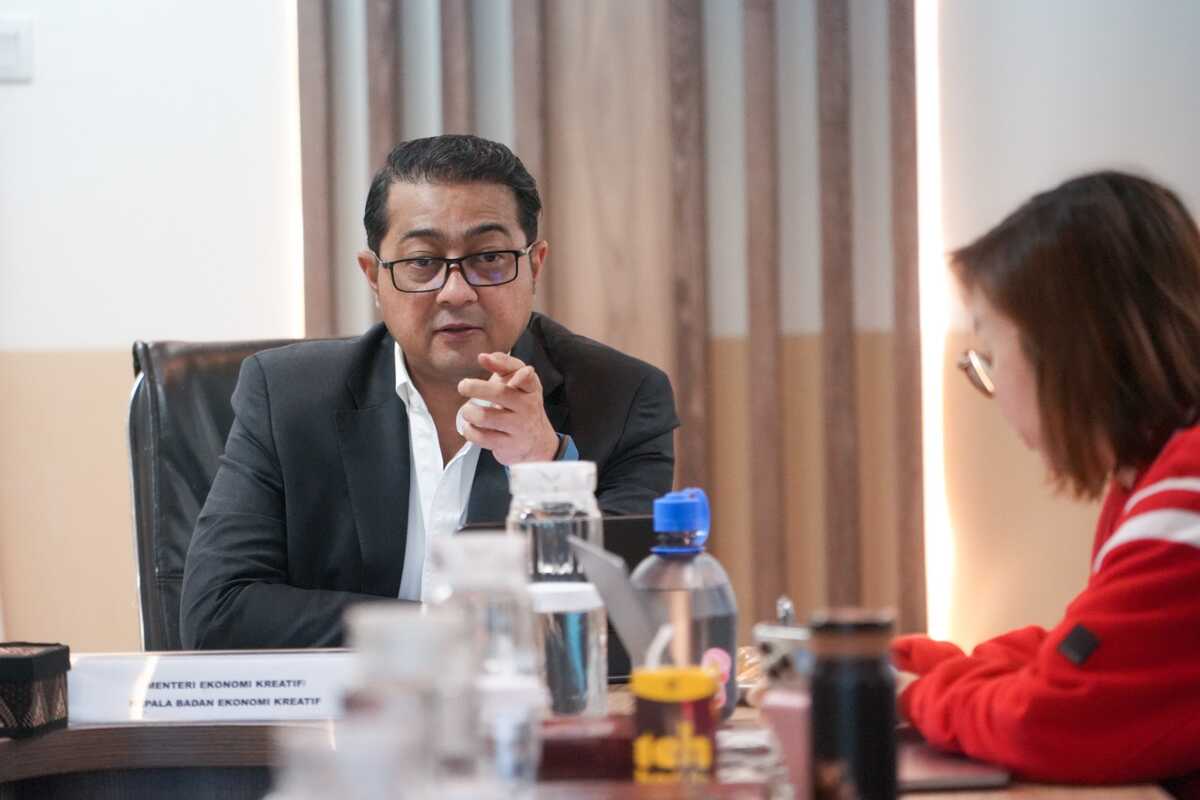
Jakarta — The Ministry of Creative Economy (Ekraf) held a leadership meeting at the Pesona Indonesia Film Building in Jakarta on Thursday, 5 June 2025, as a strategic step to strengthen its institutional role in driving growth in the national creative economy sector.
Creative Economy Minister Teuku Riefky Harsya emphasised the importance of strengthening the ministry’s role through the use of data as a basis for policy-making, as well as the curation of well-targeted programmes. He also highlighted the need for cross-sectoral synergy to address industry challenges, particularly through concrete follow-up on memoranda of understanding (MoUs) that have been agreed upon.
“MoUs are not merely ceremonial. They are the starting point for strengthening networks, especially in regions that already have creative economy institutional nomenclature. Currently, eight provinces have agencies with creative economy nomenclature, and 14 provinces are coordinating to strengthen creative economy institutions or establish dedicated creative economy agencies,” said the minister.
One of the positive impacts of the ministry’s establishment has been the increase in investment realisation in the creative economy sector. According to calculations by the Directorate of Data and Information at the Ministry of Investment/BKPM, using five Indonesian Standard Industrial Classification (KBLI) codes for the creative economy sector, investment realisation in 2024 reached Rp162.6 billion, a significant rise from Rp99.5 billion in the previous year. The highest increase occurred in the fourth quarter of 2024, with a value of Rp52.1 billion.
The 2024 creative economy investment realisation was calculated using five main KBLI codes: graphic design activities (visual communication design), design for film, video, animation and comics, digital game content design, other creative content design, and photography activities.
From 2025, the Ministry of Investment/BKPM has been working with the Ministry of Creative Economy using the 2020 KBLI reference, which covers 238 creative economy sector KBLI codes. In the first quarter of 2025, investment realisation from 69,152 projects that submitted capital investment activity reports (LKPM) reached Rp43.2 trillion — meaning progress on creative economy sector investment realisation in Q1 2025 had already reached 31.7 per cent of the annual target of Rp136.28 trillion.
The Creative Economy Minister affirmed that all of the ministry’s roles, programmes and activities must be directed towards making the creative economy a primary driver of national growth.
“Work with a collaborative spirit, a high sense of responsibility, and the courage to take leaps. The creative economy must become Indonesia’s new economic engine,” he said.
Also present at the meeting were Deputy Creative Economy Minister Irene Umar, Principal Secretary/Ministerial Secretary Dessy Ruhati, and several senior officials from the ministry.