
CORE: Productivity and Efficiency Key to Expanding Indonesia's Rice Exports
Jakarta — Rice export prices remain above USD 1,000 per tonne, while Thailand and Cambodia are in the USD 600s to USD 500s per tonne. This creates a substantial price gap, economists say.
Jakarta (ANTARA) — An economist from the Center of Reform on Economics (CORE) Indonesia says Indonesia’s prospects for expanding rice exports remain open, but require improvements in productivity and production efficiency to compete on the world market.
Executive Director of CORE Mohammad Faisal said future rice export plans need to be calculated more carefully, taking into account domestic production conditions and global market dynamics.
“If this (expanding rice exports) can be done, of course it’s good, but in my view the government needs to recalculate the export plan, because there are several factors to consider,” he told ANTARA in Jakarta on Saturday.
He explained that rice exports, in principle, can be undertaken when domestic supply is adequate or when self-sufficiency is achieved.
However Faisal argued that price competitiveness is one of the factors that needs attention because Indonesia faces competition from large exporting countries such as Thailand and Cambodia.
“Our rice export price is still above USD 1,000 per tonne, while Thailand and Cambodia are in the USD 600s and 500s per tonne. As a result, there is quite a wide price gap,” he said.
With these conditions, he said Indonesian rice exports would be hard to compete if conducted through a market mechanism that relies on price competition in the global market.
“Unless it is targeted, for example exported to meet the needs of Indonesian pilgrims alone. In this context, it would mean a special collaboration with the Government of Saudi Arabia,” he added.
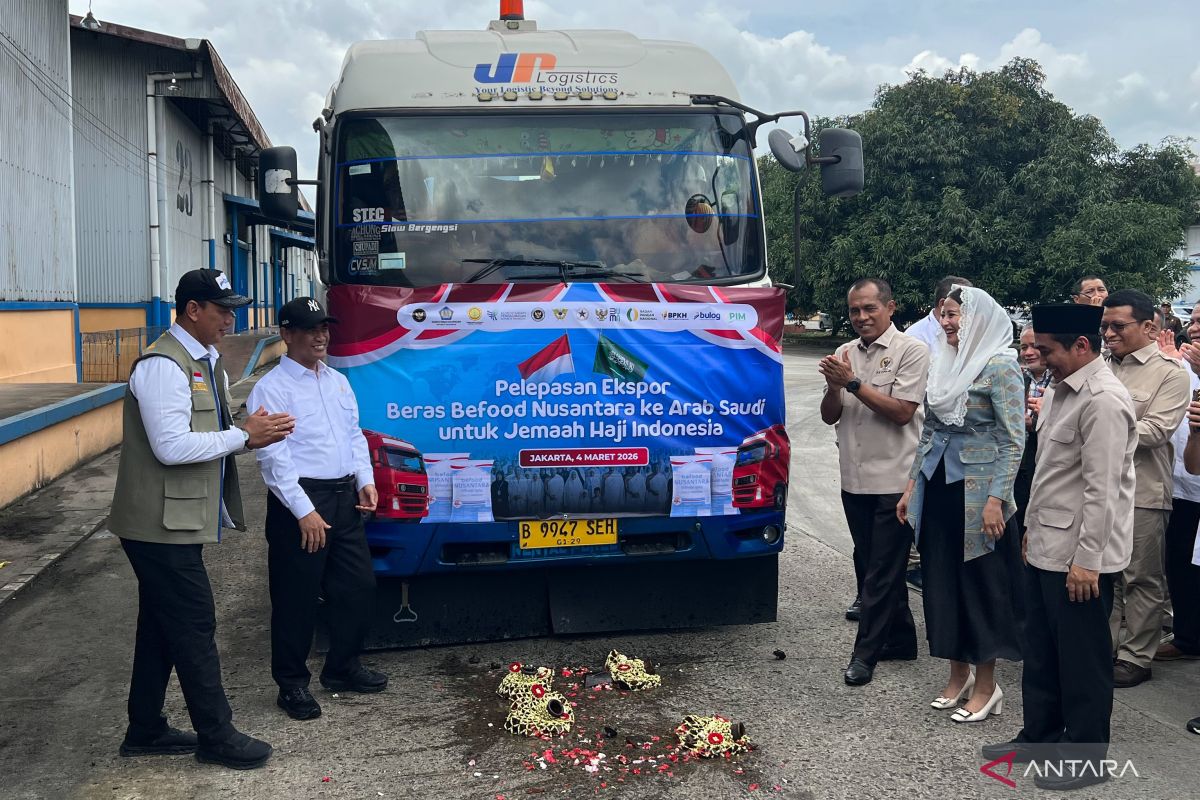
The government, through state distributor Perum Bulog, previously exported rice to meet the needs of Indonesian haj pilgrims in Saudi Arabia. The exports totalled around 2,280 tonnes and were shipped in two stages from 28 February 2026 as part of food logistics support for Indonesian pilgrims in the Holy Land.
The government also aims to develop Indonesia’s rice market in Saudi Arabia through modern retail networks after the haj rice exports.
CORE researcher Eliza Mardian assessed that Indonesia’s rice exports to Saudi Arabia could be positioned as a community-based captive market.
“In fact, exports of rice for haj pilgrims in Saudi Arabia are a captive market export based on diaspora or community, not purely commercial exports,” Eliza said.
She explained that demand for the rice is more influenced by taste and texture preferences among Indonesian pilgrims than price competitiveness in the global market.
“To become a major rice exporter like Thailand and Vietnam, we must meet structural prerequisites, including a stable production surplus,” she said.
To achieve this, she said, the agricultural sector must continue to raise production efficiency through modernisation and mechanisation to be price-competitive in the global market.
Additionally, product quality must be improved through food safety certification and the implementation of good cultivation practices to meet export-market standards.
According to data from the Central Statistics Agency (BPS), national rice production in 2025 stood at around 34.69 million tonnes, up about 13.29 percent from the previous year from around 60.21 million tonnes of dry-milled paddy with a harvested area of around 11.32 million hectares.