
Coordinating Minister for Food Drives Acceleration of National Salt Self-Sufficiency by 2027
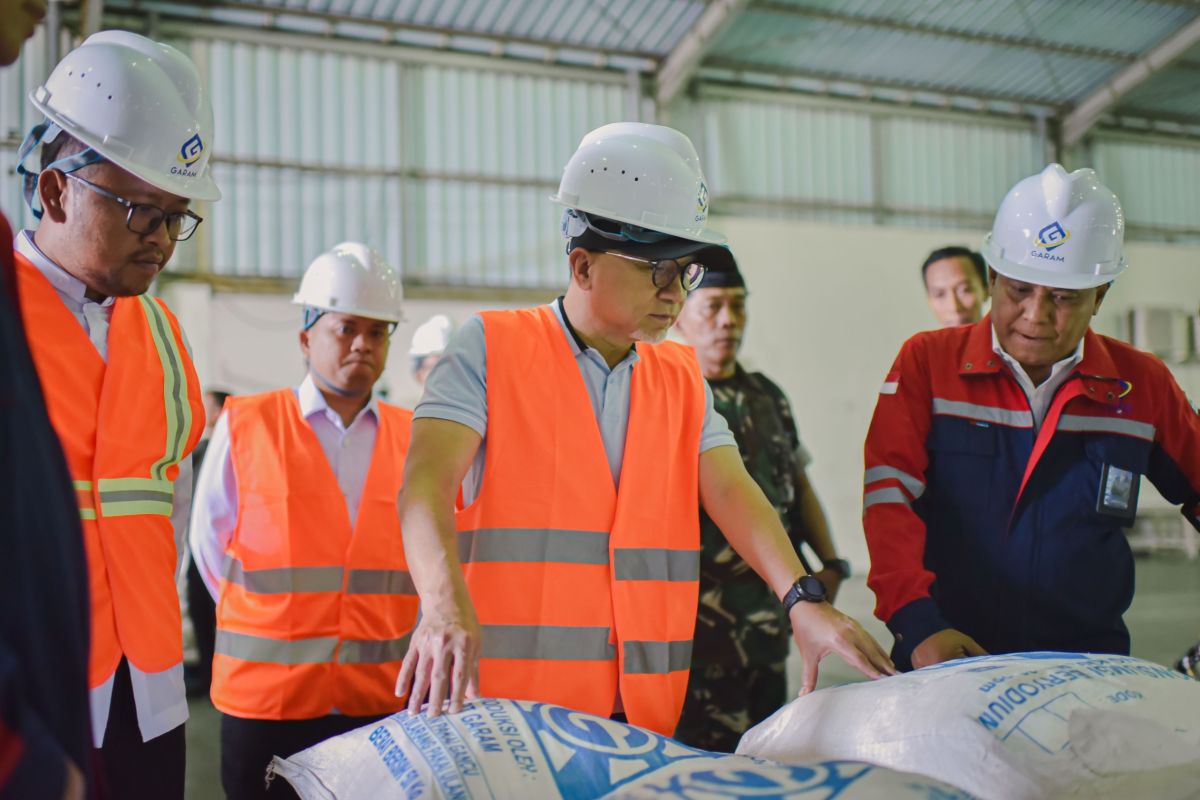
Coordinating Minister for Food Zulkifli Hasan (Zulhas) has urged the acceleration of Indonesia’s salt industry transformation towards achieving salt self-sufficiency by 2027. The Minister conveyed this message whilst visiting a PT Garam factory in Sampang District, East Java, as part of implementing Presidential Regulation No. 17 of 2025 on Accelerating National Salt Industry Development (P3N).
“My presence as Coordinating Minister for Food is to ensure the acceleration of new salt factory development and increased national production towards self-sufficiency by 2027,” said Zulhas according to a statement issued in Jakarta on Monday.
During his visit on Sunday (8 March), he emphasised the importance of transforming PT Garam to contribute further to regional economic development, particularly on the island of Madura.
Beyond land expansion, the government is also promoting production innovation through the application of mechanical vapour recompression (MVR) and seawater reverse osmosis (SWRO) technologies, which aid the purification of seawater to increase production efficiency and salt quality for industrial use.
These measures are expected to support gradual efforts to substitute salt imports.
Zulhas explained that the government is promoting the development and strengthening of salt production facilities in several regions, such as Rote in East Nusa Tenggara, Gresik in East Java, and other promising areas to increase national production capacity. Local governments have been asked to collaborate with salt farmers to prevent the conversion of salt farming land.
The government targets that by 2027, national salt requirements can be fully met from domestic production, so that harvests from salt farmers can be absorbed by industries requiring salt.
Based on data from the Central Statistics Agency (BPS), Indonesia’s national salt production in recent years has ranged around 1–2 million tonnes per year, whilst national requirements reach approximately 4.5–5 million tonnes, meaning a significant portion of national needs are still met through imports.
He explained that the majority of smallholder salt ponds still rely on natural evaporation from solar heat, so production is highly affected by weather conditions and climate anomalies.
“The majority of smallholder salt ponds still depend on evapotranspiration from solar heat. When the rainy season occurs or climate anomalies happen, production can be disrupted, making supply inconsistent,” stated Eliza.
Beyond production factors, the quality of domestic salt also remains a challenge, as sodium chloride (NaCl) content in portions of national salt production still falls below industry requirements.
According to her, the development of processing facilities at production centres such as Rote and Gresik is an important step to increase the value added of national salt.
“If modern production facilities such as washing plants and refineries are built in those regions, salt that was previously only suitable for household consumption can be upgraded to industrial-grade salt,” said Eliza.
She added that strengthening processing facilities is important so that domestic salt production can better meet industry standards.
“Therefore, financing schemes need to be developed, such as partnerships between government and the private sector,” she said.
She then emphasised the importance of supporting smallholder salt farmers to enable them to improve production quality through the application of technology, access to financing, and integration with processing industries.