
Cooking Oil Prices Rise Again to This Level, Traders Reveal the Cause
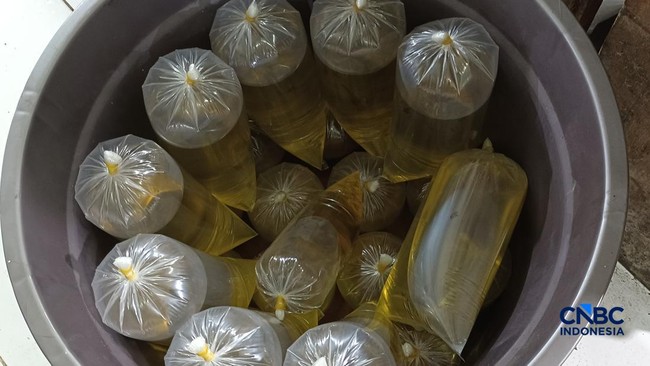
Jakarta, CNBC Indonesia - Cooking oil prices in traditional markets have been observed to creep upwards, prompting complaints from traders. This increase has occurred uniformly across various types, from premium packaging to bulk oil.
Based on CNBC Indonesia’s monitoring at Rumput Market in South Jakarta on Friday (24/4/2026), cooking oil prices were uniformly seen to have risen. The surge was evident in almost all brands sold by traders.
One trader, Deni, revealed that nearly all cooking oil products have experienced price increases.
“All cooking oil prices have risen. Tropical is Rp45,000 for a 2-litre size, previously only Rp41,000-42,000,” Deni told CNBC Indonesia when met at the location.
For the 1-litre packaging, he said, it is now sold for Rp23,000, up from Rp21,000 per litre previously. Meanwhile, second-brand cooking oil Rizki has also seen a sharp rise, to Rp20,000 per litre from Rp16,000 per litre previously.
Not only that, bulk cooking oil has also been pushed up. “Bulk oil is now Rp23,000 per kilo, previously Rp21,000 (per kg),” he said.
Deni stated that this increase was triggered by the rising price of packaging materials. “All cooking oil prices have risen, because plastic has become expensive, everything has gone up,” he continued.
The same was expressed by another grocery trader, Rosma. She said that cooking oil prices for various brands have risen simultaneously.
“Cooking oil Bimoli is Rp46,000 (2-litre packaging), Tropical Rp45,000 (2 litres). For one litre, there’s Bimoli Rp23,000 (per litre),” said Rosma.
When asked about price trends, she confirmed the same condition applies to all types of oil. “Yes, all have risen. Bulk oil has also risen, because buying plastic is already expensive, now it’s Rp23,000 per kg,” she revealed.
Nevertheless, both Deni and Rosma said that the supply of cooking oil in the market is abundant, with no shortages.
“The stock is plentiful,” said Rosma.
Latest Cooking Oil Price Movements
Based on data from the Essential Goods Market Monitoring System (SP2KP) of the Ministry of Trade (Kemendag), the national average price for premium cooking oil on Friday (24/4/2026) reached Rp21,889 per litre. This is up 0.11% from the previous day, which was recorded at Rp21,866 per litre on 23 April 2026.
On a weekly basis, this figure rose 0.84% compared to the previous week at Rp21,706 per litre.
Compared to a month ago, on Friday (27/3/2026), the premium cooking oil price was Rp21,297 per litre, representing a 2.78% increase.
On an annual basis, today’s premium cooking oil price compared to 24 April 2025 also rose by about 4.97% from the previous Rp20,853 per litre.
Meanwhile, the national average price for bulk cooking oil today is at Rp19,542 per litre, up 0.54% from the previous week at Rp19,437 per litre.
On a monthly basis, bulk cooking oil prices rose 2.66% from Rp19,036 per litre on 27 March 2026. Annually, bulk cooking oil prices increased 8.81%, from Rp17,960 per litre on 24 April 2025.
Cooking Oil Prices Rise, What Does the Trade Minister Say?
Previously, Trade Minister Budi Santoso emphasised that the surge in premium packaged cooking oil prices is not caused by supply shortages, but rather pressure from upstream factors, particularly plastic raw materials.
“If it’s premium cooking oil, especially in areas like Papua, it’s because of distribution. We have communicated with producers, who assured us that stock is available, no issues. So supply availability is there. One impact of the rise is the plastic price,” said Budi when met at the Coordinating Ministry for Food Office in Jakarta on Tuesday (21/4/2026).
He explained that high plastic prices are influenced by naphtha supply amid Middle East conflicts, impacting packaging production costs.
“We go back to upstream to resolve it, because from upstream it will eventually affect other products,” he said.
According to him, the dominance of plastic in cooking oil packaging makes this commodity highly sensitive to raw material fluctuations.
“One factor is packaging, as most are plastic. Now from upstream. Oil supply availability is no problem, but the plastic factor. That’s why we need to resolve the plastic,” he said.
Nevertheless, the government assures that national cooking oil supply remains secure. Kemendag has also coordinated with industry players to maintain smooth production, including efforts to import plastic raw materials.
“Our hope is that plastic production normalises and distribution doesn’t remain expensive. Because if production is normal, distributors must adjust,” said Budi.
He added that naphtha supply as the main plastic raw material is currently in the shipping process and will soon arrive in Indonesia.
“It will arrive soon (naphtha supply entering Indonesia), as the route process was done yesterday. But no issues, it will arrive shortly,” he concluded.