
Constitutional Court Strikes Down Lifetime Pension Law for State Officials
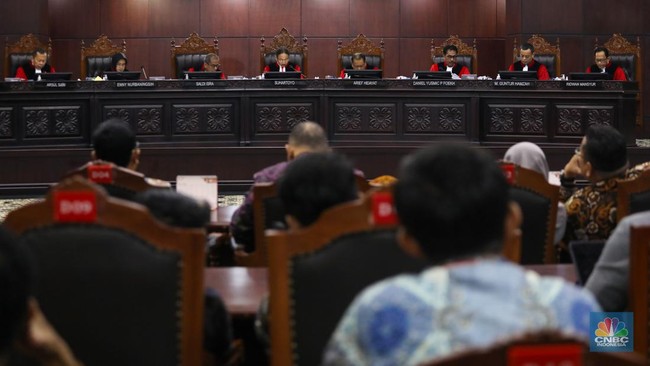
Jakarta — Indonesia’s Constitutional Court (MK) has finally granted part of a lawsuit challenging lifetime pension payments to former state officials.
The lawsuit was filed by Islamic University of Indonesia (UII) law professors Ahmad Sadzali, Anang Zubaidy, and UII students Muhammad Farhan Kamase, Zidan Patra Yudistira, Rayhan Madani, and Muhammad Fajar Rizki.
In its ruling, the MK ordered lawmakers to amend Law No. 12 of 1980 concerning financial and administrative rights for leaders and members of the highest state institutions, as well as former leaders and members of high state institutions.
The ruling was announced in Constitutional Court Plenary Session Decision No. 191/PUU-XXIII/2025 delivered in the MK’s Jakarta courtroom on 16 March 2026. MK Chief Justice Suhartoyo stated that Law No. 12 of 1980 contradicts the 1945 Constitution and has no binding legal force on a conditional basis until replaced with new legislation within two years of the judgment.
“We order lawmakers to make the replacement within a maximum period of two years from when this judgment is pronounced,” said Chief Justice Suhartoyo during the hearing, citing the MK’s YouTube channel on Tuesday (17 March 2026).
If lawmakers fail to replace the law within this timeframe, Law No. 12 of 1980 will be deemed to contradict the 1945 Constitution and will have no permanent binding legal force.
Constitutional Judge Saldi Isra elaborated on five principles the MK has requested the government to consider when revising the pension law for parliamentary members and high-ranking state officials.
First, the law’s substance concerning financial and administrative rights must be structured according to the character of state institutions, distinguishing between elected officials (through general elections), selected officials (based on merit-based selection), and appointed officials (such as cabinet ministers).
Second, regulations must consider the principle of state institutional independence, ensuring that officials performing strategic state functions are protected from pressure that could compromise their integrity and objectivity.
Third, the arrangement of pension amounts and mechanisms must continue to consider principles of proportional and fair treatment, as well as accountability, whilst taking into account Indonesia’s socio-economic conditions.
Fourth, the MK stated that new regulations must consider state institutional independence. Officials performing strategic state functions must be protected from pressure affecting their integrity and objectivity. The court suggested considering whether to maintain lifetime pensions or introduce an alternative model such as “honorarium payments” made only once after the end of office, with the length of tenure being a determining factor.
Fifth, the MK reminded lawmakers that the law-making process must involve stakeholders concerned with state finances, including civil society groups, in accordance with meaningful public participation principles.
Saldi explained that Law No. 12 of 1980 has lost relevance due to developments in state administration. The law no longer aligns with the structure of state institutions under the 1945 Constitution, as it was drafted based on the pre-amendment constitutional framework and MPR Decree No. III/MPR/1978.
Officials potentially affected by this ruling, as defined in Section 1 point d of Law No. 12 of 1980, include:
Chairs and Vice Chairs of the Supreme Audit Institution (DPA)
Chairs and Vice Chairs of the House of Representatives (DPR)
Chairs and Vice Chairs of the State Audit Board (BPK)
Chief Justice, Deputy Chief Justice, and Senior Judges of the Supreme Court (MA)
This also covers members of these high state institutions, including DPA members, DPR members, BPK members, and Supreme Court judges.