
Constitutional Court Revises "Obstruction of Justice" Clause to Prevent Misinterpretation
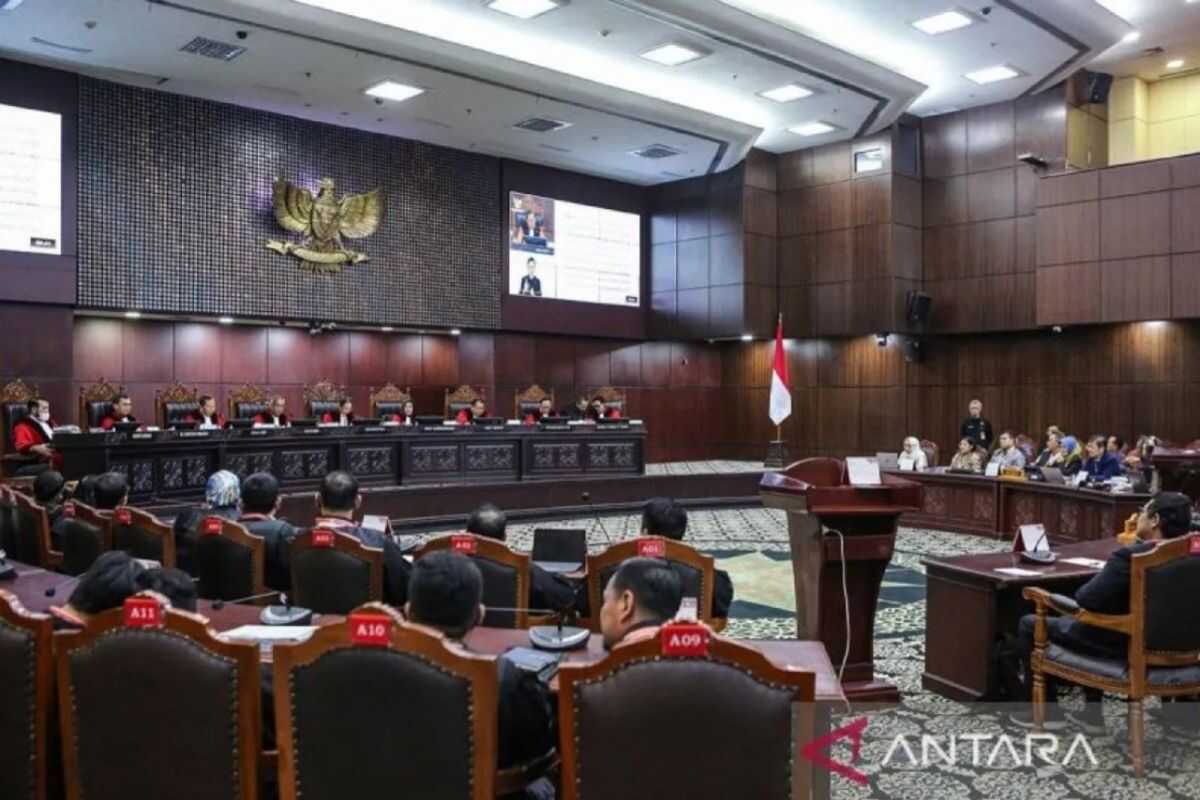
Jakarta – The Constitutional Court has modified the wording of the obstruction of justice clause in Article 21 of Law No. 31 of 1999 on the Eradication of Corruption Offences (Anti-Corruption Law) to prevent misinterpretation.
Through Decision No. 71/PUU-XXIII/2025, the Constitutional Court declared that the phrase “directly or indirectly” in Article 21 of the Anti-Corruption Law conflicts with the Constitution and has no binding legal force.
“We are granting the petitioner’s request in part,” said Constitutional Court Chief Suhartoyo, pronouncing the court’s decision on the petition filed by lawyer Hermawanto at the Plenary Session of the Constitutional Court in Jakarta on Monday.
In the legal consideration section, Constitutional Judge Arsul Sani stated that the phrase “or indirectly” in the obstruction of justice provision allows for forms of conduct that may appear non-explicit but are deemed to obstruct judicial proceedings.
Such conduct, Arsul continued, includes spreading disinformation, social pressure, or using intermediaries, assessments of which are made subjectively by law enforcement officers.
When applied to the petitioner’s profession, lawyers’ publication activities through media or public discussions and seminars in defence of their clients could potentially be categorised as indirect forms of obstruction of justice.
The Constitutional Court noted that the same risk applies to journalistic activities that investigate ongoing cases with the intention of providing information to the public.
The Constitutional Court found that the phrase “or indirectly” in Article 21 of the Anti-Corruption Law blurs the boundary between lawful conduct within the space of freedom of expression and unlawful conduct.
“This creates the potential for what is called overcriminalisation,” Arsul said.
Such circumstances would generate legal uncertainty. The public cannot predict whether actions that are actually lawful will be categorised as criminal conduct.
Additionally, the Constitutional Court found that the phrase “directly or indirectly” often produces multiple interpretations, causing not only legal uncertainty but also frequently creating arbitrariness.
At that level, the Court held that the phrase could be used elastically to ensnare anyone deemed by law enforcement to be obstructing legal proceedings.
Furthermore, with reference to Article 25 of the United Nations Convention Against Corruption (UNCAC), the Constitutional Court found that the phrase “directly or indirectly” is not part of the obstruction of justice offence definition.
“This means that universally, the existence of the obstruction of justice offence does not depend on whether the phrase ‘directly or indirectly’ is present or absent,” Arsul stated.
On the other hand, in the development of Indonesia’s national criminal law, the new Penal Code does not include the phrase “directly or indirectly” in the provisions regarding the obstruction of justice offence.
Accordingly, the Constitutional Court reasoned that as long as any person intentionally prevents, obstructs, or defeats legal proceedings, whether at the investigation, prosecution, or court examination stage against suspects and defendants or witnesses in corruption cases, they can be prosecuted under Article 21 of the Anti-Corruption Law.
“Based on the foregoing legal considerations, the Constitutional Court finds that Article 21 of the Anti-Corruption Law, insofar as it contains the phrase ‘directly or indirectly’, is inconsistent with the Constitution of the Republic of Indonesia of 1945 and has no binding legal force,” Arsul stated.
Prior to this decision, Article 21 of the Anti-Corruption Law read: “Any person who intentionally prevents, obstructs, or defeats directly or indirectly the investigation, prosecution, and court examination against suspects and defendants or witnesses in corruption cases shall be punished with imprisonment of at least three years and at most twelve years and or a fine of at least IDR 150,000,000 and at most IDR 600,000,000.”