
Constitutional Court Requests Government and Parliament to Revise Law on State Officials' Financial Rights
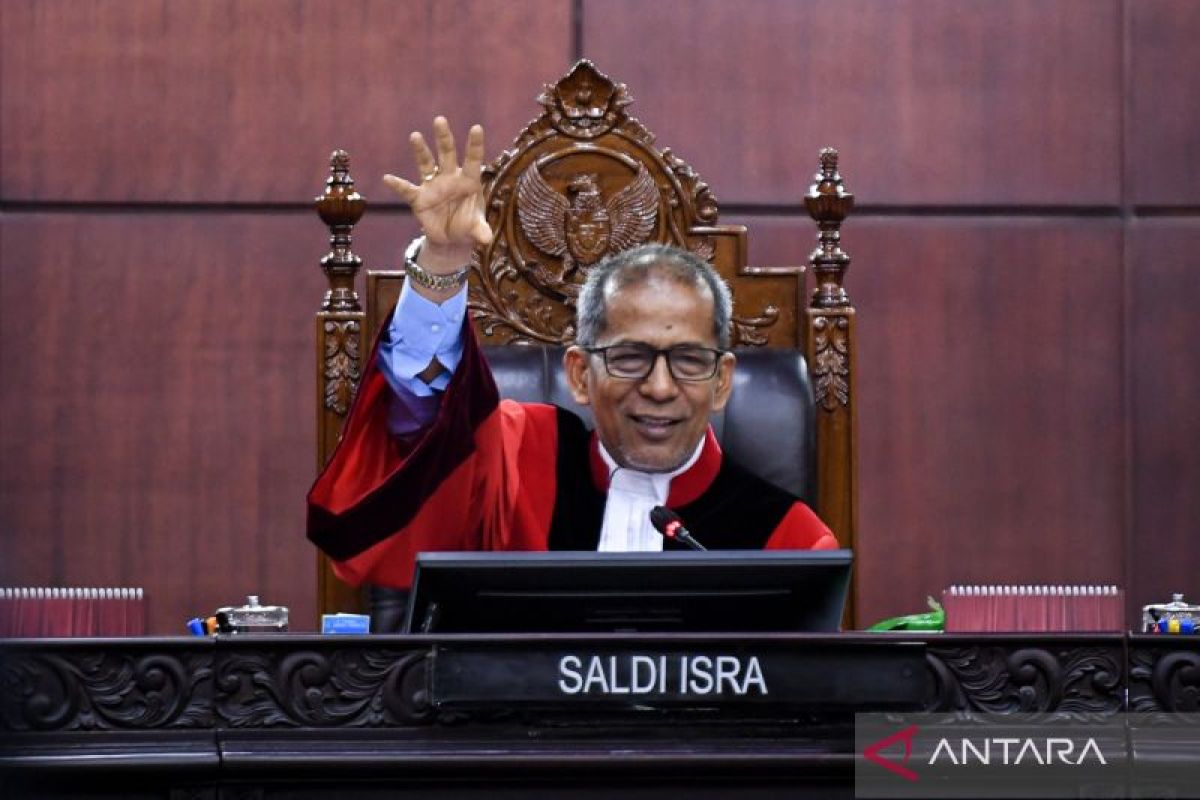
Jakarta — The Constitutional Court has requested the government and Parliament, as legislators, to revise legislation concerning the financial rights of state officials due to the outdated nature of the existing law.
Through decision number 191/PUU-XXIII/2025, the Constitutional Court ruled that Law Number 12 of 1980 on Financial and Administrative Rights of Leaders and Members of the Highest and High State Institutions and Former Leaders and Members of State Institutions is unconstitutional if not amended within two years.
Deputy Chief Justice of the Constitutional Court Saldi Isra, whilst presenting legal considerations in the Constitutional Court’s Plenary Session in Jakarta on Monday, outlined at least five points that the government must consider when revising the law.
“The regulation of the amount and mechanisms must continue to take into account principles of proportionality, justice, and accountability, as well as paying attention to the socio-economic conditions of Indonesian society,” he said, reading one of the points.
Another point highlighted by the Court was that the substance and content of legislation on financial or administrative rights of state officials should be formulated in accordance with the character of the state institution the official holds.
In this regard, the Constitutional Court noted the distinction between state officials based on their selection methods, such as officials elected through general elections (elected officials) and officials selected based on competence (selected officials).
“And there is the possibility that legislators will expand by including state officials whose positions are filled through appointment (appointed officials), such as ministerial positions,” said Saldi.
The Court also stated that new regulations must consider the principle of state institution independence. Officials performing strategic state functions must be protected from pressures that could affect their integrity and objectivity.
The regulation, continued Saldi, should also consider whether pension rights should be retained or whether an alternative model such as “honourarium” paid only once after the completion of office should be explored.
“In this context, the length of tenure, including the period of office for elected officials, selected officials, and appointed officials, becomes a factor in determining it,” he said.
The final point highlighted by the Court was that legislation must involve those concerned with state finances, including civil society groups, in accordance with the principle of meaningful public participation.
The Constitutional Court ruled that Law Number 12 of 1980, which among other things regulates pension rights for leaders and members of state institutions, including the People’s Consultative Assembly and Parliament, contradicts the Constitution if not amended within two years.
“If no amendment is made after the two-year period expires, Law Number 12 of 1980 will contradict the 1945 Indonesian Constitution and will permanently lose binding legal force,” said Saldi.
The Court stated that the law has lost relevance due to new developments in state administration. Law Number 12 of 1980 no longer aligns with the structure of state institutions under the 1945 Indonesian Constitution.
Saldi explained that Law Number 12 of 1980 was formulated based on the substance of the Constitution before amendment, namely the 1945 Constitution and People’s Consultative Assembly Decree Number III/1978.
The law was essentially drafted as an effort to consolidate various regulations governing the financial or administrative rights of leaders and members of state institutions and their predecessors.
However, in substance, the Court found that the structure of state institutions under the 1945 Constitution and People’s Consultative Assembly Decree Number III/1978 no longer aligns with the structure of state institutions under the 1945 Indonesian Constitution.
The substance in the 1945 Constitution and People’s Consultative Assembly Decree Number III/1978 affected by constitutional amendment concerns the division of state institutions into highest state institutions and high state institutions.
The 1945 Constitution regulated six state institutions: the People’s Consultative Assembly, the President, the Advisory Council, Parliament, the Audit Board, and the Supreme Court. In contrast, the 1945 Indonesian Constitution regulates more state institutions, namely the People’s Consultative Assembly, Parliament, the Regional Representative Council, the President, the Audit Board, the Supreme Court, the Constitutional Court, and the Judicial Commission.
Therefore, the Constitutional Court concluded that the norms in Article 1 (a) and (b) of Law Number 12 of 1980, which define the highest state institution as the People’s Consultative Assembly and high state institutions as the Advisory Council, Parliament, the Audit Board, and the Supreme Court, have normatively lost relevance.
Consequently, according to the Constitutional Court, all phrases referring to “highest state institutions and high state institutions” in Law Number 12 of 1980 have lost their normative foundation to be retained as the basis for determining financial or administrative rights of state institutions under the 1945 Indonesian Constitution.