
Constitutional Court Rejects Police Dual Position Challenge Due to Submission of Only Soft Copies
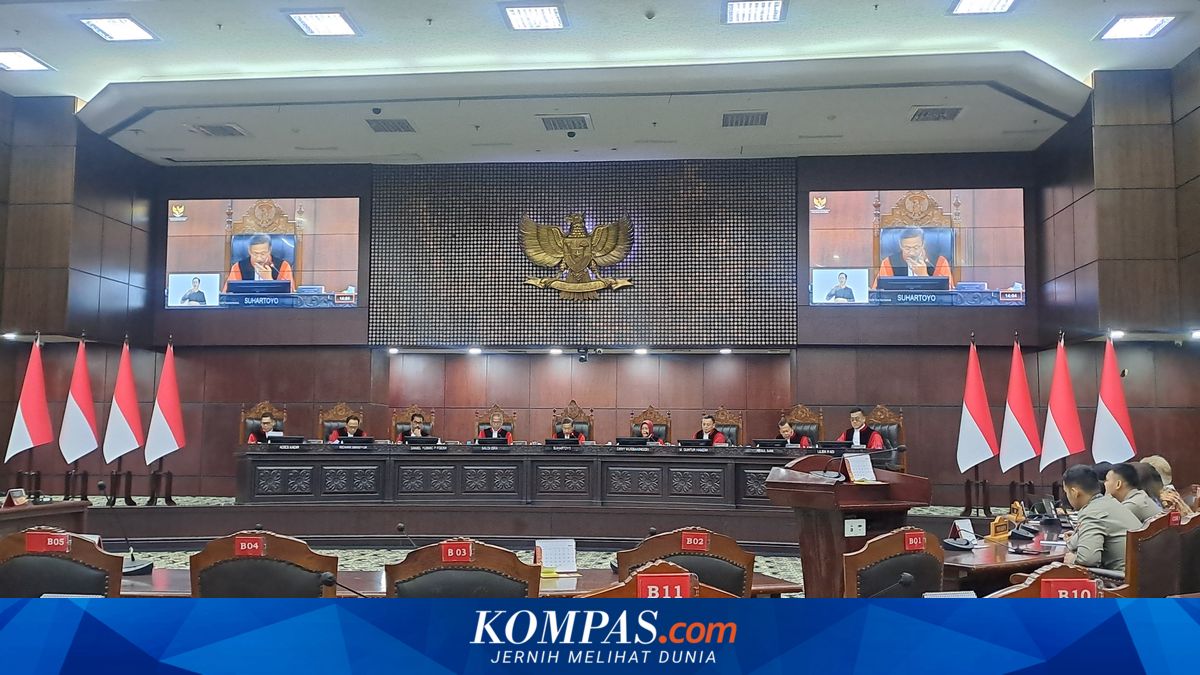
JAKARTA – The Constitutional Court (MK) has stated that the petition for judicial review regarding police officers holding dual positions outside the Indonesian National Police (Polri) institution cannot be accepted because the petitioners only submitted digital documents.
“The petitioners, when filing the petition, did not submit evidence affixed with stamps, but only handed over soft copies of the evidence,” said Constitutional Court Justice Arsul Sani, while reading out the considerations of the ruling in the MK Plenary Courtroom on Thursday (16/4/2026).
The petitioners filed the challenge to declare the explanation of Article 28 paragraph (3) of Law Number 2 of 2002 on the Republic of Indonesia State Police (Police Law) unacceptable.
In its considerations, the MK assessed that the petitioners did not meet the formal requirements because they did not include valid evidence and did not sign the petition documents.
Arsul Sani explained that from the initial filing to the amendment of the petition, the petitioners only submitted evidence in the form of digital soft files without documents affixed with stamps.
The petitioners’ legal representatives even failed to attend the court session for the petition amendment agenda on 4 March 2026.
Based on this, the MK concluded that the petition did not meet the formal provisions and thus could not be accepted.
This petition was filed by Syamsul Jahidin, Ria Merryanti, who holds the status of a civil servant (ASN), and Marina Ria Aritonang.
In their petitum, the petitioners requested that the Court declare the phrase in the Explanation of Article 28 paragraph (3) of the Police Law, namely, “What is meant by ‘positions outside the police’ are positions that have no connection with the police,” to be contrary to the 1945 Constitution of the Republic of Indonesia and to have no binding legal force conditionally (conditionally unconstitutional), insofar as it is not interpreted as: Explanation of Article 28 paragraph (3) “sufficiently clear”.