
Constitutional Court Rejects Material Test of Obstruction of Justice Provision Submitted by Hasto Kristiyanto
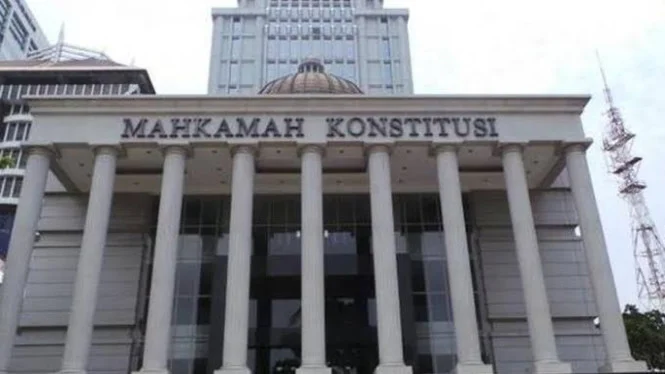
The Constitutional Court (MK) has stated that it cannot accept a material test petition regarding the obstruction of justice provision in the Anti-Corruption Law submitted by PDI Perjuangan Secretary Hasto Kristiyanto.
“The petition is declared inadmissible,” said MK Chief Justice Suhartoyo in announcing the decision on petition number 136/PUU-XXIII/2025 in the MK’s plenary hearing room in Jakarta on Monday.
Hasto’s petition was deemed inadmissible due to loss of legal object. The norm of Article 21 of Law Number 31 of 1999 concerning the Eradication of Corruption Offences (Anti-Corruption Law) that Hasto sought to test had already been amended by the MK in decision number 71/PUU-XXIII/2025.
Through a decision announced by the Court immediately before the ruling on Hasto’s petition, the phrase “directly or indirectly” in Article 21 of the Anti-Corruption Law was declared no longer applicable.
The MK stated that the phrase was inconsistent with the Constitution of the Republic of Indonesia of 1945 and possessed no binding legal force as it did not align with the principle of fair legal certainty in law enforcement.
According to the Court, the phrase “directly or indirectly” had potential for elastic use and could ensnare anyone deemed by law enforcement officials to be obstructing the legal process.
The article previously read: “Every person who deliberately prevents, obstructs, or thwarts directly or indirectly the investigation, prosecution, and examination in court proceedings against suspects and defendants, or witnesses in corruption cases, shall be punished with imprisonment of not less than 3 years and not more than 12 years and/or a fine of not less than Rp 150,000,000 and not more than Rp 600,000,000.”
Constitutional Judge M. Guntur Hamzah explained that because the phrase “directly or indirectly” in Article 21 of the Anti-Corruption Law had been declared unconstitutional, the legal object of Hasto’s petition was no longer the same.
“Therefore, according to the Court, the petitioner’s petition has lost its legal object,” Guntur stated in reading the legal reasoning.
Hasto had argued in his petition that Article 21 of the Anti-Corruption Law was interpreted in a disproportionate manner and created legal uncertainty, thus violating the principle of a fair rule of law as mandated by the constitution.