
Constitutional Court Rejects Hasto's Challenge to Obstruction of Justice Clause in Corruption Law, Finding No Reviewable Object
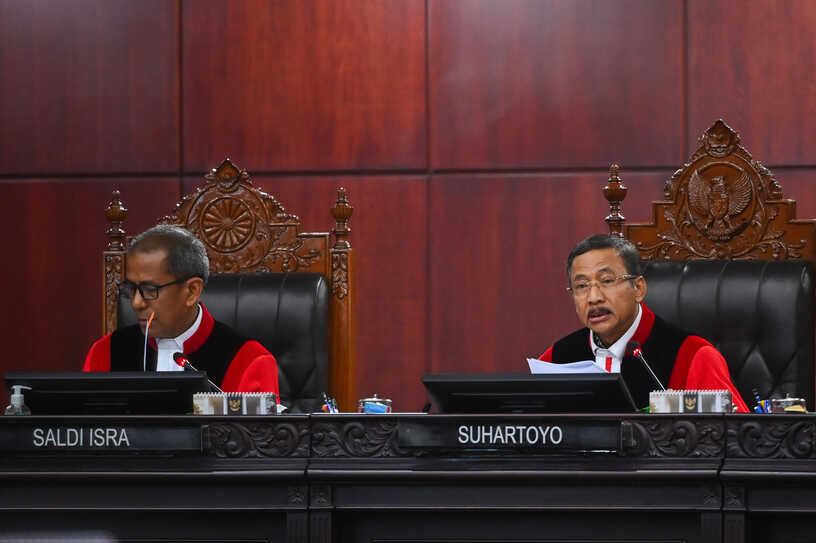
The Constitutional Court (MK) rejected the petition to review the Corruption Law (UU Tipikor) filed by PDI Perjuangan Secretary-General Hasto Kristiyanto, declaring the petition inadmissible on the grounds that it has lost its legal object.
“We declare the petitioner’s petition inadmissible,” stated Constitutional Court Chief Suhartoyo during a plenary session at the MK building on Monday, 2 March.
In his petition, Hasto had challenged the constitutionality of Article 21 of the Corruption Law, specifically regarding the definition of obstruction of justice offences. Constitutional Justice M. Guntur Hamzah explained that the court had initially intended to consider whether the criteria for obstruction of justice in Article 21 of the Corruption Law were susceptible to multiple interpretations and created space for criminalisation contrary to the 1945 Constitution.
“The court would have considered whether the criteria defining obstruction of justice in Article 21 of the Corruption Law are susceptible to multiple interpretations and create space for criminalisation,” Guntur stated when delivering the court’s legal reasoning.
However, before addressing the substantive arguments, the court established that the norm challenged by Hasto had already been decided in another case. In MK Decision Number 71/PUU-XXIII/2025 announced on 2 March 2026, the court had partially granted a previous petition and declared the phrase “directly or indirectly” in Article 21 of the Corruption Law unconstitutional.
“The phrase ‘directly or indirectly’ in Article 21 of the Corruption Law has been declared unconstitutional, and that decision carries binding legal force from the date it was announced,” Guntur stated.
According to the court, despite Hasto’s testing grounds and legal arguments differing from the previous case, the legal object of the norm he sought to challenge had been fundamentally altered. With the elimination of that phrase through the earlier decision, the substance of the article under review was no longer the same as when the petition was initially filed.
“Therefore, according to the court, the petitioner’s petition has lost its legal object,” Guntur emphasised.
On this basis, the MK declared the petition inadmissible (niet ontvankelijk verklaard), meaning the court did not assess or rule on the substantive merits of the case as there was no longer a reviewable norm in the form as petitioned.
The decision clarifies that Hasto’s petition was rejected not because the constitutional arguments were substantively rejected, but because the legal object sought to be reviewed had already been declared unconstitutional in another binding decision.