
Constitutional Court Partially Grants Challenge to Article 21 of Anti-Corruption Law, Clarifies Bounds of Obstruction of Justice Provisions
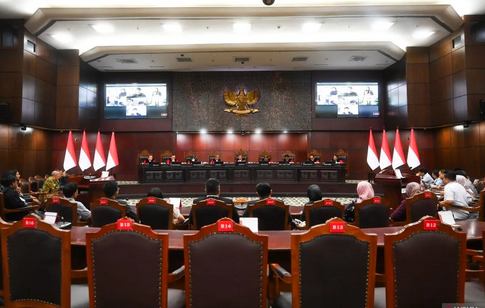
Indonesia’s Constitutional Court (MK) has partially granted a judicial review petition challenging the Anti-Corruption Law (UU Tipikor) regarding provisions on judicial obstruction, commonly known as obstruction of justice. In its ruling, the Court declared that the phrase “directly or indirectly” in Article 21 of the Anti-Corruption Law contradicts the 1945 Constitution and no longer holds binding legal force.
“The verdict is to grant the petitioner’s motion in part,” stated Constitutional Court Chief Suhartoyo whilst delivering the judgment during a plenary session at the Constitutional Court building on Monday 2 March.
The judicial review petition was filed by advocate Hirma Wanto, who challenged the constitutionality of the phrase in Article 21 of Law No. 31 of 1999 on Eradication of Corruption, as amended by Law No. 20 of 2001, against the 1945 Constitution.
Constitutional Judge Arsul Sani explained that the phrase being tested forms part of the judicial obstruction offence norm, also recognised in the Criminal Code (KUHP) and various other legal instruments, including the United Nations Convention Against Corruption (UNCAC), which Indonesia has ratified. “The legislature fundamentally formulated this norm in open terms to adapt to various evolving modes of corruption crime,” Arsul Sani stated in the legal reasoning presented to the court.
However, the Court found that the attachment of the phrase “directly or indirectly” created an excessively broad interpretation space and risked being applied in an elastically vague manner. According to the MK, this condition could ensnare parties genuinely exercising their constitutional rights. The Court highlighted that in law enforcement practice, the phrase could potentially implicate advocates, journalists, academics, and activists conducting legal assistance, publication, discussion, or criticism of legal proceedings.
“With this phrase present, the boundary between lawful conduct guaranteed freedom of expression and unlawful conduct becomes blurred,” the Court noted in its reasoning. The Court found this situation could create over-criminalisation and legal uncertainty, as the public cannot predict whether lawful conduct might be prosecuted due to overly loose interpretation.
The Constitutional Court also compared similar offence provisions in national law and Article 25 of UNCAC, neither of which contains the phrase “directly or indirectly”. “Whenever any person intentionally prevents, obstructs, or thwarts legal proceedings concerning a corruption case, criminal sanctions may be imposed against such person,” Arsul explained.
The MK emphasised that removing the phrase does not eliminate the essence of the judicial obstruction offence, but rather clarifies its application boundaries. Based on constitutional considerations, the Court declared the phrase contradicts Articles 1(3), 28G(1), and 28E(3) of the 1945 Constitution, as it fails to guarantee fair legal certainty, equality before the law, and security of person.
Nevertheless, the Court rejected the petitioner’s arguments regarding the Explanation to Article 21 of the Anti-Corruption Law. The explanation, which merely states “sufficiently clear,” was deemed no longer relevant to challenge after the principal norm was declared unconstitutional, resulting in the petition being granted in part.
Through this ruling, the Constitutional Court requires law enforcement officials to interpret and apply Article 21 of the Anti-Corruption Law without using the phrase that has been invalidated. The Court also encourages the legislature to synchronise legal norms to align with the principle of legal certainty without diminishing the effectiveness of corruption eradication.