
Constitutional Court Orders Amendment of Law on Former Officials' Pensions
Indonesia’s Constitutional Court (MK) has instructed the government and parliament, as legislators, to reformulate legislation concerning the financial rights of state officials, noting that the existing old law is no longer relevant.
Through decision number 191/PUU-XXIII/2025, the Constitutional Court declared Law Number 12 of 1980 concerning Financial and Administrative Rights of Leaders and Members of the Highest and High State Institutions, as well as Former Leaders of the Highest and High State Institutions and Former Members of High State Institutions, unconstitutional unless amended within two years.
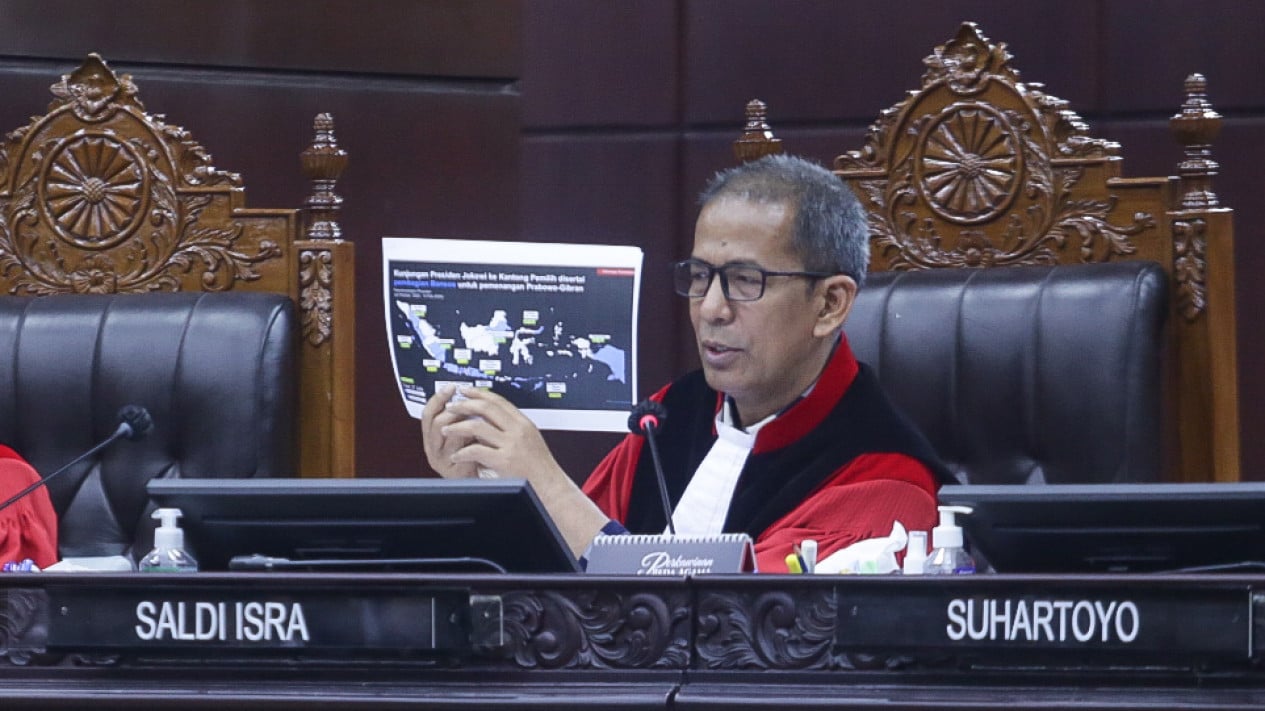
Deputy Chief of the Constitutional Court Saldi Isra, whilst presenting the legal reasoning in the Court’s Plenary Session Room in Jakarta on Monday, outlined at least five key points that the government must consider when reformulating the legislation.
“The arrangement of the amount and mechanism must continue to consider the principle of proportionality that is fair and accountable, as well as take into account the social and economic conditions of Indonesian society,” he said, reading one of the points.
Another point highlighted by the Court is that the substance or content of the law concerning financial or administrative rights of state officials must be formulated in accordance with the character of the state institution in which the official serves.
The Court emphasised the distinction between state officials based on their selection method, such as officials resulting from general elections (elected officials) and officials resulting from competency-based selection (selected officials).
“There is also the possibility that the legislature may expand by including state officials appointed through appointment or designation (appointed officials), such as ministerial positions,” Saldi stated.
Furthermore, the Court stated that the new arrangement must consider the principle of institutional independence. Officials performing strategic state functions must be protected from pressure that could affect their integrity and objectivity.
The arrangement, Saldi continued, must also consider whether the right to pensions should be retained or alternatively replaced with a different model consisting of “honour payments” that are made only once upon the conclusion of service.
“In this context, the length of service, including the tenure period for elected officials, selected officials, and appointed officials, becomes a determining factor,” he said.
The final point highlighted by the Court was that the formulation of the law must involve those with an interest in state finances, including civil society groups, in accordance with the principle of meaningful public participation.