
Constitutional Court: Law on Financial Rights of State Institutions No Longer Relevant
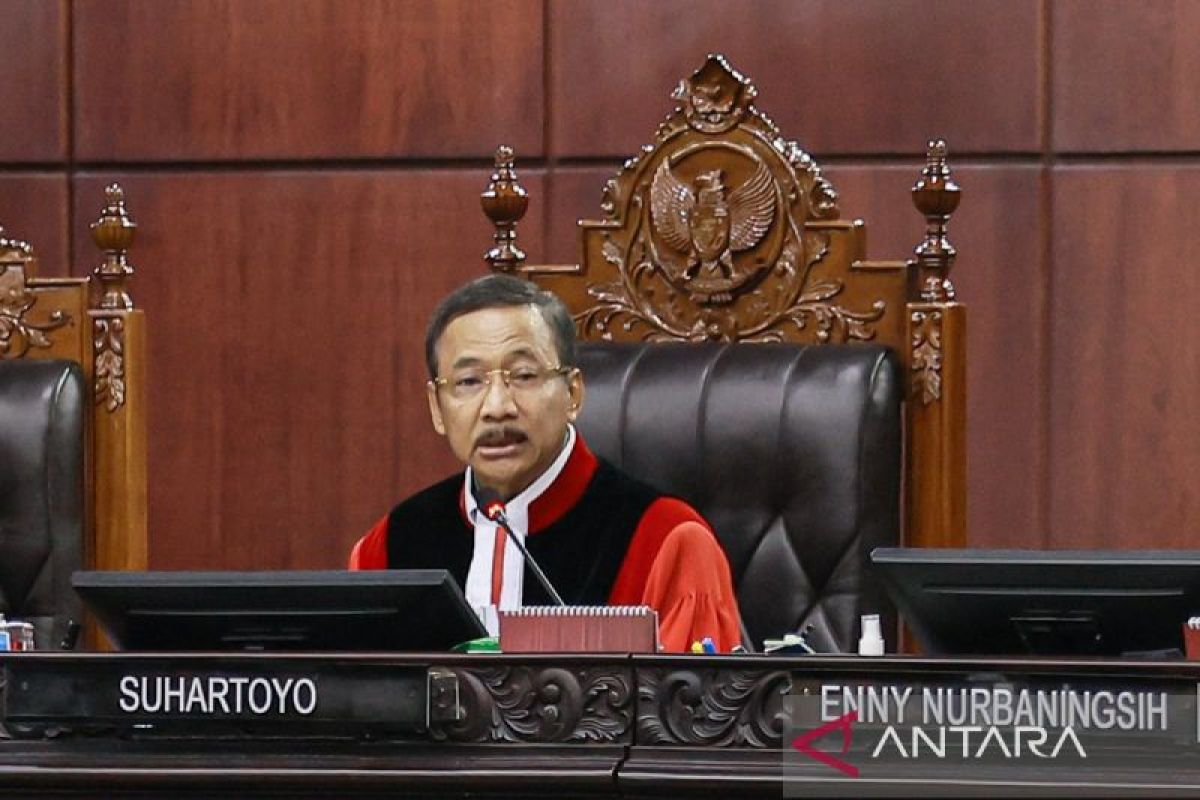
Jakarta — Indonesia’s Constitutional Court has declared Law Number 12 of 1980 concerning the Financial and Administrative Rights of Leaders and Members of the Highest and High State Institutions, and Former Leaders and Members of the Highest and High State Institutions and Former Members of High State Institutions, no longer relevant.
The Constitutional Court, in decision number 191/PUU-XXIII/2025, ruled that the law, which regulates pension rights for leaders and members of high state institutions, including the People’s Consultative Assembly (MPR) and House of Representatives (DPR), contradicts the Constitution unless amended within a maximum of two years.
“We declare Law Number 12 of 1980 contradicts the 1945 Constitution of the Republic of Indonesia and has no binding legal force conditionally insofar as it is not replaced with a new law within a maximum of two years from the pronouncement of this decision,” said Constitutional Court Chief Suhartoyo in Jakarta on Monday.
The Court stated that the law has lost relevance owing to new developments in state administration. Law Number 12 of 1980 no longer accords with the state institution structure in the 1945 Constitution as amended.
According to the Constitutional Court, this situation violates the right to self-development, the right to obtain education, and quality of life and protection and assurance of fair legal certainty, as guaranteed in Article 28C paragraph (2) and Article 28D paragraph (1) of the 1945 Constitution as amended.
Deputy Chief of the Constitutional Court Saldi Isra, when reading the legal considerations, explained that Law Number 12 of 1980 was formulated based on the substance of the constitution before amendment, namely the 1945 Constitution, and MPR Decree Number III/MPR/1978.
The law was originally formulated as an attempt to unify various regulations governing the financial or administrative rights of leaders and members of state institutions and their predecessors.
However, substantially, the Constitutional Court found that the structure of state institutions in the 1945 Constitution and MPR Decree Number III/MPR/1978 no longer align with the structure of state institutions in the 1945 Constitution as amended.
“Not only that, factually, MPR Decree Number III/MPR/1978, which was one of the legal bases for the formulation of Law Number 12 of 1980, has lost its existence because it has been repealed and declared ineffective based on MPR Decree Number I/MPR/2003,” said Saldi.
He explained that the substance in the 1945 Constitution and MPR Decree Number III/MPR/1978 affected by constitutional amendments concerns the division of state institutions into highest state institutions and high state institutions.
The 1945 Constitution regulated only six state institutions: the MPR, President, Supreme Advisory Council (DPA), DPR, Financial Audit Board (BPK), and Supreme Court (MA). Meanwhile, the 1945 Constitution as amended regulates more state institutions: the MPR, DPR, DPD, President, BPK, MA, Constitutional Court (MK), and Judicial Commission (KY).
“If the state institutions in the 1945 Constitution as amended were to be placed within Law Number 12 of 1980, at least the DPD, Constitutional Court, and Judicial Commission are not accommodated or included regarding their financial or administrative rights as state institutions. Moreover, the Supreme Advisory Council, which is no longer part of the state institution structure in the 1945 Constitution as amended, remains part of the substance of Law 12 of 1980,” said Saldi.
For this reason, the Constitutional Court determined that the norms of Article 1 letters a and b of Law 12/1980, which state that the highest state institution is the MPR and high state institutions are the Supreme Advisory Council, DPR, BPK, and MA, have normatively lost their relevance.
“Furthermore, the basis for the division of state institutions into highest state institutions and high state institutions as described in the explanation of the 1945 Constitution concerning the State System of Government has lost relevance because said explanation no longer constitutes part of the structure of the 1945 Constitution as amended,” he said.
Thus, according to the Constitutional Court, all phrases relating to “highest state institutions and high state institutions” in Law Number 12 of 1980 have lost their normative basis to be maintained as the foundation for determining the financial or administrative rights of state institutions in the 1945 Constitution as amended.
The petition was filed by lecturers from the Faculty of Law at the Islamic University of Indonesia Ahmad Sadzali and Anang Zubaidy, along with five of their students: Muhammad Farhan Kamase, Alvin Daun, Zidan Patra Yudistira, Rayhan Madani, and Muhammad Fajar Rizki.
In the petition, which has been in process since October 2025, the petitioners challenged the pension rights of leaders and members of the DPR. According to them, the provision of pension funds made in a disproportionate manner undermines the constitutional rights of citizens.