
Constitutional Court holds preliminary hearing on material review of legislative term limits
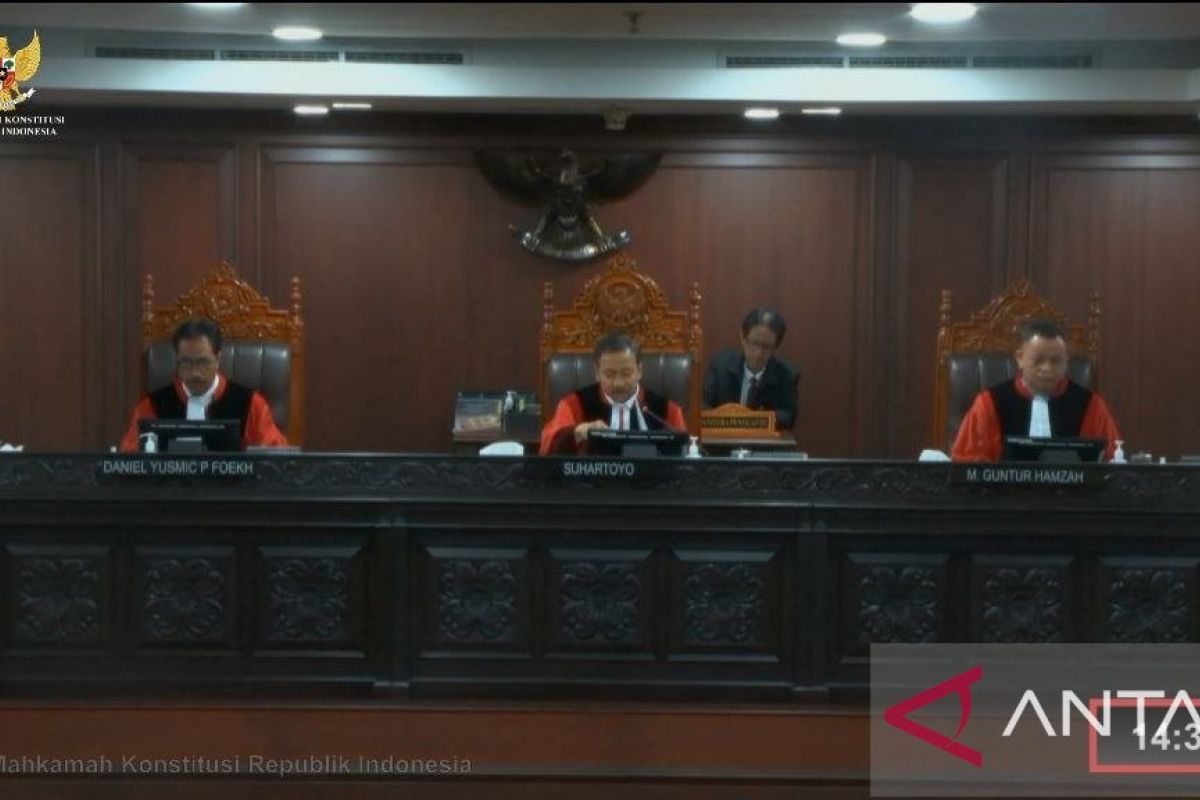
Jakarta (ANTARA) - The Constitutional Court (MK) held a preliminary examination hearing on the material review of Law No. 7 of 2017 on Elections and similar regulations governing the term of office of legislative members, which is not limited by periods, at the MK Building in Jakarta on Wednesday.
The case hearing numbered 117/PUU-XXIV/2026 was chaired by MK Chief Justice Suhartoyo and accompanied by two other constitutional justices, namely Daniel Yusmic P Foekh and M. Guntur Hamzah.
The material review concerning the term of office of legislative members was filed by Fahrizal as the petitioner.
In the first hearing, the petitioner did not attend despite being properly summoned by the MK. Therefore, the MK justices declared the preliminary examination hearing concluded and closed.
“The petitioner is only one and has been properly summoned and also re-emphasised in this hearing. That the petitioner did not attend the public hearing,” said Suhartoyo.
Because the petitioner did not attend, he said, the panel of justices will subsequently report the results of the hearing to the judges’ formulation meeting.
The MK justices stated the hearing concluded and was closed because the petitioner did not attend without proper or clear reasons.
“Because the petitioner did not attend without proper and clear reasons, the hearing cannot proceed, thus the hearing is declared concluded and closed,” said Justice Suhartoyo.
Based on tracing, the lawsuit was registered by the petitioner on 26 March 2026. The petitioner’s reason (porsita) for filing the material review of Law No. 7 of 2017 on Elections and similar regulations governing the term of office of legislative members without period limits has caused constitutional impacts contrary to the fundamental principles guaranteed by the 1945 Constitution.
According to the petitioner, the term of office of legislative members not regulated like the president’s term (maximum two periods) and regional heads (maximum two periods) is feared to potentially become political power and legislative oligarchy.
The petitioner stated that limiting power is not only to prevent executive dictatorship, but also important to prevent legislative oligarchy, because the legislature has functions as law-makers; supervisors of the government and budgetary functions.
“Great authority if not limited creates the possibility of the birth of a permanent political caste, which contradicts the identity of Indonesian democracy as government of the people, by the people, for the people,” the petitioner wrote in his petition.