
Constitutional Court Holds Hearing on Delpedro et al's Challenge to Incitement Provisions in Criminal Code
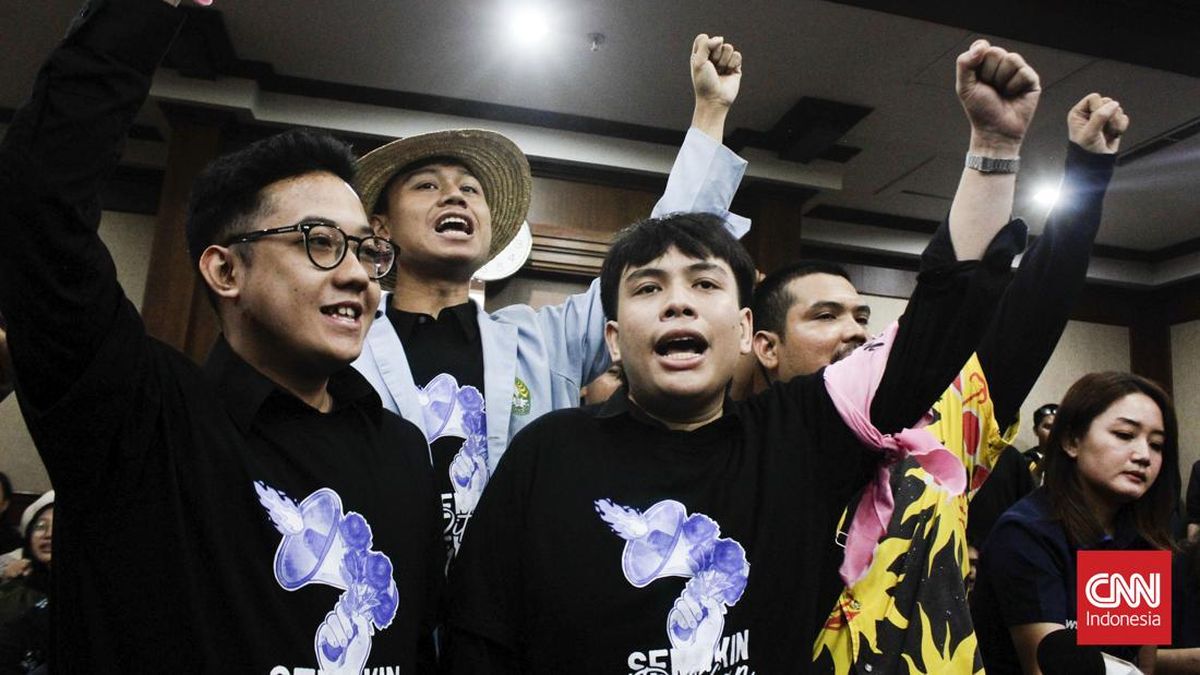
The Constitutional Court held its first hearing on the constitutionality of provisions criminalising incitement and false reporting in Law Number 1 of 2023 concerning the new Criminal Code (KUHP), filed by Delpedro Marhaen Rismansyah and Muzaffar Salim.
In the hearing chaired by Constitutional Court Vice-Chair Saldi Isra, the petitioners’ legal counsel explained why Delpedro and colleagues were challenging the constitutionality of Articles 246, 263 (paragraphs 1 and 2), and 264 of the KUHP, which govern incitement and the dissemination of false information that could potentially cause public unrest.
“The very existence of the articles being tested in this petition impedes and risks criminalising Petitioner I and Petitioner II, who focus their work on promoting human rights, political education, and advocacy,” stated M Fauzan during the hearing of case Number 93/PUU-XXIV/2026 on Thursday, 12 March, as quoted from the Constitutional Court website.
Additionally, Fauzan argued that the petitioners believed these articles risked being used as a tool to report or criminalise those who are critical in carrying out their advocacy functions.
According to Delpedro and his colleagues, such alleged criminalisation had already occurred when law enforcement processed accusations of spreading false information concerning data-based reports of approximately 400 demonstrators arrested by authorities during demonstrations in August 2025.
According to the petitioners, such accusations were inconsistent with the facts, as they had merely documented the arrested demonstrators in order to provide advocacy in the form of legal assistance to persons who participated in the demonstrations.
The petitioners’ other legal counsel, M Fahrul Rhozi Lubis, explained that in constitutional review procedures, the principle of ne bis in idem applies—provisions already tested and decided by the Constitutional Court with final legal force cannot normally be retested. However, the petitioners noted that testing can be filed again provided that the constitutional standard or grounds for the petition differ.
This was raised regarding the dissemination of false information previously decided in Constitutional Court Decision Number 78/PUU-XXI/2023. However, the object of testing in that case differed because it concerned Articles 14 and 15 of Law Number 1 of 1946 on the Criminal Code and Articles 27(3) and 45(3) of the Law on Information and Electronic Transactions (ITE Law).
Conversely, the petition filed this time tests provisions in Article 263 of Law Number 1 of 2023, so according to the petitioners, it does not conflict with the principle of ne bis in idem.
The overkriminalisation gap
The petitioners contended that the wording of the norms in the tested articles had a broad and unclear scope, creating legal uncertainty. This condition was deemed likely to ensnare activists and human rights defenders when expressing criticism, reporting violations, or providing information concerning matters of public interest.
Additionally, certain phrases in the provisions were considered to open the door to overkriminalisation.
Vague criminal norms, according to the petitioners, enable broad interpretation by law enforcement officials in determining whether an action can be classified as a criminal offence.
Furthermore, the petitioners highlighted Article 246 of the KUHP, which governs the element of “incitement”. Although the article contained explanatory notes, the petitioners maintained that there were no firm and objective boundaries regarding the meaning of incitement. As a result, appeals or calls made in public spaces within the context of democratic life risk being interpreted as a criminal offence.
Additionally, Article 263(1) of Law Number 1 of 2023 was deemed to lack a clear definition of the phrase “the information or notice is false”. Such lack of clarity, the petitioners argued, opened the door to subjective interpretation, thereby creating legal uncertainty.
Meanwhile, Articles 263(2) and 264 of the KUHP were also deemed to contain vague phrases such as “reasonably suspected”, “may cause unrest”, “uncertain information”, “excessive”, and “incomplete”.
The petitioners believed these phrases risked leading to subjective application of the law and conflicted with the lex certa principle in criminal law. The lex certa principle is a doctrine in criminal law requiring that provisions of legislation be formulated clearly, precisely, definitively, and without ambiguity.
According to the petitioners, the principle of legality as set forth in Article 1(1) of the KUHP requires that every criminal norm be formulated clearly, decisively, and without giving rise to multiple interpretations. The lack of clarity in the formulation of criminal norms was considered likely to violate the guarantee of legal certainty as enshrined in Article 28D(1) of the Constitution of the Republic of Indonesia of 1945.
Additionally, the petitioners also believed that the applicability of these articles risked restricting freedom of expression and freedom to express opinion as guaranteed in Articles 28E(2) and (3) and Article 28F of the 1945 Constitution.
Therefore, the petitioners requested that the Constitutional Court declare Articles 246, 263(1) and (2), and 264 of the KUHP in conflict with the Constitution and without binding legal force.
The Constitutional Court subsequently granted Delpedro and his colleagues 14 days to revise their petition. The revised petition should be received by the Constitutional Court no later than Wednesday, 25 March 2026.