
Constitutional Court Hearing: TNI Affirms Military Judiciary Remains Independent and Transparent
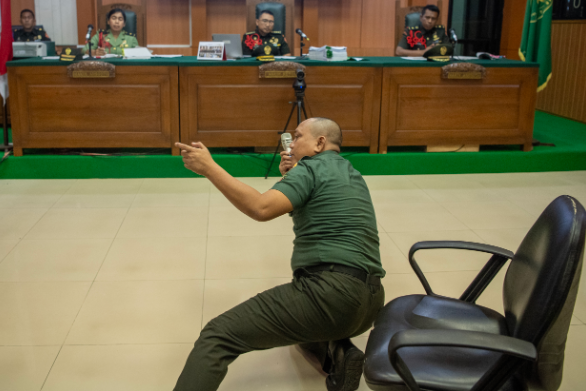
A constitutional review hearing on military judiciary regulations was held at the Constitutional Court on Thursday 12 March 2026. In this hearing, the Indonesian National Armed Forces (TNI) affirmed that the military judiciary system guarantees judicial independence and transparency in court proceedings.
Case number 260/PUU-XXIII/2025 examined several provisions in Law Number 31 of 1997 on Military Courts. The petition was filed by Lenny Damanik and Eva Meliani Br. Pasaribu, who contended that the regulations could potentially enable impunity for TNI personnel.
The hearing was presided over by Constitutional Court Chief Suhartoyo alongside other constitutional judges, with the agenda of hearing testimony from relevant parties including the TNI Commander. The TNI Commander was represented by Inspector General Hersan during the proceedings.
Hersan stated that petitioners’ assertions that the military judiciary lacked objectivity and transparency were inconsistent with current conditions.
“The petitioners’ concerns regarding military courts allegedly failing to guarantee objectivity and transparency are irrelevant concerns when viewed against current legal facts and operational procedures,” he stated during the hearing on 12 March.
He explained that military judges retain independence in exercising judicial authority as guaranteed by the Constitution. From a technical judicial standpoint, the military judiciary operates under the oversight of the Republic of Indonesia’s Supreme Court, not under military command control.
“Although situated within the military environment, military judges possess independence in judicial authority and are not directly subject to superior command control in deciding cases,” he said.
Regarding transparency, Hersan affirmed that military court proceedings are in principle open to the public as stipulated in Article 141, paragraphs (2) and (3) of the Military Court Law. Restrictions apply only to specific cases, such as morality offences or matters involving children.
He also rejected assertions of intervention or institutional bias in the military judiciary.
“Judicial independence is guaranteed by Article 24 of the Indonesian Constitution and the Judicial Authority Law, which designates military judges as independent state officials upholding law and justice without intervention from any party,” he stated.
Hersan added that technical judicial guidance for military courts is entirely conducted by the Supreme Court, not by TNI leadership.
“This provision confirms that administrative guidance by TNI Headquarters does not diminish judges’ freedom to examine and decide cases,” he said.
He also affirmed that military personnel committing criminal offences may face enhanced sanctions because in addition to principal penalties, they may also receive administrative sanctions including dismissal from military service.
“Law enforcement against military personnel demands higher moral standards. In addition to principal penalties, personnel may also receive administrative sanctions including additional penalties in the form of dismissal from military service,” he stated.
According to Hersan, the existence of mechanisms such as the Authorised Superior for Punishment (Ankum) and Case-Submitting Officer (Papera) form part of the military legal system that integrates command responsibility with law enforcement.
“In military organisations, discipline forms the primary foundation of state strength. Therefore, a commander’s authority to ensure legal proceedings against subordinates is a legal obligation inherent in maintaining operational readiness and institutional honour,” he said.
He also conveyed that all military court verdicts must be uploaded to the Supreme Court’s Decision Registry so they can be accessed by the public openly.
Based on these points, the TNI contended that the provisions of Article 9 number 1, Article 43 paragraph (3), and Article 127 of the Military Court Law do not conflict with the Constitution and instead provide legal certainty for military personnel committing criminal offences.
On the other hand, petitioners contended that these regulations could potentially violate the principle of equality before the law. The petitioners’ legal counsel, Ibnu Syamsu Hidayat, argued that the regulations create broad opportunity for military courts to handle various common criminal offences.
“The phrase ‘adjudicate criminal offences’ in Article 9 number 1 of Law Number 31 of 1997 creates opportunity for broad interpretation of military court authority, which can adjudicate not only military disciplinary violations but also other criminal matters such as corruption, traffic violations, domestic violence, narcotics, and child protection,” he asserted.
Petitioners contended that such conditions could potentially weaken the rule of law principle and civilian supremacy in the democratic system. Meanwhile, the TNI also argued that petitioners lack legal standing to file the constitutional review petition.