
Constitutional Court Dismisses Petition Over "Sumatra" versus "Sumatera" Spelling
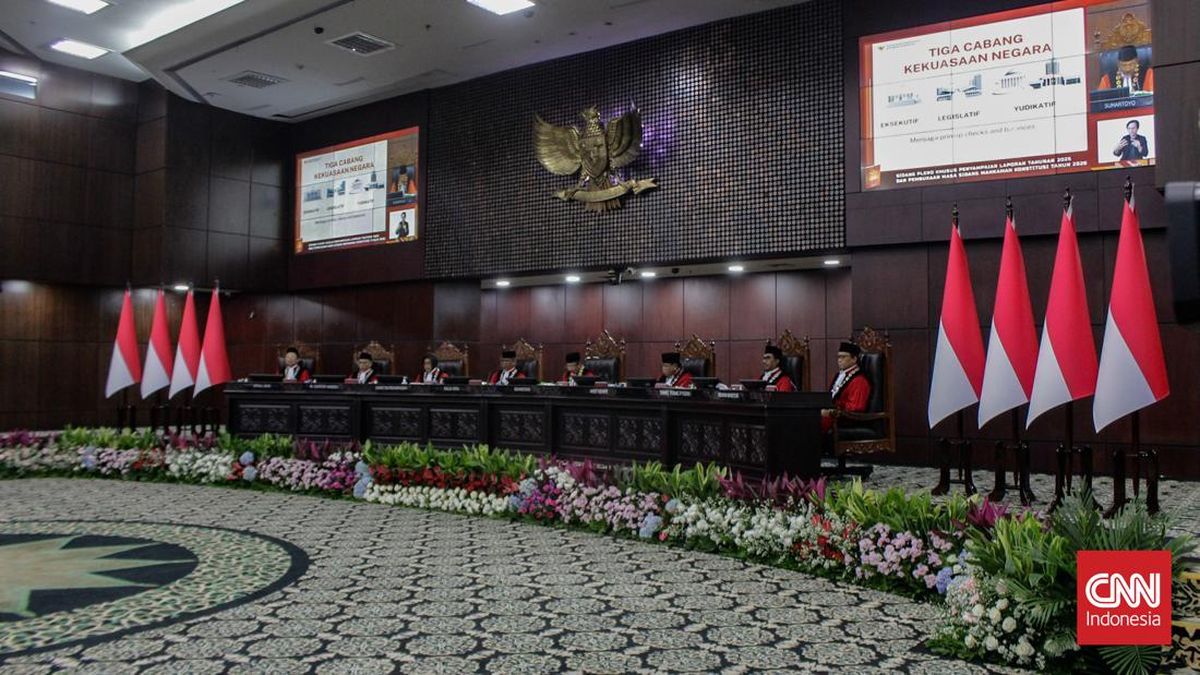
Indonesia’s Constitutional Court (MK) has declared it unable to accept a petition for judicial review concerning the spelling of “Sumatra” versus “Sumatera” in legislation, filed by two language ambassadors from South Sumatra Province (Sumsel).
The court ruled it could not accept case number 57/PUU-XXIV/2026, determining that the two language ambassadors lacked legal standing to bring the petition.
The MK found that the two South Sumatra language ambassadors, Insan Kamil and Andhita Putri Maharani, as petitioners did not have any connection to the requirement of constitutional injury. Furthermore, the two language ambassadors could not provide evidence that they had previously raised the issue of changing the word “Sumatera” to “Sumatra” with the local regional government or with the legislature.
“Based on these facts and legal considerations, there is no doubt for the Court to declare that the Petitioners do not have legal standing to file this petition,” said MK Deputy Chairman Saldi Isra when reading the Court’s legal reasoning regarding the material review of Law Number 9 of 2023 Concerning South Sumatra Province (South Sumatra Law) during the Decision Pronouncement Session in Jakarta on Monday, 16 March, as cited from the MK website.
Previously in their petition, Insan and Andhita, serving as Language Ambassadors for South Sumatra Province in 2025, had claimed constitutional injury by outlining concrete facts they had experienced.
As language ambassadors, Insan and Andhita were tasked with promoting the Trigatra Bangun Bahasa (Build Language) slogan, one element of which is prioritising proper and correct Indonesian language use. The two language ambassadors claimed to have suffered constitutional injury due to the discrepancy between the spelling “Sumatera” in the South Sumatra Law and “Sumatra” in the Greater Indonesian Dictionary (KBBI).
Where the law uses “Sumatera Selatan,” the dictionary uses “Sumatra Selatan.” On this basis, the two petitioners claimed they were unable to convey certain information and that this hindered their function as language ambassadors.
During the decision pronouncement session, Saldi noted that the Court was competent to hear the petitioners’ case, but because they lacked legal standing to file the petition, the Court would not consider the language ambassadors’ petition further.
“We rule that petition Number 57/PUU-XXIV/2026 cannot be accepted,” said MK Chairman Suhartoyo when reading the decision on the petition.
Previously, during a Preliminary Examination Session held on Thursday, 12 February, the petitioners had argued the constitutionality of Article 1 Number 1 of the South Sumatra Law against the Constitution.
It was noted that Law Number 10 of 1948 on the Division of Sumatra into Three Provinces explicitly used the spelling “Sumatra” without the letter “e.” This spelling indicated that from the outset of the administrative region’s establishment by the legislature, “Sumatra” had been set as the official and standard nomenclature. This provision formed the historical foundation of the legal identity of the Sumatran region and the initial reference for government bureaucratic administration in the Sumatra region.
The petitioners then stated that the change in spelling from “Sumatra” to “Sumatera” appeared in Law 16/1955 on the Emergency Law Establishing Autonomous Regional Provinces in Sumatra, and Law 25/1959 on the Ratification of Emergency Law 3/1950 on the Establishment of First-Level Regional Areas in South Sumatra.
Also cited was Emergency Law Number 16 of 1955 on the Amendment to Emergency Regulation in Lieu of Law Number 3 of 1950 as a Law without being accompanied by adequate juridical, linguistic, or administrative explanation.
“As a result of the absence of normative argumentation explaining the rationale for this change, serious questions arise concerning the rationality of the legislature in altering a regionally and administratively established nomenclature without proper justification,” the petitioners stated.
The petitioners also noted that Constitutional Court decision Number 31/PUU-XXIII/2025 regarding the change in spelling from “Batanghari” to “Batang Hari” served as evidence that the Court recognised the importance of accurate regional name spelling.
According to them, this meant that a region’s name reflects the social, cultural, and historical identity of the people inhabiting it. Regional naming constitutes the state’s acknowledgement of historical and cultural values that have been passed down through generations.
“Therefore, correcting the spelling of regional names is not merely a matter of state administration, but also an effort to preserve collective identity and maintain social order in community life,” they stated in their petition.
The two South Sumatra language ambassadors held the view that a region’s name is not merely a geographical marker, but a legal identity that determines the subject of governmental authority.
“Regional naming affects the validity of administrative action, clarity of authority, and the legal relationship between the state and citizens,” they said.
“Therefore, inaccurate spelling of regional names has the potential to create legal implications far broader than a mere technical spelling matter,” they added.