
Constitutional Court Amends Obstruction of Justice Clause in Anti-Corruption Law
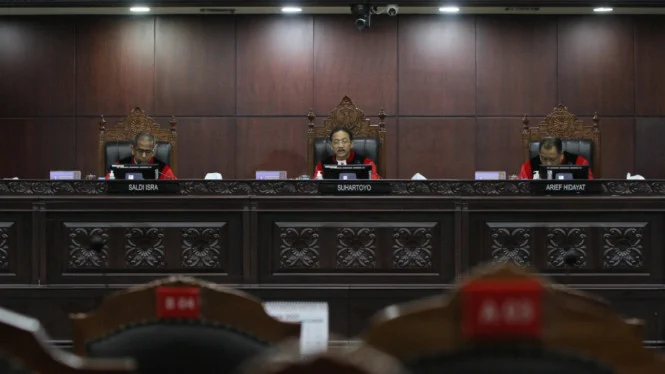
Indonesia’s Constitutional Court (MK) has amended Article 21 of Law Number 31 of 1999 on the Eradication of Corruption (Anti-Corruption Law) regarding the obstruction of justice provision to prevent misinterpretation.
Article 21 of the Anti-Corruption Law previously stated: “Any person who deliberately prevents, obstructs, or fails to advance directly or indirectly the investigation, prosecution, and examination at court proceedings against suspects and defendants or witnesses in corruption cases shall be punished with imprisonment of at least 3 years and at most 12 years and/or a fine of at least Rp150,000,000 and at most Rp600,000,000.”
Through Decision Number 71/PUU-XXIII/2025, the Constitutional Court ruled that the phrase “directly or indirectly” in Article 21 of the Anti-Corruption Law is unconstitutional and has no binding legal force. Constitutional Court Chief Judge Suhartoyo announced the court’s decision on the petition submitted by advocate Hermawanto at the Constitutional Court’s plenary hearing in Jakarta on Monday, 2 March 2026.
In the legal reasoning section, Constitutional Judge Arsul Sani stated that the phrase “or indirectly” in the obstruction of justice provision permits forms of conduct that appear implicit but are deemed to hinder judicial proceedings. Such conduct, according to Arsul, includes the dissemination of disinformation, social pressure, or the use of intermediaries, whose assessment would be made subjectively by law enforcement officials.
When applied to the petitioner’s profession, advocates’ activities of publishing through the media or conducting public discussions and seminars in order to defend their clients would potentially be categorised as indirect forms of obstruction of justice. The Constitutional Court noted that similar potential risks could arise from journalistic activities involving investigation into ongoing cases with the aim of providing information to the public.
The Constitutional Court found that the phrase “or indirectly” in Article 21 of the Anti-Corruption Law has blurred the boundary between lawful conduct within the scope of freedom of expression and unlawful conduct. “This therefore has the potential to create what is referred to as overcriminalisation,” stated Arsul.
Such circumstances would create legal uncertainty. Because the public cannot predict whether actions that are actually lawful will be categorised as punishable conduct.